
PROFILE
OFFICIAL NAME:
Republic of Benin
Geography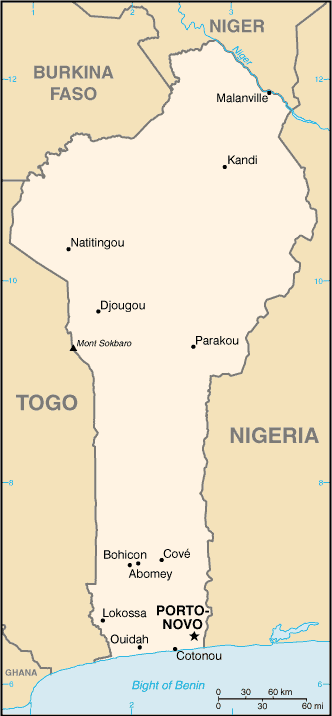
Area: 116,622 sq. km. (43,483 sq. mi.).
Cities: Capital--Porto-Novo
(pop. 295,000). Political
and economic capital--Cotonou (pop. 2
million).
Terrain: Mostly flat plains of 200 meters
average elevation, but the Atacora Mountains
extend along the northwest border, with the
highest point being Mont Sokbaro 658 meters.
Climate: Tropical, average temperatures between
24o and
31oC. Humid in south; semiarid in
north.
People
Nationality: Noun
and adjective--Beninese (singular and
plural).
Population (2007): 7.9 million.
Annual growth rate (2006 est.): 2.73%.
Ethnic groups: African 99% (42 ethnic groups,
most important being Fon, Adja, Yoruba, and
Bariba),
Europeans 5,500.
Religions: Indigenous beliefs (animist) 50%,
Christian 30%, Muslim 20%.
Languages: French (official), Fon and Yoruba in
the south; Nagot, Bariba and Dendi in the north.
Education (2007): Literacy--Total
population 35%; men 48%, women 23%.
Health (2005): Infant
mortality rate--89/1,000. Life
expectancy--55 yrs.
Work force: The labor market is characterized by
an increased reliance on informal employment,
family helpers, and the use of apprentices.
Training and job opportunities are not well
matched.
Government
Type: Republic under multiparty democratic rule.
Independence: August 1, 1960.
Constitution: December 11, 1990.
Branches: Executive--President,
elected by popular vote for 5-year term,
appoints the Cabinet. Legislative--Unicameral,
83-seat National Assembly directly elected by
popular vote for 4-year terms.Judicial--Constitutional
Court, Supreme Court, High Court of Justice.
Subdivisions: Twelve departments: Borgou,
Alibori, Atakora, Donga, Zou, Collines, Mono,
Couffo, Oueme, Plateau, Atlantique, and
Littoral.
Political parties (partial listing of major
parties): La Renaissance du Bénin (RB), Party of
Democratic Renewal (PRD), Social-Democrat Party
(PSD), African Movement for Development and
Progress (MADEP), Party of Democratic
Renewal-Rainbow (PRD-Arc-en-ciel), Alliance
Etoile, Action Front for Democratic Renewal (FARD-ALAFIA),
African Congress for Renewal (CAR-DUNYA),
Impulse for Progress and Democracy (IPD),
Alliance for Democracy and Progress (ADP),
National Union for Democracy and Progress (UNDP),
New Generation for the Republic (NGR), National
Party Together (PNE), Key Force (FC), Hope Force
(FE) Union for the Relief (UPR), Alliance of the
Forces of Progress (AFP), National Rally for
Democracy (RND), Rally for Progress and Renewal
(RPR), Movement for the People Alternative
(MAP), National Rally for Unity and Democracy (RUND),
Congress of African Democrat (CAD), Democratic
Union for Economic and Social Development (UDES),
Rally for Democracy and Progress (RDP),
Communist Party of Benin (PCB).
Economy
GDP (2007): $5.92 billion.
GDP growth rate (2007): 4.2%.
Per capita GDP (2007): $749.
Inflation rate (2007): 1.3%.
Natural resources: Small offshore oil deposits,
unexploited deposits of high quality marble
limestone, and timber.
Agricultural: Products--corn,
sorghum, cassava, tapioca, yams, beans, rice,
cotton, palm oil, cocoa, peanuts, poultry, and
livestock. Arable
land--13%. Permanent crops 4%, permanent
pastures 4%, forests and woodland 31%.
Business and industry: Textiles, cigarettes,
food and beverages, construction materials,
petroleum.
Trade: Exports--$259
million: cotton, crude oil, palm products,
cocoa. Imports--$1.2
billion: foodstuffs, tobacco, petroleum
products, energy, and capital goods. Major
trade partners--Nigeria, France, China,
Italy, Brazil, Libya, Indonesia, U.K., Cote
d'Ivoire.
GEOGRAPHY
Benin, a narrow, north-south strip of land in
West Africa, lies between the Equator and the
Tropic of Cancer. Benin's latitude ranges from 6o30N
to 12o30N and its longitude from 10E
to 3o40E. Benin is bounded by Togo to
the west, Burkina Faso and Niger to the north,
Nigeria to the east, and the Bight of Benin to
the south. With an area of 112,622 square
kilometers, roughly the size of Pennsylvania,
Benin extends from the Niger River in the north
to the Atlantic Ocean in the south, a distance
of 700 kilometers (about 500 mi.). Although the
coastline measures 121 kilometers (about 80
mi.), the country measures about 325 kilometers
(about 215 mi.) at its widest point. It is one
of the smaller countries in West Africa: eight
times smaller than Nigeria, its neighbor to the
east. It is, however, twice as large as Togo,
its neighbor to the west. A relief map of Benin
shows that it has little variation in elevation
(average elevation 200 meters).
The country can be divided into four main areas
from the south to the north. The low-lying,
sandy, coastal plain (highest elevation 10
meters) is, at most, 10 kilometers wide. It is
marshy and dotted with lakes and lagoons
communicating with the ocean. The plateaus of
southern Benin (altitude between 20 meters and
200 meters) are split by valleys running north
to south along the Couffo, Zou, and Oueme
Rivers. An area of flat lands dotted with rocky
hills whose altitude seldom reaches 400 meters
extends around Nikki and Save. Finally, a range
of mountains extends along the northwest border
and into Togo; this is the Atacora, with the
highest point, Mont Sokbaro, at 658 meters. Two
types of landscape predominate in the south.
Benin has fields of lying fallow, mangroves, and
remnants of large sacred forests. In the rest of
the country, the savanna is covered with thorny
scrubs and dotted with huge baobab trees. Some
forests line the banks of rivers. In the north
and the northwest of Benin the Reserve du W du
Niger and Pendjari National Park attract
tourists eager to see elephants, lions,
antelopes, hippos, and monkeys.
Benin's climate is hot and humid. Annual
rainfall in the coastal area averages 36 cm. (14
in.), not particularly high for coastal West
Africa. Benin has two rainy and two dry seasons.
The principal rainy season is from April to late
July, with a shorter less intense rainy period
from late September to November. The main dry
season is from December to April, with a short
cooler dry season from late July to early
September. Temperatures and humidity are high
along the tropical coast. In Cotonou, the
average maximum temperature is 31oC
(89oF); the minimum is 24oC
(75oF).
Variations in temperature increase when moving
north through a savanna and plateau toward the
Sahel. A dry wind from the Sahara called the
Harmattan blows from December to March. Grass
dries up, the vegetation turns reddish brown,
and a veil of fine dust hangs over the country,
causing the skies to be overcast. It also is the
season when farmers burn brush in the fields.
PEOPLE
The majority of Benin's 7.86 million people live
in the south. The population is young, with a
life expectancy of 53 years. About 42 African
ethnic groups live in this country; these
various groups settled in Benin at different
times and also migrated within the country.
Ethnic groups include the Yoruba in the
southeast (migrated from Nigeria in the 12th
century); the Dendi in the north-central area
(they came from Mali in the 16th century); the
Bariba and the Fulbe (Peul) in the northeast;
the Betammaribe and the Somba in the Atacora
Range; the Fon in the area around Abomey in the
South Central and the Mina, Xueda, and Aja (who
came from Togo) on the coast.
Recent migrations have brought other African
nationals to Benin that include Nigerians,
Togolese, and Malians. The foreign community
also includes many Lebanese and Indians involved
in trade and commerce. The personnel of the many
European embassies and foreign aid missions and
of nongovernmental organizations and various
missionary groups account for a large number of
the 5,500 European population.
Several religions are practiced in Benin.
Animism is widespread (50%), and its practices
vary from one ethnic group to the other. Arab
merchants introduced Islam in the north and
among the Yoruba. European missionaries brought
Christianity to the south and central areas of
Benin. Muslims account for 20% of the population
and Christians for 30%. Many nominal Muslims and
Christians continue to practice animistic
traditions. Voodoo originated in Benin and was
introduced to Brazil and the Caribbean Islands
by African slaves taken from this particular
area of the Slave Coast.
HISTORY
Benin was the seat of one of the great medieval
African kingdoms called Danhomey. Europeans
began arriving in the area in the 18th century,
as the kingdom of Danhomey was expanding its
territory. The Portuguese, the French, and the
Dutch established trading posts along the coast
(Porto-Novo, Ouidah, Cotonou), and traded
weapons for slaves. Slave trade ended in 1848.
Then, the French signed treaties with Kings of
Abomey (Guézo, Glèlè) and Hogbonou (Toffa) to
establish French protectorates in the main
cities and ports. However, King Behanzin fought
the French influence, which cost him deportation
to Martinique. As of 1900, the territory became
a French colony ruled by a French Governor.
Expansion continued to the North (kingdoms of
Parakou, Nikki, Kandi), up to the border with
former Upper Volta. On December 4, 1958, it
became the République du Dahomey, self-governing
within the French community, and on August 1,
1960, the Republic of Benin gained full
independence from France.
Post-Independence Politics
Between 1960 and 1972, a succession of military
coups brought about many changes of government.
The last of these brought to power Major Mathieu
Kérékou as the head of a regime professing
strict Marxist-Leninist principles. The
Revolutionary Party of the People of Benin (PRPB)
remained in complete power until the beginning
of the 1990s. Kérékou, encouraged by France and
other democratic powers, convened a national
conference that introduced a new democratic
constitution and held presidential and
legislative elections. Kérékou's principal
opponent at the presidential poll, and the
ultimate victor, was Prime Minister Nicéphore
Soglo. Supporters of Soglo also secured a
majority in the National Assembly.
Benin was thus the first African country to
effect successfully the transition from
dictatorship to a pluralistic political system.
In the second round of National Assembly
elections held in March 1995, Soglo's political
vehicle, the Parti de la Renaissance du Benin,
was the largest single party but lacked an
overall majority. The success of a party formed
by supporters of ex-president Kérékou, who had
officially retired from active politics,
encouraged him to stand successfully at both the
1996 and 2001 presidential elections.
During the 2001 elections, however, alleged
irregularities and dubious practices led to a
boycott of the run-off poll by the main
opposition candidates. The four top-ranking
contenders following the first round
presidential elections were Mathieu Kérékou
(incumbent) 45.4%, Nicephore Soglo (former
president) 27.1%, Adrien Houngbedji (National
Assembly Speaker) 12.6%, and Bruno Amoussou
(Minister of State) 8.6%. The second round
balloting, originally scheduled for March 18,
2001, was postponed for days because both Soglo
and Houngbedji withdrew, alleging electoral
fraud. This left Kérékou to run against his own
Minister of State, Amoussou, in what was termed
a "friendly match."
In December 2002, Benin held its first municipal
elections since before the institution of
Marxism-Leninism. The process was smooth with
the significant exception of the 12th district
council for Cotonou, the contest that would
ultimately determine who would be selected for
the mayoralty of the capital city. That vote was
marred by irregularities, and the electoral
commission was forced to repeat that single
election. Nicephore Soglo's Renaisance du Benin
(RB) party won the new vote, paving the way for
the former president to be elected Mayor of
Cotonou by the new city council in February
2002.
National Assembly elections took place in March
2003 and were generally considered to be free
and fair. Although there were some
irregularities, these were not significant and
did not greatly disrupt the proceedings or the
results. These elections resulted in a loss of
seats by RB--the primary opposition party. The
other opposition parties, the Party for
Democratic Renewal (PRD) led by the former Prime
Minister Adrien Houngbedji and the Alliance
Etoile (AE), joined the government coalition.
Former West African Development Bank Director
Boni Yayi won the March 2006 election for the
presidency in a field of 26 candidates.
International observers including the United
Nations, Economic Community of West African
States (ECOWAS), and others called the election
free, fair, and transparent. President Kérékou
was barred from running under the 1990
constitution due to term and age limits.
President Yayi was inaugurated on April 6, 2006.
Benin held legislative elections on March 31,
2007 for the 83 seats in the National Assembly.
The "Force Cowrie for an Emerging Benin" (FCBE),
a coalition of parties, closely linked to
President Yayi, won a plurality of the seats in
the National Assembly, providing the president
with considerable influence over the legislative
agenda.
Principal Government Officials
President of the Republic (Head of State and
Head of the Government)--Boni Yayi
Minister of Foreign Affairs, African
Integration, Francophonie and the Beninese
Diaspora--Moussa Okanla
Minister of State, in charge of Economic
Forecasting, Development and the Evaluation of
Public Action--Pascal Irene Koupaki
Minister of State in charge of National
Defense--Issifou Kogui N'douro
Minister of Agriculture, Animal Husbandry and
Fishing--Roger Dovonou
Minister of Labor and Civil Service--Emmanuel
Tiando
Minister of Administrative and Institutional
Reform--Bio Gounou Idrissou Sina
Minister of Culture, Tourism and Handicrafts--Soumanou
Toleba
Minister of Urban Development, Housing, Land
Reform and Coastal Erosion Prevention--François
Gbénoukpo Noudégbèssi
Minister of Microfinance and Promotion of Youth
and Women Employment--Sakinatou Abdou Alfa Orou
Sidi
Minister of Interior and Public
Security--General Félix Hessou
Minister of Decentralization, Local Authority
and Planning--Issa Démolo Moko
Minister of Economy and Finance--Soulé Mana
Lawani
Minister of Industry, Commerce, and Small and
Medium Scale Enterprises--Grégoire Akofodji
Minister of Mines, Energy and Water--Sacca Lafia
Minister of Health--Kessile Tchala
Minister of Primary Education--Christine
Ouinsavi
Ministry of Secondary Education, and Vocational
and Technical Training--Bernadette Sohoudji
Agbossou
Minister of Higher Education and Scientific
Research--Vicentia Bocco
Minister of Youth, Sports and Leisure--Galiou
Soglo
Minister of Family, Women and Children--Clémence
Yimbéré Dansou
Minister of the Environment and the Conservation
of Nature--Juliette Biao Koudenoukpo
Keeper of the Seals, Minister of Justice,
Legislation and Human Rights-- Gustave Anani
Cassa
Minister in charge of the Relations with the
Institutions, Spokesman of the Government--Alexandre
Houtondji
Minister-Delegate for Communication and
Information Technology in the Office of the
President of the Republic--Désiré Adadja
Minister of Literacy and Promotion of National
Languages--Roger Gbegnonvi
Minister-Delegate for Transport and Public Works
in the Office of the President of the
Republic--Armand Zinzindohoue
Ambassador to the United States--Sègbé Cyrille
Oguin
Permanent Representative to the United
Nations--Simon Idohou
Benin maintains an embassy in the United States
at 2124 Kalorama Road, Washington, DC 20008,
tel. 202-232-6656. The Permanent Representative
of the Republic of Benin to the United Nations
is located at 4 East 73rd Street, New York, NY
10021 tel. 212-249-6014, fax 212-734-4735.
ECONOMY
Benin's economy is chiefly based on agriculture.
Cotton accounts for 40% of GDP and roughly 80%
of official export receipts. There also is
production of textiles, palm products, and
cocoa. Corn, beans, rice, peanuts, cashews,
pineapples, cassava, yams, and other various
tubers are grown for local subsistence. Benin
began producing a modest quantity of offshore
oil in October 1982. Production ceased in recent
years but exploration of new sites is ongoing. A
modest fishing fleet provides fish and shrimp
for local subsistence and export to Europe. A
number of formerly government-owned commercial
activities are now privatized, and the
government, consistent with its commitments to
the IMF and World Bank, has plans to continue on
this path. Smaller businesses are privately
owned by Beninese citizens, but some firms are
foreign owned, primarily French and Lebanese.
The private commercial and agricultural sectors
remain the principal contributors to growth.
Economic Development
Since the transition to a democratic government
in 1990, Benin has undergone a remarkable
economic recovery. A large injection of external
investment from both private and public sources
has alleviated the economic difficulties of the
early 1990s caused by global recession and
persistently low commodity prices (although the
latter continues to affect the economy). The
manufacturing sector is confined to some light
industry, which is mainly involved in processing
primary products and the production of consumer
goods. Benin is dependent on imported
electricity, mostly from Ghana, which currently
accounts for a significant proportion of the
country's imports. Benin has several initiatives
to attract foreign capital to build electricity
generation facilities in Benin in order to break
this dependency. The service sector has grown
quickly, stimulated by economic liberalization
and fiscal reform. Membership of the CFA Franc
Zone offers reasonable currency stability.
Benin's trading partners include Germany,
Brazil, U.A.E., Spain, the United States,
Singapore, India, Netherlands, Japan, and China.
Benin also is a member of the West African
economic community ECOWAS.
In March 2003, the World Bank and International
Monetary Fund (IMF) agreed to support a
comprehensive debt reduction package for Benin
under the enhanced Heavily Indebted Poor
Countries (HIPC) Initiative. Debt relief under
HIPC amounts to approximately $460 million.
Benin received $27.1 million in 2002 and
received $32.9 million in 2003. HIPC will reduce
Benin's debt-to-export ratio, freeing up
considerable resources for education, health,
and other anti-poverty programs.
Despite its growth, the economy of Benin still
remains underdeveloped and dependent on
subsistence agriculture, cotton production, and
regional trade. Inflation has subsided over the
past several years. Real economic growth for
2007 was 4.2%. Commercial and transport
activities, which make up a large part of GDP,
are vulnerable to developments in Nigeria,
including fuel shortages.
FOREIGN RELATIONS
Abroad, Benin has strengthened ties with France,
the former colonial power, as well as the United
States and the main international lending
institutions. Benin also has adopted a mediating
role in the political crises in Liberia,
Guinea-Bissau, and Togo and provided a
contribution to the UN force in Haiti. Benin
currently has peacekeeping forces, under the UN
aegis, in Cote d'Ivoire and the Democratic
Republic of the Congo. Benin's democratic
standing, stability, and positive role in
international peacekeeping have helped Benin's
international stature continue to grow. Benin
enjoys stable relations with Nigeria, the main
regional power. Benin held a seat on the UN
Security Council; its membership term ended
December 31, 2005.
U.S.-BENINESE RELATIONS
The United States and Benin have had an
excellent history of relations in the years
since Benin embraced democracy. The U.S.
Government continues to assist Benin with the
improvement of living standards that are key to
the ultimate success of Benin's experiment with
democratic government and economic
liberalization, and are consistent with U.S.
values and national interest in reducing poverty
and promoting growth. The bulk of the U.S.
effort in support of consolidating democracy in
Benin is focused on long-term human resource
development through U.S. Agency for
International Development (USAID)
programs.
Efforts to pursue this national interest are
spearheaded by USAID, which has effective
programs focused on primary education, family
health (including family planning), women's and
children's health, and combating sexually
transmitted diseases, especially the spread of
HIV. USAID's Democracy and Governance program
also emphasizes encouraging greater civil
society involvement in national decisionmaking;
strengthening mechanisms to promote transparency
and accountability; improving the environment
for decentralized private and local initiatives;
and enhancing the electoral system and the
national legislature. A panoply of
military-to-military cooperation programs
reinforces democratizing efforts. U.S.-Benin
military cooperation is now being expanding,
both bilaterally and within a broader regional
framework.
In February 2006, the Government of Benin signed
a 5-year $307 million Millennium Challenge
Compact (MCC) to increase investment and private
sector activity in Benin. The program removes
key constraints to growth and supports
improvements in physical and institutional
infrastructures in four critical sectors: land,
financial services, justice, and markets. The
proposed projects reinforce each other,
contributing to an economic rate of return of
17%.
The U.S. advances the ethos of law enforcement
by working with Beninese authorities to crack
down on crimes, help eradicate corruption,
promote good governance, the rule of law, and
greater official accountability.
The U.S. Public Affairs Office in Cotonou leads
the U.S.-Benin cultural, professional, and
educational exchanges, with a focus on helping
educate the Government of Benin and the public
on the trade opportunities and advantages of the
African Growth and Opportunity Act. The PA
Office also helps in expanding efforts to build
a more responsible media.
The U.S. Peace
Corps program
in Benin provides ongoing opportunities for
increased understanding between Beninese and
Americans. The approximately 110 volunteers
promote sustainable development through
activities in health, education, the
environment, and small enterprise development.
The U.S. Peace Corps program in Benin is one of
the most successful in Africa, in part because
of Beninese receptivity and collaboration.
Currently, trade between Benin and the United
States is small, but interest in American
products is growing. The United States is
interested in promoting increased trade with
Benin in order to contribute to U.S. trade with
Benin's neighbors, particularly Nigeria, Niger,
and Burkina Faso, which receive large amounts of
their own imports through the port of Cotonou.
Such trade also is facilitated by Benin's
membership in the Economic Community of West
African States (ECOWAS) and in the CFA franc
monetary zone. The U.S. Government also works to
stimulate American investment in key sectors
such as energy, telecommunications, and
transportation. Benin has been eligible for the
African Growth and Opportunity Act (AGOA) since
the program began in 2000. It qualified for AGOA
textile and apparel benefits in January 2004.
Principal U.S. Officials
Ambassador--Gayleatha
B. Brown
Deputy Chief of Mission--Martina Boustani
Director, USAID Mission--Rudolph Thomas
Peace Corps Director--Sheryl Cowan
Public Affairs Officer--Rhonda Watson
Political/Economic Officer--Jason Hahn
Consular Officer--Christopher Derrick
Management Officer--Lyngrid Rawlings
The U.S.
Embassy is
located on rue Caporal Bernard Anani, 01 BP
2012, Cotonou, Benin, tel. 229-21-30-06-50, fax
229-21-30-14-39. For American citizen services
and visa questions, the Embassy consular section
fax number is 229-21-30-66-82.
 Information
on Countries from Around the World
Information
on Countries from Around the World