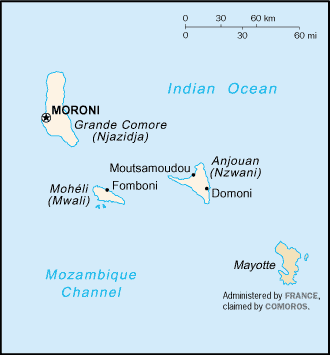
Area: 2,171 sq. km. (838 sq. mi.); slightly less
than half the size of Delaware. Major
islands--Grande Comore (1,025 sq. km.),
Anjouan (424 sq. km.), Mayotte (374 sq. km.),
and Moheli (211 sq. km.).
Cities: Capital--Moroni
(pop. 30,000); Mutsamudu (pop. 20,000).
Terrain: Rugged.
Climate: Tropical marine.
People
Nationality: Noun
and adjective--Comoran(s).
Population (2006 est.): 690,948. Mayotte (1990
est.)--70,000.
Annual growth rate (2006 est.): 2.87%.
Ethnic groups: Antalote, Cafre, Makoa, Oimatsaha,
Sakalava.
Religions: Sunni Muslim 98%, Roman Catholic 2%.
Languages: Shikomoro (a Swahili-Arabic blend),
Arabic (official), French (official).
Education: Attendance--60%
primary, 34% secondary. Literacy--56.5%.
Health: Life
expectancy--62.33 yrs. Infant
mortality rate--72.85/1,000.
Work force (1996): 144,500. Agriculture--80%.
Government
Type: Republic.
Independence: July 6, 1975 (Mayotte remains
under French administration).
Constitution: Adopted by referendum on December
23, 2001.
Branches: Executive--national
president; regional island presidents. Legislative--National
Assembly. Judicial--traditional
Muslim and codified law from French sources.
Political parties: 17 political parties.
Suffrage: Universal adult.
Economy
GDP (purchasing power parity): $419 million.
Annual growth rate: 0.5%.
Per capita income: $720.
Agriculture (40% of GDP): Products--vanilla,
cloves, perfume essences, copra, banana,
cassava, coconuts.
Services (56% of GDP): Commerce, tourism.
Industry (4% of GDP): Types--perfume
distillation.
Trade: Exports (1999
est.)--$7.9 million: vanilla, cloves, perfume
essences, copra. Major
markets--France, Germany. Imports (1998
est.)--$35.84 million: rice, petroleum, meat,
wheat flour, cotton textiles, cement. Major
suppliers--France 38%, Pakistan 13%, Kenya
8%, South Africa 8%.
PEOPLE
The Comorans inhabiting Grande Comore, Anjouan,
and Moheli (86% of the population) share
African-Arab origins. Islam is the dominant
religion, and Koranic schools for children
reinforce its influence. Although Arab culture
is firmly established throughout the
archipelago, a substantial minority of the
citizens of Mayotte (the Mahorais) are Catholic
and have been strongly influenced by French
culture.
The most common language is Shikomoro, a Swahili
dialect. French and Arabic also are spoken.
About 57% of the population is literate.
HISTORY
Over the centuries, the islands were invaded by
a succession of diverse groups from the coast of
Africa, the Persian Gulf, Indonesia, and
Madagascar. Portuguese explorers visited the
archipelago in 1505. "Shirazi" Arab migrants
introduced Islam at about the same time. Between
1841 and 1912, France established colonial rule
over Grande Comore, Anjouan, Mayotte, and Moheli
and placed the islands under the administration
of the governor general of Madagascar. Later,
French settlers, French-owned companies, and
wealthy Arab merchants established a
plantation-based economy that now uses about
one-third of the land for export crops. After
World War II, the islands became a French
overseas territory and were represented in
France's National Assembly. Internal political
autonomy was granted in 1961. Agreement was
reached with France in 1973 for Comoros to
become independent in 1978. On July 6, 1975,
however, the Comoran parliament passed a
resolution declaring unilateral independence.
The deputies of Mayotte abstained. As a result,
the Comoran Government has effective control
over only Grande Comore, Anjouan, and Moheli.
Mayotte remains under French administration.
GOVERNMENT AND POLITICAL CONDITIONS
The Union of Comoros is ruled by President Ahmed
Abdallah Sambi. Comoros has been plagued by
political instability and civil strife following
numerous coups and secession attempts since
independence from France in 1975. Former
President Azali seized power in a bloodless coup
in April 1999, overthrowing interim President
Tadijiddine Ben Said Massounde, who himself had
held the office since the death of
democratically elected President Mohamed Taki
Abdoulkarim in November 1998. In May 1999, Azali
decreed a constitution that gave him both
executive and legislative powers. When Azali
took power, he had pledged to step down in 2000
and relinquish control to a democratically
elected president. Instead, in 2001, Azali
resigned from the military and ran as a civilian
candidate for the national presidency. He was
elected in 2002 in flawed but fair elections.
On May 26, 2006, following a two-stage electoral
process that was generally free and fair, Ahmed
Abdallah Mohamed Sambi was installed as the new
President of the Union of the Comoros. The
inauguration of President Sambi in June 2006
marked the first democratic transition of power
in Comoran history. In June 2007, individual
island elections on Grande Comore and Moheli
were held on schedule and judged to have been
free and fair. On the Anjouan, however, island
governor Mohamed Bacar refused to step down,
held a sham election and declared himself Island
Governor for another term. In March of this
year, Comoran and African Union (AU) forces
restored constitutional rule on Anjouan. A new
election for island governor was held on June
15.
Principal Government Officials
President--Ahmed Abdallah Sambi
Minister of Foreign Affairs--Ahmed Ben Said
Jaffar
Ambassador to the United States and to the
United Nations--Mohamed Toihiri
Comoros maintains a mission to the United States
at 866 United Nations Plaza, Suite 418 New York,
NY 10017 (tel. 212-750-1637).
ECONOMY
Comoros, with an estimated gross domestic
product (GDP) per capita income of about $700,
is among the world's poorest and least developed
nations. Although the quality of the land
differs from island to island, most of the
widespread lava-encrusted soil formations are
unsuited to agriculture. As a result, most of
the inhabitants make their living from
subsistence agriculture and fishing.
Agriculture, involving more than 80% of the
population and 40% of the gross domestic
product, provides virtually all foreign exchange
earnings. Services including tourism,
construction, and commercial activities
constitute the remainder of the GDP. Plantations
engage a large proportion of the population in
producing the islands' major cash crops for
export: vanilla, cloves, perfume essences, and
copra. Comoros is the world's leading producer
of essence of ylang-ylang, used in manufacturing
perfume. It also is the world's second-largest
producer of vanilla. Principal food crops are
coconuts, bananas, and cassava. Foodstuffs
constitute 32% of total imports.
The country lacks the infrastructure necessary
for development. Some villages are not linked to
the main road system or at best are connected by
tracks usable only by four-wheel-drive vehicles.
The islands' ports are rudimentary, although a
deepwater facility functions in Anjouan. Only
small vessels can approach the existing quays in
Moroni on Grande Comore, despite improvements.
Long-distance, ocean-going ships must lie
offshore and be unloaded by smaller boats;
during the cyclone season, this procedure is
dangerous, and ships are reluctant to call at
the island. Most freight is sent first to
Mombasa, Kenya or the island of Reunion and
transshipped from there.
France, Comoros' major trading partner, finances
small projects only. The United States receives
a growing percentage of Comoros' exports but
supplies only a negligible fraction of its
imports (less than 1%).
Comoros has an international airport at Hahaya
on Grande Comore. Comoros has its own currency,
the Comorian Franc, which is currently valued at
557 CF = U.S. $1.
NATIONAL SECURITY
The military resources of the Comoros consist of
a small standing army and a 500-member police
force, as well as a 500-member defense force. A
defense treaty with France provides naval
resources for protection of territorial waters,
training of Comorian military personnel, and air
surveillance. France maintains a small maritime
base and a Foreign Legion contingent on Mayotte.
FOREIGN RELATIONS
In November 1975, Comoros became the 143rd
member of the United Nations. The new nation was
defined as consisting of the entire archipelago,
despite the fact that France maintains control
over Mayotte.
Comoros also is a member of the African Union,
the European Development Fund, the World Bank,
the International Monetary Fund, the Indian
Ocean Commission, and the African Development
Bank.
U.S.-COMORIAN RELATIONS
The United States recognized the Comoran
Government in 1977. The two countries enjoy
friendly relations. The U.S. closed its Embassy
in Moroni in 1993 and is now represented by a
nonresident Ambassador in neighboring
Madagascar.
Principal U.S. Embassy Officials (all
officers resident in Antananarivo, Madagascar)
Ambassador--R.
Niels Marquardt
Deputy Chief of Mission--Eric Stromayer
Management Officer--Stephen Dodson
Public Affairs Officer--Rodney Ford
Political-Economic-Commercial Chief--Dovie
Holland
Political Officer--Jeff Hulse
Political-Economic-Commercial Officer for
Comoros--Brian Neubert
Regional Security Officer--Christopher Gillis
Consular Officer--vacant
The address of the U.S.
Embassy in
Madagascar is 14-16 Rue Rainitovo, Antsahavola,
Antananarivo. The mailing address is B.P. 620,
Antsahavola, Antananarivo, Madagascar (tel:
261-20-22-212-57; fax: 261-20-22-345-39; E-mail:uswebmaster@wanadoo.mg).
 Information
on Countries from Around the World
Information
on Countries from Around the World