
PROFILE
OFFICIAL NAME:
Republic of Equatorial Guinea
Geography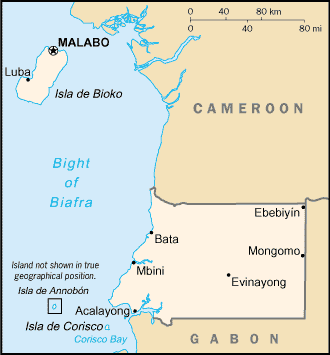
Location: Western Africa, bordering the Bay of
Biafra. Bordering
nations--Cameroon, Gabon.
Area: 28,050 sq. km; slightly smaller than
Maryland.
Cities: Capital--Malabo. Other
cities--Bata (also capital of Littoral
province on the mainland).
Terrain: Varies. Bioko Island is volcanic, with
three major peaks of 9,876 feet, 7,416 feet, and
6,885 feet. Behind the coastal plain, the
mainland provinces are hilly at a level of
approximately 2,000 feet, with some 4,000-foot
peaks. Annobon Island is volcanic.
Climate: Tropical; always warm, humid. The
weather alternates between wet and dry seasons
over the course of a year.
People
Nationality: Noun--Equatorial
Guinean(s), Equatoguinean(s) Adjective--Equatorial
Guinean, Equatoguinean.
Population (July 2008 est.): 616,459.
Annual growth rate (2008 est.): 2.732%;
(1975-2002): 2.8%.
Ethnic groups: The Fang ethnic group of the
mainland constitutes the great majority of the
population and dominates political life and
business. The Bubi group comprises about 50,000
people living mainly in Bioko Island. The
Annobonese on the island of Annobon are
estimated at about 3,000 in number. The other
three ethnic groups are found on the coast of
Rio Muni and include the Ndowe and Kombe (about
3,000 each) and the Bujebas (about 2,000). The
pygmy populations have long been integrated into
the dominant Bantu-speaking cultures. Europeans
number around 2,000, primarily Spanish and
French. There is a thriving Lebanese community,
other Arabs (primarily Egyptians), a large
number of Filipinos, and a rapidly expanding
Chinese presence.
Languages: Official--Spanish,
French; other--pidgin
English, Fang, Bubi, Ibo.
Religion: Nominally Christian and predominantly
Roman Catholic; pagan practices.
Education: Primary school compulsory for ages
6-14. Attendance (2007
est.)--90%. Adult
literacy (2005
est.)--87%.
Health (2008 est.): Life expectancy--61.23
years. Infant
mortality rate--83.75/1,000.
Government
Type: Nominally multi-party Republic with
strong domination by the executive branch.
Independence: October 12, 1968 (from Spain).
Constitution: Approved by national referendum
November 17, 1991; amended January 1995.
Branches: Executive--President
(Chief of State), Prime Minister, and a Council
of Ministers appointed by the president. Legislative--100-member
Chamber of People's Representatives (members
directly elected by universal suffrage to serve
five-year terms). Judicial--Supreme
Tribunal.
Administrative subdivisions: Seven
provinces--Annobon, Bioko Norte, Bioko Sur,
Centro Sur, Kie-Ntem, Littoral, Wele-Nzas.
Political parties: The ruling party is the
Partido Democratico de Guinea Ecuatorial (PDGE),
formed July 30, 1987. There are 12 other
recognized parties that formed in the early
1990s.
Suffrage: 18 years of age; universal adult.
Economy
GDP (2007 est.): $10.4 billion.
Real GDP growth rate (2007 est.) 9.1%.
Inflation rate (2008 est. average): 5.5%.
Unemployment rate: (2007 est.) 8%.
Natural resources: Petroleum, natural gas,
timber, small, unexploited deposits of gold,
manganese, and uranium.
Agriculture (2006 est.): 2.8% of GDP. Products--coffee,
cocoa, rice, yams, cassava (tapioca), bananas,
palm oil nuts, manioc, livestock, and timber.
Industry (2006 est.): 92.6% of GDP. Types--petroleum,
natural gas, fishing, lumber.
Services (2006): 4.5% of GDP.
Trade (2007 est.): Exports--$10.03
billion: hydrocarbons (97%), timber (2%), others
(1%). Imports--$3.219
billion. Major
trading partners--United States, Spain,
China, Canada, France, United Kingdom, Cameroon,
and Norway.
Currency: Communaute Financiere Africaine (CFA)
franc.
GEOGRAPHY
The Republic of Equatorial Guinea is located
in west central Africa. Bioko Island lies about
40 kilometers (25 mi.) from Cameroon. Annobon
Island lies about 595 kilometers (370 mi.)
southwest of Bioko Island. The larger
continental region of Rio Muni lies between
Cameroon and Gabon on the mainland; it includes
the islands of Corisco, Elobey Grande, Elobey
Chico, and adjacent islets.
Bioko Island, called Fernando Po until the
1970s, is the largest island in the Gulf of
Guinea--2,017 square kilometers (780 sq. mi.).
It is shaped like a boot, with two large
volcanic formations separated by a valley that
bisects the island at its narrowest point. The
195-kilometer (120-mi.) coastline is steep and
rugged in the south but lower and more
accessible in the north, with excellent harbors
at Malabo and Luba, and several scenic beaches
between those towns.
On the continent, Rio Muni covers 26,003 square
kilometers (10,040 sq. mi.). The coastal plain
gives way to a succession of valleys separated
by low hills and spurs of the Crystal Mountains.
The Rio Benito (Mbini), which divides Rio Muni
in half, is not navigable except for a
20-kilometer stretch at its estuary.
Temperatures and humidity in Rio Muni are
slightly lower than on Bioko Island.
Annobon Island, named for its discovery on New
Year's Day 1472, is a small volcanic island
covering 18 square kilometers (7 sq. mi.). The
coastline is abrupt except in the north; the
principal volcanic cone contains a small lake.
Most of the estimated 1,900 inhabitants are
fisherman specializing in traditional,
small-scale tuna fishing and whaling. The
climate is tropical--heavy rainfall, high
humidity, and frequent seasonal changes with
violent windstorms.
PEOPLE
The majority of the Equatoguinean people are
of Bantu origin. The largest tribe, the Fang, is
indigenous to the mainland, but substantial
migration to Bioko Island has resulted in Fang
dominance over the earlier Bantu inhabitants.
The Fang constitute 80% of the population and
are themselves divided into 67 clans. Those in
the northern part of Rio Muni speak Fang-Ntumu,
while those in the south speak Fang-Okah; the
two dialects are mutually unintelligible. The
Bubi, who constitute 15% of the population, are
indigenous to Bioko Island. In addition, there
are coastal tribes, sometimes referred to as "Playeros,"
consisting of Ndowes, Bujebas, Balengues, and
Bengas on the mainland and small islands, and "Fernandinos,"
a Creole community, on Bioko. Together, these
groups comprise 5% of the population. There are
also foreigners from neighboring Cameroon,
Nigeria, and Gabon.
Spanish and French are both official languages,
though use of Spanish predominates. The Roman
Catholic Church has greatly influenced both
religion and education.
Equatoguineans tend to have both a Spanish first
name and an African first and last name. When
written, the Spanish and African first names are
followed by the father's first name (which
becomes the principal surname) and the mother's
first name. Thus people may have up to four
names, with a different surname for each
generation.
HISTORY
The first inhabitants of the region that is
now Equatorial Guinea are believed to have been
Pygmies, of whom only isolated pockets remain in
northern Rio Muni. Bantu migrations between the
17th and 19th centuries brought the coastal
tribes and later the Fang. Elements of the
latter may have generated the Bubi, who
immigrated to Bioko from Cameroon and Rio Muni
in several waves and succeeded former Neolithic
populations. The Annobon population, native to
Angola, was introduced by the Portuguese via Sao
Tome.
The Portuguese explorer, Fernando Po (Fernao do
Poo), seeking a route to India, is credited with
having discovered the island of Bioko in 1471.
He called it Formosa ("pretty flower"), but it
quickly took on the name of its European
discoverer. The Portuguese retained control
until 1778, when the island, adjacent islets,
and commercial rights to the mainland between
the Niger and Ogoue Rivers were ceded to Spain
in exchange for territory in South America
(Treaty of Pardo). From 1827 to 1843, Britain
established a base on the island to combat the
slave trade. The Treaty of Paris settled
conflicting claims to the mainland in 1900, and
the mainland territories were united
administratively under Spanish rule.
Spain lacked the wealth and the interest to
develop an extensive economic infrastructure in
what was commonly known as Spanish Guinea during
the first half of this century. However, through
a paternalistic system, particularly on Bioko
Island, Spain developed large cacao plantations
for which thousands of Nigerian workers were
imported as laborers. At independence in 1968,
largely as a result of this system, Equatorial
Guinea had one of the highest per capita incomes
in Africa. The Spanish also helped Equatorial
Guinea achieve one of the continent's highest
literacy rates and developed a good network of
health care facilities.
In 1959, the Spanish territory of the Gulf of
Guinea was established with status similar to
the provinces of metropolitan Spain. As the
Spanish Equatorial Region, a governor general
ruled it exercising military and civilian
powers. The first local elections were held in
1959, and the first Equatoguinean
representatives were seated in the Spanish
parliament. Under the Basic Law of December
1963, limited autonomy was authorized under a
joint legislative body for the territory's two
provinces. The name of the country was changed
to Equatorial Guinea. Although Spain's
commissioner general had extensive powers, the
Equatorial Guinean General Assembly had
considerable initiative in formulating laws and
regulations.
In March 1968, under pressure from Equatoguinean
nationalists and the United Nations, Spain
announced that it would grant independence to
Equatorial Guinea. A constitutional convention
produced an electoral law and draft
constitution. In the presence of a UN observer
team, a referendum was held on August 11, 1968,
and 63% of the electorate voted in favor of the
constitution, which provided for a government
with a General Assembly and a Supreme Court with
judges appointed by the president.
In September 1968, Francisco Macias Nguema was
elected first president of Equatorial Guinea,
and independence was granted in October. In July
1970, Macias created a single-party state and by
May 1971, key portions of the constitution were
abrogated. In 1972 Macias took complete control
of the government and assumed the title of
President-for-Life. The Macias regime was
characterized by abandonment of all government
functions except internal security, which was
accomplished by terror; this led to the death or
exile of up to one-third of the country's
population. Due to pilferage, ignorance, and
neglect, the country's
infrastructure--electrical, water, road,
transportation, and health--fell into ruin.
Religion was repressed, and education ceased.
The private and public sectors of the economy
were devastated. Nigerian contract laborers on
Bioko, estimated to have been 60,000, left en
masse in early 1976. The economy collapsed, and
skilled citizens and foreigners left.
On August 3, 1979 a lieutenant colonel in charge
of military police, Teodoro Obiang Nguema
Mbasogo, led a successful coup d'etat; Macias
was arrested, tried, and executed. Obiang
assumed the Presidency in October 1979. Obiang
initially ruled Equatorial Guinea with the
assistance of a Supreme Military Council. A new
constitution, drafted in 1982 with the help of
the United Nations Commission on Human Rights,
came into effect after a popular vote on August
15, 1982; the Council was abolished, and Obiang
remained in the presidency for a 7-year term. He
was reelected in 1989. In February 1996, he
again won reelection with 98% of the vote;
several opponents withdrew from the race,
however, and international observers criticized
the election. Subsequently, Obiang named a new
cabinet, which included some opposition figures
in minor portfolios.
Despite the formal ending of one-party rule in
1991, President Obiang and a circle of advisors
(drawn largely from his own family and ethnic
group) maintain real authority. The president
names and dismisses cabinet members and judges,
ratifies treaties, leads the armed forces, and
has considerable authority in other areas. He
appoints the governors of Equatorial Guinea's
seven provinces. The opposition had few
electoral successes in the 1990s. By early 2000,
President Obiang's Democratic Party of
Equatorial Guinea (PDGE) party fully dominated
government at all levels. In December 2002,
President Obiang won a new seven-year mandate
with 97% of the vote. Reportedly, 95% of
eligible voters voted in this election, although
many observers noted numerous irregularities.
GOVERNMENT
The 1982 constitution gives the President
extensive powers, including naming and
dismissing members of the cabinet, making laws
by decree, dissolving the Chamber of
Representatives, negotiating and ratifying
treaties and calling legislative elections. The
President retains his role as commander in chief
of the armed forces and maintains close
supervision of military activity. In June 2004,
the President reorganized the cabinet and
created two new positions: Minister of National
Security and Director of National Forces. The
Prime Minister is appointed by the President and
operates under powers designated by the
President. The Prime Minister coordinates
government activities.
The Chamber of Representatives is comprised of
100 members elected by direct suffrage for
5-year terms. In practice, the Chamber has not
demonstrated independence, and it rarely acts
without presidential approval or direction.
National assembly elections were held in May
2008; 99 of the 100 seats went to the PDGE.
The President appoints the governors of the
seven provinces. Each province is divided
administratively into districts and
municipalities. The internal administrative
system falls under the Ministry of Interior and
Territorial Administration; several other
ministries are represented at the provincial and
district levels.
The judicial system follows similar
administrative levels. At the top are the
President and his judicial advisors (the Supreme
Court). In descending rank are the appeals
courts, chief judges for the divisions, and
local magistrates. Tribal laws and customs are
honored in the formal court system when not in
conflict with national law. The current court
system, which often uses customary law, is a
combination of traditional, civil, and military
justice, and it operates in an ad hoc manner for
lack of established procedures and experienced
judicial personnel.
The other official branch of the government is
the State Council. The State Council's main
function is to serve as caretaker in case of
death or physical incapacity of the President.
It comprises the following ex officio members:
the President of the Republic, the Prime
Minister, the Minister of Defense, the President
of the national assembly and the Chairman of the
Social and Economic Council.
Although the abuses and atrocities that
characterized the Macias years have been
eliminated, the government continues to be
dominated by the presidency. Religious freedom
is tolerated.
Principal Government Officials
President--Teodoro Obiang Nguema Mbasogo,
Brig. Gen. (ret.)
Prime Minister--Ricardo Mangue
Minister of Foreign Affairs and International
Cooperation--Pastor Micha Ondo Bile
Ambassador to the United States--Purification
Angue Ondo
Equatorial Guinea maintains an embassy at 2020
16th Street NW, Washington, DC 20009 (Tel. (202)
518-5700, Fax. (202) 518-5252). Its mission to
the United Nations is at 801 Second Avenue,
Suite 1403, New York, N.W. 10017 (Tel.
212-599-1523).
POLITICAL CONDITIONS
In the period following Spain's grant of
local autonomy to Equatorial Guinea in 1963,
there was a great deal of political party
activity. Bubi and Fernandino parties on the
island preferred separation from Rio Muni or a
loose federation. Ethnically based parties in
Rio Muni favored independence for a united
country comprising Bioko and Rio Muni, an
approach that ultimately won out. (The
Movimiento para la Auto-determinacion de la Isla
de Bioko (MAIB), which advocates independence
for the island under Bubi control, is one of the
offshoots of the era immediately preceding
independence). After the accession of Macias to
power, political activity largely ceased in
Equatorial Guinea. Opposition figures who lived
among the exile communities in Spain and
elsewhere agitated for reforms; some of them had
been employed in the Macias and Obiang
governments. After political activities in
Equatorial Guinea were legalized in the early
1990s, some opposition leaders returned, but
repressive actions continued sporadically.
The country's first freely contested municipal
elections were held in September 1995. Most
observers agree that the elections themselves
were relatively free and transparent and that
the opposition parties garnered between
two-thirds and three-quarters of the total vote.
The government, however, delayed announcement of
the results and then claimed a highly dubious
52% victory overall and the capture of 19 of 27
municipal councils. In early January 1996 Obiang
called for presidential elections. International
observers agreed that the campaign was marred by
fraud, and most of the opposition candidates
withdrew in the final week. Obiang claimed
re-election with 98% of the vote. In an attempt
to mollify his critics, Obiang gave minor
portfolios in his cabinet to people identified
as opposition figures. In the legislative
election in March 1999, the party increased its
majority in the 80-seat parliament from 68 to
75. The main opposition parties refused the
seats they had allegedly won. In May 2000, the
ruling PDGE overwhelmed its rivals in local
elections. Opposition parties rejected the next
election, the December 2002 presidential
election, as invalid. During this election,
President Obiang was re-elected with 97% of the
vote. Following his re-election Obiang formed a
government based on national unity encompassing
all opposition parties, except for the CPDS,
which declined to join after Obiang refused to
release one of their jailed leaders.
In April 2004, parliamentary and municipal
elections took place. President Obiang's
Democratic Party of Equatorial Guinea (PDGE) and
allied parties won 98 of 100 seats in parliament
and all but seven of 244 municipal posts.
International observers criticized both the
election and its results.
While President Obiang's rule, in which schools
reopened, primary education expanded, and public
utilities and roads restored, compares favorably
with Macias' tyranny and terror, it has been
criticized for not implementing genuine
democratic reforms. Corruption and a
dysfunctional judicial system disrupt the
development of Equatorial Guinea's economy and
society. In 2004, the President appointed a new
Prime Minister, Miguel Abia Biteo, and replaced
several ministers; however, the government
budget still did not include all revenues and
expenditures. The United Nations Development
Program proposed a broad governance reform
program, but the Equatoguinean Government was
not moving rapidly to implement it. In August
2006 a new Prime Minister, Ricardo Mangue, was
named and the pace of reform accelerated.
On May 4, 2008, legislative elections resulted
in an overwhelming victory for the PDGE.
Ninety-nine of the 100 seats in the assembly
went to the PDGE while the opposition party, the
Convergence for Social Democracy (CPDS), only
received one. (This is one less seat than the
2004 elections that granted the CPDS two seats.)
Results were similar in the municipal elections
held the same day, granting PDGE 319 councillor
seats while CPDS only gained 13. International
elections observers reported that the elections
were generally conducted in a free and fair
manner. Nevertheless, irregularities were
reported, which included the barring of certain
members of the international press.
In May 2002 a special tribunal convicted 68
prisoners and their relatives and sentenced them
to 6 to 20 years in prison for an alleged
attempted coup d'etat. Among the prisoners were
leaders of the three main opposition parties
that had remained independent from President
Obiang's ruling party. There were numerous
irregularities associated with the trial,
including evidence of torture and a lack of
substantive proof. In August 2003, 31 of these
convicted prisoners were granted a presidential
amnesty.
In March 2004, Zimbabwean police in Harare
impounded a plane from South Africa with 64
alleged mercenaries on board. The group said
they were providing security for a mine in
Democratic Republic of the Congo, but a couple
of days later an Equatorial Guinean minister
said they had detained 15 more men who he
claimed were the advance party for the group
captured in Zimbabwe. Nick du Toit, the leader
of the group of South Africans, Armenians, and
one German in Equatorial Guinea, said at his
trial in Equatorial Guinea that he was playing a
limited role in a coup bid organized by Simon
Mann, the alleged leader of the group held in
Zimbabwe, to remove Obiang from power and
install an exiled opposition politician, Severo
Moto.
In September 2004, Mann was sentenced to seven
years in jail in Zimbabwe after being convicted
of illegally trying to buy weapons. In
subsequent legal proceedings, three
Equatoguineans and three South Africans were
acquitted. In June 2005, President Obiang
granted amnesty to the six Armenian pilots. In
Harare, Mann obtained a reduced sentence based
on good behavior in late 2007. Zimbabwe
consented to Equatorial Guinea's extradition
request and flew Mann to Malabo in early 2008.
His trial began in June 2008. During the trail
he reportedly confessed to the attempted coup,
implicating Severo Moto, Sir Mark Thatcher, and
Ely Calil, a nationalized British citizen of
Lebanese ancestry with connections to Nigeria.
Mann has been allowed visits by western media
and family members.
Although Equatorial Guinea lacks a
well-established democratic tradition, it has
broken with the anarchic, chaotic, brutal, and
repressive pattern of the Macias years and is
improving its human rights and political
performance. On June 5, 2008 President Obiang
granted amnesty to 37 political prisoners, and
the government has indicated a willingness to
grant amnesty to other political prisoners. In
addition, the country is undertaking an
ambitious, multi-billion dollar development
program that is improving the quality of life
and providing opportunities for employment for
its citizens. Equatorial Guinea also is a
candidate for membership in the Extractive
Industries Transparency Initiative (EITI), which
aims to strengthen governance by improving
transparency and accountability in the oil, gas,
and minerals sector. The country is engaging
with the EITI Secretariat to meet the
requirements of EITI membership.
ECONOMY
Oil and gas exports have increased
substantially and will drive the economy for
years to come. Real GDP growth was 9.1% in 2007
(est.). Per capita income rose from about $590
in 1998 to $2,000 in 2000, $5,300 in 2004, and
approximately $10,000 in 2007. The energy export
sector is responsible for this rapid growth, and
recorded even bigger gains in 2007 with a new,
state-of-the-art liquefied natural gas (LNG)
production and shipping facility coming on line
in 2007. Oil production increased from 81,000
barrels per day (bbl/d) in 1998 to approximately
500,000 bbl/d equivalent by the end of 2007.
Exploration efforts continue in search of
further potential offshore concessions, and
promising discoveries were announced in late
2007.
Equatorial Guinea has other resources, including
its tropical climate, fertile soils, rich
expanses of water, deepwater ports, and reserves
of unskilled labor. However, its hydrocarbon
riches dwarf all other economic activity. The
government is actively seeking to diversify the
economy by encouraging agriculture, tourism, and
fishing. The ongoing construction boom is also
enhancing related skills. The once-significant
economic mainstays of the colonial era--cocoa,
coffee, and timber--are also receiving
attention, though they remain miniscule in
comparison to the energy sector.
Equatorial Guinea's economic policies comprise
an open investment regime. Qualitative
restrictions on imports, non-tariff protection,
and many import licensing requirements were
lifted in 1992 when the government adopted a
public investment program endorsed by the World
Bank. The Government of Equatorial Guinea has
sold some state enterprises. It is attempting to
create a more favorable investment climate, and
its investment code contains numerous incentives
for job creation, training, promotion of
nontraditional exports, support of development
projects and indigenous capital participation,
freedom for repatriation of profits, exemption
from certain taxes and capital, and other
benefits. Trade regulations have been further
liberalized since Central African Economic and
Monetary Union (CEMAC) reform codes in 1994.
This included elimination of quota restrictions
and reductions in the range and amounts of
tariffs. The CEMAC countries agreed to the
introduction of a value added tax (VAT) in 1999.
While business laws promote a liberalized
economy, the business climate remains difficult.
Application of the laws remains selective.
Corruption among officials is widespread, and
many business deals are concluded under
nontransparent circumstances. A wage law now
regulates separate wage levels for the
petroleum, private, and government sector.
There is little industry in the country, and the
local market for industrial products is small.
The government seeks to expand the role of free
enterprise and to promote foreign investment but
has had little success in creating an atmosphere
conducive to investor interest.
The Equatoguinean budget has grown enormously in
the past 5 years as royalties and taxes on
foreign company oil and gas production have
provided new resources to a once poor
government. The 2007 government revenue was
about $7 billion. Oil revenues account for more
than 81% of government revenue. Value Added Tax
and trade taxes are other large revenue sources
for the government.
The Equatoguinean Government has undertaken a
number of reforms since 1991 to reduce its
predominant role in the economy and promote
private sector development. Its role is a
diminishing one, although many government
interactions with the private sector are at
times capricious. Beginning in early 1997, the
government initiated efforts to attract
significant private sector involvement through
cooperative efforts with the Corporate Council
on Africa visit and numerous ministerial
efforts. In 1998, the government privatized
distribution of petroleum products. There are
now Total and Mobil stations in the country. The
maritime border with Nigeria was settled in
2000, allowing Equatorial Guinea to continue
exploitation of its oil fields. In October 2002,
the government launched a national oil company,
GEPetrol, under the Ministry of Mines and
Hydrocarbons. The government is anxious for
greater U.S. investment, and the aforementioned
new Marathon LNG production refinery was the
biggest new step in that direction for 2007.
Much more is on the way, as U.S. hydrocarbon
producers have announced $7 billion in new
investments, starting in 2008. In addition,
China has recently won exploration and drilling
rights in a new offshore block, and will begin
operations soon.
The government has expressed interest in
privatizing the outmoded electricity utility.
Several ports and a new terminal were built to
accommodate the needs of the oil industry. A
French company operates cellular telephone
service in cooperation with a state enterprise,
though the sector was opened to competition in
2007.
Equatorial Guinea's balance-of-payments
situation has improved substantially since the
mid-1990s because of new oil and gas production
and favorable world energy prices. Exports
totaled $8.1 billion in 2006. Crude oil exports
now annually accounts for more than 94% of
export earnings. Timber exports, by contrast,
now represent only about 2% of export revenues.
Imports into Equatorial Guinea also are growing
very quickly. Imports totaled $4.3 billion in
2006.
Equatorial Guinea in the 1980s and 1990s
received foreign assistance from numerous
bilateral and multilateral donors, including
European countries, the United States, and the
World Bank. Many of these aid programs have
ceased altogether or have diminished. Spain,
France, and the European Union continue to
provide some project assistance, as do China and
Cuba. The government also has discussed working
with World Bank assistance to develop government
administrative capacity.
Equatorial Guinea operated under an
International Monetary Fund-negotiated Enhanced
Structural Adjustment Facility (ESAF) until
1996. Since then, there have been no formal
agreements or arrangements. However, since 1996,
the IMF has held regular held Article IV
consultations (periodic country evaluations).
After the 2003 consultations, IMF directors
stressed the need for further improvements in
governance and transparency, the attainment of a
sustainable fiscal position, implementation of
structural reforms to bolster the non-oil
sector, the development of a transparent
framework for saving and managing part of the
country's oil wealth, and a comprehensive effort
to reduce poverty. In 2007, the government
undertook a multi-million dollar Social
Development Fund project, which engaged U.S.
Agency for International Development (USAID)
expertise and regulation, to improve the quality
of life and raise standards in education and
health care.
Trade and Investment
With investments estimated at over $12
billion, the United States is the largest
cumulative bilateral foreign investor in
Equatorial Guinea. In 2003, 74% of U.S. exports
to Equatorial Guinea consisted of energy
sector-related transportation and machinery
equipment. The United States' main import from
Equatorial Guinea is petroleum (99% of imports
in 2003). In 1999, the European Union (EU)
imported $281.7 million in goods from Equatorial
Guinea, 89% of which was petroleum and 7%
timber. The European Union exported $104 million
to Equatorial Guinea. Approximately 20% of these
exports were oil and gas-related, and the
remaining 80% ranged from agricultural products
to clothing to used cars.
Infrastructure
Infrastructure has improved dramatically in
the last few years. Numerous, large-scale
infrastructure investments have recently been
completed or are underway. Surface transport
options are increasing as the government has
invested heavily in road pavement projects. In
2002, the African Development Bank and the
European Union co-financed two projects to
improve the paved roads from Malabo to Luba and
Riaba; and to build an interstate road network
to link Equatorial Guinea to Cameroon and Gabon.
A Chinese construction company is completing a
project to link Mongomo to Bata, both cities on
the mainland. In November 2003, the government
announced an ambitious ten-project program to
upgrade the country's road network and improve
the airport facilities at Bata, the country's
second city (on the mainland). These projects
have since been completed and additional airport
expansion and new-city corridors are now under
construction.
Equatorial Guinea's electricity sector is owned
and operated by the state-run monopoly, SEGESA.
Equatorial Guinea's electricity generating
capacity is now more than adequate to meet
demand on both the continent and the island of
Bioko, although the power supply is unreliable.
The country's distribution network remains
incapable of delivering reliable electricity to
end users, due to aging equipment and poor
management, as demonstrated by regular blackouts
in Malabo. As a result, small diesel generators
are widely used as a back-up power source. A
project to modernize the grid is underway, with
scheduled completion by 2010. Equatorial Guinea
is estimated to have 2,600 megawatts (MW) of
hydropower potential.
Potable water is available in the major towns
but is not always reliable because of poor
maintenance and aging infrastructure;
consequently, supply interruptions are frequent
and prolonged in some neighborhoods. A major
project upgrading the public water system is
also underway, with the cities of Malabo and
Bata expecting completion in 2009. Some villages
and rural areas are equipped with generators and
water pumps, usually owned by private
individuals.
Telecommunications have improved dramatically in
recent years. Parastatal Getesa, a joint venture
with a 40% ownership stake held by France
Telecom, provides telephone service in the major
cities through an efficient, digital fixed
network and good mobile coverage. Getesa's
fixed-line service has 20,000 subscribers and
the mobile service is used by over 200,000.
Internet is widely available and access is
increasing, providing improved access to
information.
Equatorial Guinea has two of the deepest
Atlantic seaports of the region, including the
main business and commercial port city of Bata.
The ports of both Malabo and Bata have been
severely overextended. A half-billion dollar
renovation project for the Port of Malabo is
nearing completion, and a renovation of the Bata
port scheduled to begin in 2008. In partnership
with the U.S. petroleum company Amerada Hess,
the British company Incat made significant
progress in a project to renovate and expand
Luba, the country's third-largest port, located
on Bioko Island. Luba has become a major
transportation hub for offshore oil and gas
companies operating in the Gulf of Guinea. Luba
is located some 50 kilometers from Malabo and
was previously virtually inactive except for
minor fishing activities and occasional use to
ease congestion in Malabo.
The influx of oil workers has increased
international air activity. Major international
carriers now connect Malabo to the European
cities of Amsterdam, Paris, Madrid, and Zurich.
A weekly business-class charter flight was
providing service to Houston, Texas. The runway
at Malabo's international airport (3,200 meters)
is equipped with lights and can service Boeing
747s. The runway at Bata (2,400 meters) does not
currently operate at night but can accommodate
aircraft as large as B737s. Bata is undergoing
an upgrade with runway extension and expansion.
Two minor airstrips (800 meters) are located at
Mongomo and on the island of Annobon. Air
service between the island and continental
territories is restricted to 5 small airlines.
In March 2006 the European Union blacklisted
airlines based in Equatorial Guinea from flying
into the EU. A project to gain International
Civil Aviation Organization (ICAO) accreditation
for various parts of the airline industry is
underway.
Energy Developments
Equatorial Guinea is now the third-largest
producer of crude oil in sub-Saharan Africa,
after Nigeria and Angola. Equatorial Guinea's
oil reserves are located mainly in the
hydrocarbon-rich Gulf of Guinea, containing
estimated probable reserves as high as 10% of
the world total. As a result, large amounts of
foreign investment primarily by U.S. companies
have poured into the country's oil sector in
recent years. Equatorial Guinea's total proven
oil reserves are estimated at 1.1 billion
barrels.
Oil production from Equatorial Guinea is
expanding rapidly, averaging approximately
400,000 bbl/d by the end of 2007. In October
2004, the government capped production levels at
350,000 bbl/d to extend the life of the
country's petroleum reserves, but lifted the cap
the next year to allow expansion. With the
addition of LNG production that came on line in
2007, total hydrocarbon production is now near
500,000 bbl/d equivalent. Three fields--Zafiro,
Ceiba, and Alba--currently account for the
majority of the country's oil output.
In 2001, GEPetrol became Equatorial Guinea's
national oil company. It was established as the
primary state-run institution responsible for
the country's downstream oil sector activities.
However, since 2001 its primary focus has become
managing the government's interest stakes in
various Production Sharing Contracts (PSCs) with
foreign oil companies. GEPetrol also partners
with foreign firms to undertake exploration
projects and has a say in the country's
environmental policy implementation. In its
recent block-licensing negotiations, Equatorial
Guinea has pursued increases in the government's
stake in new PSCs. In early 2008 it announced a
$2.2 billion purchase of U.S.-based Devon
Energy's stake in the country's oil fields,
increasing its participation to 20% in the
Zafiro field operation.
The Zafiro field is Equatorial Guinea's largest
oil producer, with output rising from an initial
level of 7,000 bbl/d in August 1996 to
approximately 280,000 bbl/d by 2004. Ceiba,
Equatorial Guinea's second major producing oil
field, is located just offshore of Rio Muni and
is estimated to contain 300 million barrels of
oil. Production at Ceiba has risen dramatically
during the past 2-3 years, following
improvements and upgrades to the facility. Alba,
Equatorial Guinea's third significant field was
discovered in 1991. Original estimates of
reserves at Alba were around 68 million barrels
of oil equivalent (BOE), but recent exploration
has increased estimates significantly to almost
1 billion BOE. Unlike the Zafiro or Ceiba
fields, exploration and production at Alba has
focused on natural gas, including condensates.
Ceiba's discovery has significantly increased
interest in petroleum exploration of surrounding
areas, with many new companies acquiring
licenses in exploration blocks further offshore
in the Rio Muni basin. International companies
with interests in one or more exploration blocks
include Chevron (U.S.), Vanco Energy (U.S.),
Atlas Petroleum International (U.S.), Devon
Energy (U.S.), Roc Oil (Australia), Petronas
(Malaysia), Sasol Petroleum (South Africa), and
Glencore (Switzerland). In October 2004, Noble
Energy Equatorial Guinea, an Equatoguinean
subsidiary of American Noble Energy, Inc. signed
a contract to exploit a new oil field off the
island of Bioko. Recently, Equatorial Guineau
gave the Chinese National Offshore Oil Company
(CNOOC) the rights to its newest oil field.
While China's capacity for deep-water drilling
remains thus far unproven, CNOOC expects to
complete two new oil rigs by 2009.
Equatorial Guinea's natural gas reserves are
located offshore Bioko Island, primarily in the
Alba and Zafiro oil and gas fields. Natural gas
and condensate production in Equatorial Guinea
has expanded rapidly in the last five years in
response to new investments by major
stakeholders in the Alba natural gas field.
Alba, the country's largest natural gas field,
contains 1.3 trillion cubic feet (Tcf) of proven
reserves, with probable reserves estimated at
4.4 Tcf or more.
Marathon Oil, other investors, and the
state-owned gas company, SONOGAS, joined
together in a $1.5 billion deal to construct a
liquefied natural gas (LNG) facility on Bioko
Island. The world-class facility shipped its
first product in May 2007. In early 2008
Marathon and the government announced plans to
construct and operate LNG trains 2 and 3,
pending confirmation of feedstock gas from
national and neighboring gas fields.
DEFENSE
The Equatoguinean military consists of
approximately 2,500 service members. The largest
contingent is the Army with 1,400 soldiers; the
police have 400 para-military policemen, the
Navy has 200 members and the Air Force has
approximately 120. The Gendarmerie numbers
approximately 300. In 2003, the government
disbursed $75 million in military expenditures,
about 9% of the 2002 budget. It continues to
acquire equipment and has one of the strongest
navies in the region. In 2005, the American
consulting firm MPRI, Inc. was licensed to
contract with the government to begin extensive
training of the military and police forces. The
primary purpose has been to professionalize
security personnel, and a strong human rights
and anti-trafficking provision was included in
the curriculum. The program has been effective
and continues to expand.
Between 1984 and 1992, service members went
regularly to the United States on the
International Military Education Training
program, after which funding for this program
for Equatorial Guinea ceased. U.S.
military-to-military engagement has been dormant
since 1997 (the year of the last Joint Combined
Exchange Training Exercise), although their
representatives did attend a military-hosted
conference on Gulf of Guinea Security
Cooperation in November 2006, and are slated to
be involved in the follow-up conference later in
2008. The USS Fort McHenry made a highly
successful ship visit to Malabo in January 2008,
with additional similar visits being planned.
FOREIGN RELATIONS
A transitional agreement, signed in October
1968, implemented a Spanish pre-independence
decision to assist Equatorial Guinea and
provided for the temporary maintenance of
Spanish forces there. A dispute with President
Macias in 1969 led to a request that all Spanish
troops immediately depart, and a large number of
civilians left at the same time. Diplomatic
relations between the two countries were never
broken but were suspended by Spain in March 1977
in the wake of renewed disputes. After Macias'
fall in 1979, President Obiang asked for Spanish
assistance, and since then, Spain has regained
its place of influence in Equatorial Guinea. The
two countries signed permanent agreements for
economic and technical cooperation, private
concessions, and trade relations. Spain
maintained a bilateral assistance program in
Equatorial Guinea. Most Equatoguinean opposition
elements (including a purported
government-in-exile) are based in Spain to the
annoyance of the Equatoguinean Government.
Relations between the two countries grew
difficult after the March 2004 coup attempt due
to their hosting opposition figure Severo Moto
and their belief that Spain had foreknowledge of
the coup. However, the Spanish Foreign Minister,
Miguel Angel Moratinos, visited Equatorial
Guinea in March 2005, and President Obiang
visited Spain in 2007.
Equatorial Guinea has had generally cordial
relations with its neighbors. It is a member of
the Central African Economic and Monetary Union
(CEMAC), which includes Cameroon, Central
African Republic, Chad, Congo/Brazzaville, and
Gabon. Equatorial Guinea is also part of the
central Africa CFA franc zone, and the
Cameroon-based Bank of Central African States
coordinates monetary policy. The Bank of France
guarantees the CFA franc, and French technical
advisers work in the finance and planning
ministries. France, Spain, Cuba, and China have
participated in infrastructure and technical
development projects.
Equatorial Guinea had a minor border dispute
with Cameroon that was resolved by the
International Court of Justice in 2002. The
Corisco border dispute with Gabon was resolved
by an agreement signed with the help of UN
mediation in January 2004, but the small island
of Mbane and potentially oil-rich waters
surrounding it remain contested, and the case
was submitted to the International Court of
Justice in 2006. United Nations Secretary
General Ban Ki-Moon opened up mediation efforts
on June 10, 2008 to facilitate a settlement
between the two countries over the disputed
island. The majority Fang ethnic group of
mainland Equatorial Guinea extends both north
and south into the forests of Cameroon and
Gabon. Cameroon exports some food products to
Equatorial Guinea and imports oil from
Equatorial Guinea for its refinery at nearby
Limbe. The development of the oil industry by
U.S.-based companies and the lack of a
well-trained work force have provided motivation
for an influx of English-speaking workers (legal
and illegal) from Cameroon, Nigeria, and Ghana.
(However, relations with the Nigerian Government
have lately been cordial as the two countries
delineated their offshore borders to facilitate
development of nearby gas fields.) Roundups and
expulsion of foreigners following the March 2004
coup attempt revived tensions between these
neighbors. A brazen daylight attack on two banks
in Bata by two boatloads of armed bandits in
December 2007 was presumed to originate in the
Niger Delta or neighboring Cameroon, temporarily
leading to heightened tensions.
The country is using its oil wealth to expand
its overseas presence, establishing diplomatic
missions in over 30 countries around the world.
It has also become more active in the CEMAC,
using the leverage of its growing reserves to
gain reforms.
U.S.-EQUATORIAL GUINEA RELATIONS
The Equatoguinean Government favorably views
the U.S. Government and American companies. The
United States is the largest single foreign
investor in Equatorial Guinea. U.S. companies
have the largest and most visible foreign
presence in the country, though the Chinese
presence is growing rapidly. In an effort to
attract increased U.S. investment, American
passport-holders are entitled to visa-free entry
for short visits. The United States is the only
country with this privilege. With the increased
U.S. investment presence, relations between the
U.S. and the Government of Equatorial Guinea
have been characterized by a positive,
constructive relationship.
Equatorial Guinea maintains an embassy in
Washington, DC, and has recently opened a new
consulate in Houston, Texas. President Obiang
has worked to cultivate the Equatorial
Guinea-U.S. relationship with regular visits to
the U.S. for meetings with senior government and
business leaders, as well as to the opening
sessions of the United Nations.
Despite improvements in its record, the 2007
U.S. State Department Human Rights report on
Equatorial Guinea cited shortcomings in basic
human rights, political freedom, and labor
rights. U.S. Government policy involves
constructive engagement with Equatorial Guinea
to encourage an improvement in the human rights
situation and positive use of petroleum funds
directed toward the development of a working
civil society. Equatoguineans visit the U.S.
under programs sponsored by the U.S. Government,
American oil companies, and educational
institutions. The Ambassador's Self-Help Fund
annually finances a number of small grassroots
projects.
In view of growing ties between U.S. companies
and Equatorial Guinea, the U.S. Government's
overseas investment promotion agency, the
Overseas Private Investment Corporation (OPIC),
has concluded the largest agreement in
Sub-Saharan Africa for a major U.S. project in
Equatorial Guinea. The U.S. Agency for
International Development has no U.S.-funded
projects ongoing, but USAID does administer the
Social Needs Fund of the Equatorial Guinean
Government. This program is unique, and is
projected to expand to a total value of $60
million over the next several years. The Peace
Corps has had no presence in the country since
the mid-1990s. American-based non-governmental
organizations and other donor groups have very
little involvement in the country.
Principal U.S. Embassy Officials
Ambassador--Donald
C. Johnson
Deputy Chief of Mission--Anton Smith
Management/Consular Officer--Casey Casebeer
USAID Contractor-Social Needs Fund--William
Gelman
The United States has reopened its Embassy in
Malabo, with the first resident Ambassador in 12
years arriving in November 2006. Inquiries
should be directed to: Tel: (240) 09.88.95; Fax:
(240) 09.88.94. The street/mailing address is:
Carretera de Aeropuerto KM-3 (El Paraiso), Apt.
95, Malabo, Equatorial Guinea. The U.S. mailing
address is American Embassy-Malabo, Department
of State, Washington, DC 20521-2320. Business
hours are Monday to Thursday: 07:30 to 17:00;
Friday: 07:30 to 12:30.
 Information
on Countries from Around the World
Information
on Countries from Around the World