
PROFILE
OFFICIAL NAME:
Burkina Faso
Geography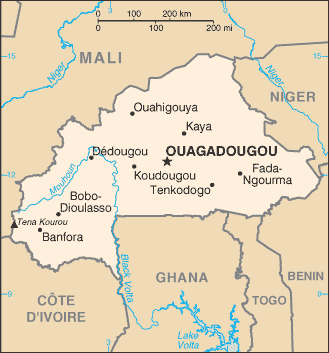
Area: 274,200 sq. km. (106,000 sq. mi.); about
the size of Colorado.
Cities: Capital--Ouagadougou
(pop. 1 million). Other
cities--Bobo-Dioulasso (410,000), Koudougou
(83,000).
Terrain: Savanna; brushy plains and scattered
hills.
Climate: Sahelian; pronounced wet and dry
seasons.
People
Nationality: Noun
and adjective--Burkinabe (accent on last e).
Population (2006): 14.4 million.
Annual growth rate (2005): 2.53%.
Ethnic groups: 63 ethnic groups among which are
Mossi (almost half of the total population),
Bobo, Mande, Lobi, Fulani, Gourounsi, and Senufo.
Religions: Traditional beliefs 20%, Muslim 55%,
Christian 25%.
Languages: French (official), Moore, Dioula,
others.
Education: Literacy (2003)--26.6%.
Health: Infant
mortality rate (2005)--95.57/1,000. Life
expectancy (2003)--48.45
years.
Work force: Agriculture--90%; industry--2.1%; commerce,
services, and government--5.5%.
Government
Type: Republic.
Independence: August 5, 1960.
Constitution: June 11, 1991.
Branches: Executive--president
(head of state) prime minister (head of
government). Legislative--one
chamber. Judiciary--independent.
Subdivisions: 13 regions, 45 provinces, 350
departments.
Political parties: Congress for Democracy and
Progress (CDP), Alliance for Democracy
Federation/ African Democratic Assembly (ADF/RDA),
Party for Democracy and Progress/Socialist Party
(PDP/PS), National Union for Democracy and
Development (UNDD), and numerous other small
opposition parties.
Suffrage: Direct universal.
Central government budget (2004): $540 million.
Defense: 5.5% of government budget.
Economy
GDP (2006): $6.2 billion.
Annual growth rate (2006): 6.4%.
Per capita income (2006): $440.
Avg. inflation rate (2006): 2.5%.
Natural resources (limited quantities):
Manganese, gold, limestone, marble, phosphate.
Agriculture (37% of GDP): Products--cotton,
millet, sorghum, rice, livestock, peanuts, shea
nuts, maize.
Industry (19% of GDP): Type--mining,
agricultural processing plants, brewing and
bottling, light industry.
Trade (2004): Exports--$439
million: cotton, gold, livestock, peanuts, shea
nut products. Major
markets--Singapore, China, Thailand,
European Union, Asia. Imports--$843
million.
Official exchange rate: Fixed to the euro. Communaute
Financiere Africaine (CFA)
francs 656=1 euro (2003: approx. CFA francs
579=U.S.$1; 2005: CFA francs 534=U.S.$1).
GEOGRAPHY
Burkina Faso is a landlocked country located in
the middle of West Africa's "hump." It is
geographically in the Sahel--the agricultural
region between the Sahara Desert and the coastal
rain forests. Most of central Burkina Faso lies
on a savanna plateau, 200 meters-300 meters (650
ft.-1,000 ft.) above sea level, with fields,
brush, and scattered trees. The largest river is
the Mouhoun (Black Volta), which is partially
navigable by small craft. Burkina Faso has West
Africa's largest elephant population. Game
preserves also are home to lions, hippos,
monkeys, warthogs, and antelope. Infrastructure
and tourism are, however, not well developed.
Annual average rainfall varies from about 100
centimeters (40 in.) in the south to less than
25 centimeters (10 in.) in the north and
northeast, where hot desert winds accentuate the
dryness of the region. The cooler season,
November to February, is pleasantly warm and dry
(but dusty), with cool evenings. March-June can
be very hot. In July-September, the rains bring
a 3-month cooler and greener humid season.
PEOPLE
Burkina Faso's 14.4 million people (2006) belong
to two major West African cultural groups--the
Voltaic and the Mande (whose common language is
Dioula). The Voltaic Mossi make up about
one-half of the population. The Mossi claim
descent from warriors who migrated to
present-day Burkina Faso from Ghana and
established an empire that lasted more than 800
years. Predominantly farmers, the Mossi kingdom
is still led by the Mogho Naba, whose court is
in Ouagadougou.
Burkina Faso is an ethnically integrated,
secular state. Most of Burkina's people are
concentrated in the south and center of the
country, sometimes exceeding 48 per square
kilometer (125/sq. mi.). Hundreds of thousands
of Burkinabe migrate to Cote d'Ivoire and Ghana,
many for seasonal agricultural work. These flows
of workers are obviously affected by external
events; the September 2002 coup attempt in Cote
d'Ivoire and the ensuing fighting there have
meant that hundreds of thousands of Burkinabe
returned to Burkina Faso. A plurality of
Burkinabe are Muslim, but most also adhere to
traditional African religions. The introduction
of Islam to Burkina Faso was initially resisted
by the Mossi rulers. Christians, both Roman
Catholics and Protestants, comprise about 25% of
the population, with their largest concentration
in urban areas.
Few Burkinabe have had formal education.
Schooling is in theory free and compulsory until
the age of 16, but only about 54% of Burkina's
primary school-age children are enrolled in
primary school due to actual costs of school
supplies and school fees and to opportunity
costs of sending a child who could earn money
for the family to school. The University of
Ouagadougou, founded in 1974, was the country's
first institution of higher education. The
Polytechnical University in Bobo-Dioulasso was
opened in 1995. The University of Koudougou was
founded in 2005 to substitute for the former
teachers training school, Ecole Normale
Superieure de Koudougou.
HISTORY
Until the end of the 19th century, the history
of Burkina Faso was dominated by the
empire-building Mossi. The French arrived and
claimed the area in 1896, but Mossi resistance
ended only with the capture of their capital
Ouagadougou in 1901. The colony of Upper Volta
was established in 1919, but it was dismembered
and reconstituted several times until the
present borders were recognized in 1947.
The French administered the area indirectly
through Mossi authorities until independence was
achieved on August 5, 1960. The first President,
Maurice Yameogo, amended the constitution soon
after taking office to ban opposition political
parties. His government lasted until 1966, when
the first of several military coups placed Lt.
Col. Sangoule Lamizana at the head of a
government of senior army officers. Lamizana
remained in power throughout the 1970s, as
President of military and then elected
governments.
With the support of unions and civil groups,
Col. Saye Zerbo overthrew President Lamizana in
1980. Colonel Zerbo also encountered resistance
from trade unions and was overthrown 2 years
later by Maj. Dr. Jean-Baptiste Ouedraogo and
the Council of Popular Salvation (CSP).
Factional infighting developed between moderates
in the CSP and radicals led by Capt. Thomas
Sankara, who was appointed Prime Minister in
January 1983, but was subsequently arrested.
Efforts to bring about his release, directed by
Capt. Blaise Compaore, resulted in yet another
military coup d'etat, led by Sankara and
Compaore on August 4, 1983.
Sankara established the National Revolutionary
Committee with himself as President and vowed to
"mobilize the masses." But the committee's
membership remained secret and was dominated by
Marxist-Leninist military officers. In 1984,
Upper Volta changed its name to Burkina Faso,
meaning "the country of honorable people." But
many of the strict security and austerity
measures taken by Sankara provoked resistance.
Despite his initial popularity and personal
charisma, Sankara was assassinated in a coup
which brought Capt. Blaise Compaore to power in
October 1987.
Compaore pledged to pursue the goals of the
revolution but to "rectify" Sankara's
"deviations" from the original aims. In fact,
Compaore reversed most of Sankara's policies and
combined the leftist party he headed with more
centrist parties after the 1989 arrest and
execution of two colonels who had supported
Compaore and governed with him up to that point.
GOVERNMENT AND POLITICAL CONDITIONS
With Compaore alone at the helm, a democratic
constitution was approved by referendum in 1991.
In December 1991, Compaore was elected
President, running unopposed after the
opposition boycotted the election. The
opposition did participate in the following
year's legislative elections, in which the
ruling party won a majority of seats.
The government of the Fourth Republic includes a
strong presidency, a prime minister, a Council
of Ministers presided over by the president, a
unicameral National Assembly, and the judiciary.
The legislature and judiciary are nominally
independent but remain susceptible to executive
influence.
Burkina held multiparty municipal elections in
1995, 2000, and 2006, as well as legislative
elections in 1997, 2002, and 2007. Balloting was
considered largely free and fair in all
elections despite minor irregularities. However,
the ruling party's dominance meant that the
playing field was not entirely even. The
Congress for Democracy and Progress (CDP), the
governing party, won overwhelming majorities in
all the elections until the 2002 legislative
election, where the CDP won with a small
majority of the 111 seats. The opposition made
large gains in the 2002 elections.
Compaore won the November 1998 presidential
election for a second 7-year term against two
minor-party candidates. But within weeks of
Compaore's victory the domestic opposition took
to the streets to protest the December 13, 1998
murder of leading independent journalist Norbert
Zongo, whose investigations of the death of the
President's brother's chauffeur suggested
involvement of the Compaore family.
The opposition Collective Against Impunity--led
by human rights activist Halidou Ouedraogo and
including opposition political parties of Prof.
Joseph Ki-Zerbo and (for a while) Hermann
Yameogo, son of the first President--challenged
Compaore and his government to bring Zongo's
murderers to justice and make political reforms.
The Zongo killings still resonate in Burkina
politics, though not as strongly as in the past.
There has been no significant progress on the
investigation of the case.
Compaore was re-elected to the presidency for a
5-year term in November 2005. The current
cabinet is dominated by Compaore and the CDP.
Given the fragile roots of democratic
institutions, constitutional checks and balances
are seldom effective in practice. The
constitution was amended in 2000 to limit the
president to a 5-year term, renewable once,
beginning with the November 2005 election. The
amendment is controversial because it did not
make any mention of retroactivity, meaning that
President Compaore's eligibility to present
himself for the 2005 presidential election is a
matter of debate. The Constitutional Court ruled
in October 2005 that the amendment was not
retroactive, and Compaore went on to win the
November 2005 presidential election with over
80% of the vote. Most international and national
electoral observers believed that the election
was fair.
Principal Government Officials
President--Blaise Compaore
Prime Minister--Tertius Zongo
Ministers
Health--Bedouma Alain Yoda
Economy and Finance--Jean-Baptiste Marie Pascal
Compaore
Agriculture, Water and Fisheries--Laurent Sedogo
Justice and Keeper of the Seal--Zakalia Kote
Defense--Yero Boly
Foreign Affairs and Regional Cooperation--Djibrill
Bassole
Transportation--Gilbert N. Ouedraogo
Civil Service and State Reform--Seydou Bouda
Territorial
Administration/Decentralization--Clement
Pegdwende Sawadogo
Security--Assane Sawadogo
Mines and Energy--Abdoulaye Abdoulkader Cisse
Commerce, Enterprise Promotion and Handicraft--Mamadou
Sanou
Culture, Tourism and Communication, Spokesman of
the Government--Filippe Sawadogo
Infrastructures and Territorial Unlocking--Hippolyte
Lingani
Secondary and Superior Education and Scientific
Research--Joseph Pare
Basic Education and Mass Literacy--Marie Odile
Bonkoungou-Balima
Environment and Standard of Living--Salif
Sawadogo
Labor and Social Security--Jerome Bougouma
Presidential Missions, Analysis, and
Prospective--Gueda Jacques Ouedraogo
Youth and Employment--Justin Koutaba
Social Action and National Solidarity--Pascaline
Tamini-Bihoun
Animal Resources--Sekou Ba
Human Rights--Salamata Sawadogo
Post, Information and Communications
Technologies--Joachim Tankoano
Promotion of Women--Celine M. Yoda-Konkobo
Housing and Urbanization--Vincent T. Dabilougou
Sports and Leisure--Jean-Pierre A. M. Palm
Parliamentary Relations--Cecile Beloum
Deputy Minister in Charge of Budget--Lucien
Marie Noel Bembamba
Deputy Minister in Charge of Regional
Cooperation--Minata Samate-Cessouma
Deputy Minister in Charge of Local
Collectivities--Soungalo Ouattara
Deputy Minister in Charge of Agriculture--Issaka
Maiga
Deputy Minister in Charge of Mass Literacy and
Non Formal Education--Ousseini Tamboura
Deputy Minister in Charge of Technical Education
and Vocational Training--Maxime Some
Ambassador to the United States--Paramanga
Ernest Yonli
Burkina Faso maintains an embassy in
the United States at 2340 Massachusetts Ave. NW,
Washington, DC 20008 (tel. 202-332-5577).
Next Elections Scheduled
Presidential elections--November 2010.
ECONOMY
Burkina Faso is one of the poorest countries in
the world, with a per capita gross domestic
product (GDP) of $440. More than 80% of the
population relies on subsistence agriculture,
with only a small fraction directly involved in
industry and services. Drought, poor soil, lack
of adequate communications and other
infrastructure, a low literacy rate, and an
economy vulnerable to external shocks are all
longstanding problems. The export economy also
remains subject to fluctuations in world prices.
Burkina remains committed to the structural
adjustment program it launched in 1991, and it
has been one of the first beneficiaries of the
World Bank/International Monetary Fund (IMF)
debt-relief and poverty reduction programs for
highly indebted poor countries. At least 20% of
the government budget is financed from
international aid, and the majority of
infrastructure investments are externally
financed. Growth rates had been more than 5%
from the late 1990s through 2006, but slowed in
2007 in part due to depressed world prices for
cotton, Burkina Faso's largest export.
Many Burkinabe migrate to neighboring countries
for work, and their remittances provide a
contribution to the economy's balance of
payments that is second only to cotton as a
source of foreign exchange earnings. Political
and economic problems in Cote d'Ivoire have had
a direct impact on this source of revenue for
millions of Burkina households. The military
crisis in neighboring Cote d'Ivoire negatively
affected trade between the two countries, due to
the year-long closure of the border between
Burkina Faso and Cote d'Ivoire from September
2002 to September 2003. Goods and services, as
well as remittances, continue to flow from
Burkinabe living in Cote d'Ivoire, but they have
been rerouted through other countries in the
region, such as Togo, Ghana, and Benin.
Commercial and personal traffic across the
border is slowly rebuilding steam.
Burkina is attempting to improve the economy by
developing its mineral resources, improving its
infrastructure, making its agricultural and
livestock sectors more productive and
competitive, and stabilizing the supplies and
prices of food grains. Staple crops are millet,
sorghum, maize, and rice. The cash crops are
cotton, groundnuts, karite (shea nuts), and
sesame. Livestock, once a major export, has
declined.
Manufacturing is limited to cotton and food
processing (mainly in Bobo-Dioulasso) and import
substitution heavily protected by tariffs. Some
factories are privately owned, and others are
set to be privatized. Burkina Faso's
newly-written investment code has helped to
promote foreign investment. U.S. investors,
particularly in the mining sector, have taken
note of this development, and in 2007, the
country's only commercial gold mine was opened.
Three others are slated to follow in the next
two years. A railway connects Burkina with the
port of Abidjan, Cote d'Ivoire, 1,150 kilometers
(712 mi.) away. Due to the closure of the border
with Cote d'Ivoire, this railway was not
operational between September 2002 and September
2003, but cargo and limited passenger service
are now offered. Primary roads between main
towns in Burkina Faso are paved. Domestic air
service and flights within Africa are limited.
Phones and Internet service providers are
relatively reliable, but the cost of utilities
is very high.
FOREIGN RELATIONS
Burkina has excellent relations with European
aid donors, as well as Libya, Taiwan, and other
states which have offered financial aid. France
and the European Union, in particular, provide
significant aid. Other donors with large
bilateral aid programs include Germany, Denmark,
the Netherlands, Belgium, and Canada. President
Compaore is active in subregional diplomacy in
West Africa. He was elected in January 2007 to
be Chairman of the Economic Community of West
African States (ECOWAS) and has acted as a
mediator in the political crises in neighboring
Togo and Cote d'Ivoire. In January 2008, Burkina
Faso became a non-permanent member of the UN
Security Council; it will hold this position for
two years.
U.S.-BURKINA RELATIONS
U.S. relations with Burkina Faso are excellent.
In the past, bilateral relations were subject to
strains because of the Compaore government's
involvement in arms trading and other
sanctions-breaking activity. In addition to
regional peace and stability, U.S. interests in
Burkina are to promote continued democratization
and greater respect for human rights and to
encourage sustainable economic development.
Although the Agency for International
Development (USAID) closed its office in
Ouagadougou in 1995, about $18 million annually
of USAID funding goes to Burkina's development
through non-governmental and regional
organizations. The largest is a Food for Peace
school lunch program administered by Catholic
Relief Services. Burkina has been the site of
several development success stories. U.S.
leadership in building food security in the
Sahel after the 1968-74 drought has been
successful in virtually eliminating famine,
despite recurrent drought years. River blindness
has been eliminated from the region. In both
cases, the U.S. was the main donor to
inter-African organizations headquartered in
Ouagadougou which through sustained efforts have
achieved and consolidated these gains. In 2005,
Burkina Faso and the Millennium Challenge
Corporation (MCC) signed a $12 million Threshold
Country Program to build schools and increase
girls' enrolment rates. In November 2005, the
Millennium Challenge Corporation selected
Burkina Faso as eligible to submit a proposal
for Millennium Challenge Account assistance for
fiscal year 2006, making it one of only two
countries eligible for threshold as well as
compact funding. In July 2008, the Government of
Burkina Faso is expected to sign a five-year
Compact that will focus on agriculture, land
reform, road infrastructure, and education.
The Peace Corps entered Burkina Faso in 1966.
The Peace Corps program was phased out in 1987,
but was invited to return to Burkina Faso in
1995 as part of a newly established health
project. One year later, the Peace Corps
established a secondary education project and in
2003, Peace Corps introduced a small enterprise
development project to complement the
government's poverty reduction and private
sector promotional programs. In 2005, the
Government of Burkina Faso asked for assistance
to increase the level of girls' access to
education, which later became the focus of the
Millennium Challenge Corporation's Threshold
Compact with Burkina Faso. All Peace Corps
Volunteers, regardless of sector, are trained in
how to promote awareness on HIV/AIDS and gender
and development.
U.S. trade with Burkina is still extremely
limited--$18.1 million in U.S. exports and $1
million in Burkinabe exports to the U.S. in
2006--but investment possibilities exist,
especially in the mining and communications
sectors.
Principal U.S. Officials
Ambassador--Jeanine
Jackson
Deputy Chief of Mission--David E. Brown
Political Officer--Breanna Green
Economic Officer--Pamela Hamblett
Management Officer--Eugene Aaron
Peace Corps Country Director--Douglass Teschner
Public Affairs Officer--Joann Lockard
Vice Consul--Wossenyelesh Mazengia
The U.S.
Embassy in
Burkina Faso is located on 602 Avenue Raoul
Follereau in Ouagadougou. Mailing addresses are:
International mail: Ambassade des Etats-Unis, 01
B.P. 35, Ouagadougou 01, Burkina Faso; Mail from
the U.S.: Department of State, 2440 Ouagadougou
Place, Washington, DC 20521-2440. Tel: (226)
50-30-67-23; fax: (226) 50-31-23-68 or (226)
50-30-38-90. Email address: amembouaga@state.gov.
 Information
on Countries from Around the World
Information
on Countries from Around the World