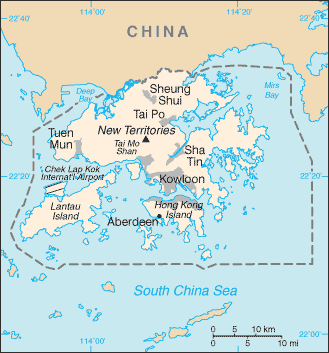
Geography
Area: 1,104.3 sq. km.; Hong Kong comprises Hong
Kong Island, Kowloon, the New Territories, and
numerous small islands.
Terrain: Hilly to mountainous, with steep slopes
and natural harbor.
Climate: Tropical monsoon. Cool and humid in
winter, hot and rainy from spring through
summer, warm and sunny in fall.
People
Population (end-2007): 6.96 million.
Population growth rate (2007): 0.8%.
Ethnic groups: Chinese 95%; other 5%.
Religions: About 43% participate in some form of
religious practice. Christian, about 9.6%.
Languages: Cantonese (a dialect of Chinese) and
English are official.
Education: Literacy--97.1%
(98.7% male, 95.4% female).
Health (2007): Infant
mortality rate--1.7/1,000. Life
expectancy-- 82.4 yrs. (overall); 79.3 yrs.
males, 85.4 yrs. females.
Work force (2008): 3.66 million. Wholesale,
retail, and import/export trades and restaurants
and hotels --29.0%; finance,
insurance, real estate, and business services--14.3%; manufacturing--4.2%.
Government
Type: Special Administrative Region (SAR) of
China, with its own constitution (the Basic
Law).
Branches: Executive--Administration:
Chief Executive selected in March 2007;
Executive Council, serving in an advisory role
for the Chief Executive. Legislative--Legislative
Council (Legco) elected in September 2004. Judicial--Court
of Final Appeal is highest court, other lower
courts.
Subdivisions: Hong Kong, Kowloon, New
Territories.
Suffrage: Permanent residents, at 18 years or
over, living in Hong Kong for the past seven
years are eligible to vote in certain local
elections and for Legco members.
Economy (2007)
GDP (2007): $207.2 billion.
GDP real growth rate (2007): 6.4%.
Per capita GDP (2007): $29,900.
Natural resources: Outstanding deepwater harbor.
Industry: Types--textiles,
clothing, electronics, plastics, toys, watches,
clocks.
Trade: Exports--$344.6
billion: clothing, electronics, textiles,
watches and clocks, office machinery. Imports--$367.7
billion: consumer goods, raw materials and
semi-manufactures, capital goods, foodstuffs,
fuels.
PEOPLE
Hong Kong's population has increased steadily
over the past decade, reaching 6.96 million in
2007. Hong Kong is one of the most densely
populated areas in the world, with an overall
density of some 6,303 people per square
kilometer. Cantonese, the official Chinese
language in Hong Kong, is spoken by most of the
population. English, also an official language,
is widely understood, being spoken by more than
one-third of the population. Every major
religion is practiced freely in Hong Kong. All
children are required by law to be in full-time
education between the ages of 6 and 15.
Preschool education for most children begins at
age 3. Primary school begins normally at the age
of 6 and lasts for 6 years. At about age 12,
children progress to a 3-year course of junior
secondary education. Most stay on for a 2-year
senior secondary course, while others join
full-time vocational training. More than 90% of
children complete upper secondary education or
equivalent vocational education.
HISTORY
According to archaeological studies, human
activity on Hong Kong dates back over five
millennia. Excavated neolithic artifacts suggest
an influence from northern Chinese stone-age
cultures. The territory was settled by Han
Chinese during the seventh century, A.D.,
evidenced by the discovery of an ancient tomb at
Lei Cheung Uk in Kowloon. The first major
migration from northern China to Hong Kong
occurred during the Sung Dynasty (960-1279). The
British East India Company made the first
successful sea venture to China in 1699, and
Hong Kong's trade with British merchants
developed rapidly soon after. After the Chinese
defeat in the First Opium War (1839-42), Hong
Kong was ceded to Britain in 1842 under the
Treaty of Nanking. Britain was granted a
perpetual lease on the Kowloon Peninsula under
the 1860 Convention of Beijing, which formally
ended hostilities in the Second Opium War
(1856-58). The United Kingdom, concerned that
Hong Kong could not be defended unless
surrounding areas also were under British
control, executed a 99-year lease of the New
Territories in 1898, significantly expanding the
size of the Hong Kong colony.
In the late 19th century and early 20th
centuries, Hong Kong developed as a warehousing
and distribution center for U.K. trade with
southern China. After the end of World War II
and the communist takeover of Mainland China in
1949, hundreds of thousands of people fled from
China to Hong Kong. Hong Kong became an economic
success and a manufacturing, commercial,
finance, and tourism center. High life
expectancy, literacy, per capita income, and
other socioeconomic measures attest to Hong
Kong's achievements over the last five decades.
On July 1, 1997, China resumed the exercise of
sovereignty over Hong Kong, ending more than 150
years of British colonial rule. Hong Kong is a
Special Administrative Region of the People's
Republic of China with a high degree of autonomy
in all matters except foreign and defense
affairs. According to the Sino-British Joint
Declaration (1984) and the Basic Law, Hong Kong
will retain its political, economic, and
judicial systems and unique way of life for 50
years after reversion and will continue to
participate in international agreements and
organizations under the name, "Hong Kong,
China."
GOVERNMENT AND POLITICAL CONDITIONS
The Hong Kong Special Administrative Region
(SAR) is headed by Chief Executive Donald Tsang,
who first took office in 2005 and whose current
term ends in 2012. The Election Committee that
votes on the Chief Executive (CE) is made up of
approximately 800 Hong Kong residents from four
constituency groups: commercial, industrial, and
financial interests; professionals; labor,
social services, and religious interests; and
the legislature, the Chinese People's Political
Consultative Conference, and the P.R.C. National
People's Congress.
In December 2006, pro-democracy Civic Party
legislator Alan Leong garnered 134 nominations
from the Election Committee, enabling Leong to
challenge incumbent CE Tsang's bid for a new
five-year term in 2007. Tsang, with solid
support from the pro-government and pro-business
sectors, won the March 25, 2007 Election
Committee vote with 649 of the 795 votes. Leong
garnered 123 votes.
In July 2002, the Hong Kong Government
implemented the Principal Officials
Accountability System, which was designed to
make the government more responsive to public
concerns. Twelve political appointees, directly
responsible to the Chief Executive, run the 12
policy bureaus. Three other senior civil service
positions--the Chief Secretary, Financial
Secretary, and Justice Secretary--are also
filled by political appointments. This system
was expanded in 2008 to include one Under
Secretary and one Political Assistant position
being filled by appointment in each bureau.
While Hong Kong remains a free and open society
where human rights are respected, courts are
independent, and there is well-established
respect for the rule of law, residents are
limited in their ability to change their
government, and the legislature is limited in
its power to affect government policies. The
September 12, 2004 Legislative Council (Legco)
elections were seen as generally free, open, and
widely contested, although Hong Kong groups have
alleged voter intimidation, manipulation, or
pressure in connection with them.
In December 2005 the Legco rejected a Hong Kong
Government-proposed package of incremental
reforms to the mechanisms for choosing the CE in
2007 and forming the Legco in 2008. In July
2007, the Hong Kong Government's Commission on
Strategic Development issued a Green Paper on
Constitutional Development, which set out a
myriad of options to reform the CE and Legco
electoral mechanisms, with the "ultimate aim" of
universal suffrage as prescribed by the Basic
Law.
On December 12, 2007, Chief Executive Donald
Tsang submitted a report on the Green Paper to
the central government. The report said more
than half of local people wanted universal
suffrage by 2012, but 2017 might be a more
realistic date. In December 2007, the P.R.C.
National People's Congress Standing Committee (NPCSC)
issued a decision on Hong Kong's constitutional
development which, while ruling out universal
suffrage in 2012, appears to open the way for
Hong Kong to achieve full universal suffrage for
the CE in 2017, and full universal suffrage for
Legco sometime thereafter. Any amendments to the
Basic Law will require approval by the CE, at
least two-thirds of Legco, and then the NPCSC.
Principal Government Officials
Chief Executive--Donald Tsang
Chief Secretary for Administration--Henry Tang
Financial Secretary--John Tsang
Secretary for Justice--Wong Yan Lung, SC
Secretary for Education--Michael Suen
Secretary for Commerce and Economic
Development--Rita Lau
Secretary for Constitutional and Mainland
Affairs--Stephen Lam
Secretary for Security--Ambrose Lee
Secretary for Food and Health--York Chow
Secretary for the Civil Service--Denise Yue
Secretary for Home Affairs--Tsang Tak-sing
Secretary for Labour and Welfare--Matthew Cheung
Secretary for Financial Services and the
Treasury--K C Chan
Secretary for Development--Carrie Lam
Secretary for the Environment--Edward Yau
Secretary for Transport and Housing--Eva Cheng
ECONOMY
Hong Kong is one of the world's most open and
dynamic economies. Hong Kong per capita GDP is
comparable to other developed countries. Real
GDP expanded by 6.4% in 2007 year-on-year,
driven by thriving exports, vibrant inbound
tourism and strong consumer spending. Severe
acute respiratory syndrome (SARS) caused the
Hong Kong economy to shrink during the first
half of 2003, and property prices had fallen 66%
from their late 1997 peak, but have since more
than doubled from that lower base. The
unemployment rate declined to 3.3% in April-June
2008, the lowest level since mid-1998. The
surplus for fiscal year 2007-08 was $15.9
billion or 7.6% of GDP, attributed to the robust
economy, increased corporate profits and
salaries, the buoyant stock market, and a stable
property market.
Hong Kong enjoys a number of economic strengths,
including a sound banking system, virtually no
public debt, a strong legal system, ample
foreign exchange reserves and an able and
rigorously enforced anti-corruption regime. Hong
Kong’s liberal economic system enables it to
respond quickly to changing circumstances. It
continues to take measures designed to improve
its attractiveness as a commercial and trading
center, especially after China's entry into the
World Trade Organization (WTO), and is
continually refining its financial architecture.
The government is deepening its economic
interaction with the Pearl River Delta in an
effort to maintain Hong Kong's position as a
gateway to China. These efforts include the
conclusion of a free trade agreement with China,
known as “the Closer Economic Partnership
Arrangement” (CEPA), which applies zero tariffs
to all Hong Kong-origin goods and preferential
treatment in 40 service sectors. Hong Kong,
along with the Macau SAR, is also participating
in a new pan-Pearl River Delta trade block with
nine Chinese provinces, which aims to lower
trade barriers among members, standardize
regulations, and improve infrastructure. U.S.
companies have a generally favorable view of
Hong Kong's business environment, including its
legal system and the free flow of information,
low taxation, and infrastructure. The American
Chamber of Commerce's annual business confidence
survey, released in December 2007, showed 99% of
respondents had a "good" or "satisfactory"
outlook for 2008. Survey results indicated a
positive economic outlook through 2010.
FOREIGN RELATIONS
Hong Kong's foreign relations and defense are
the responsibility of China. Hong Kong is a
separate customs territory and economic entity
separate from the rest of China and is able to
enter into international agreements on its own
behalf in commercial and economic matters. Hong
Kong, independently of China, participates as a
full member of numerous international economic
organizations including the World Trade
Organization (WTO), the Asia Pacific Economic
Cooperation forum (APEC), and the Financial
Action Task Force (FATF). It is an articulate
and effective champion of free markets and the
reduction of trade barriers.
U.S.-HONG KONG RELATIONS
U.S. policy toward Hong Kong, grounded in a
determination to promote Hong Kong's prosperity,
autonomy, and way of life, is stated in the
U.S.-Hong Kong Policy Act of 1992. The United
States maintains substantial economic and
political interests in Hong Kong. The United
States supports Hong Kong's autonomy by
concluding and implementing bilateral
agreements; promoting trade and investment;
arranging high-level visits; broadening law
enforcement cooperation; bolstering educational,
academic, and cultural links; and supporting the
large community of U.S. citizens and visitors.
Hong Kong is an active member of the global
coalition against terrorism. Hong Kong has
joined the Container Security Initiative and
remains an important partner with regard to
eliminating funding for terrorist networks and
combating money laundering. Hong Kong agreed to
participate in the Secure Freight Initiative in
a limited capacity on a pilot basis in November
2007 and is scheduled to continue it
participation through April 2009. Hong Kong has
passed legislation designed to bring Hong Kong
into compliance with applicable UN anti-terror
resolutions and Financial Action Task Force
recommendations.
The United States has substantial economic and
social ties with Hong Kong. There are some 1,100
U.S. firms, including 891 regional operations
(298 regional headquarters and 593 regional
offices), and about 54,000 American residents in
Hong Kong. According to U.S. Government
statistics, U.S. exports to Hong Kong totaled
$20.1 billion in 2007. U.S. direct investment in
Hong Kong at the end of 2007 totaled about $47.4
billion, making the United States one of Hong
Kong's largest investors, along with China,
Japan, and the Netherlands.
The United States and Hong Kong signed a civil
aviation agreement in October 2002, which
significantly liberalized the aviation market.
Hong Kong enjoys a high degree of autonomy as a
separate customs territory, with no changes to
borders, staffing, or technology export controls
since the 1997 handover. Intellectual property
rights (IPR) protection is relatively strong and
Hong Kong continues to take steps to improve
both its legislation and its enforcement regime.
The Hong Kong Government maintains three Economic
and Trade Offices in
the United States. Addresses, telephone numbers,
and web sites for these offices are listed
below:
1520 - 18th Street NW
Washington, DC 20036
Tel: (202) 331-8947
Fax: (202) 331-8958
Web Site: http://www.hketowashington.gov.hk/dc/index.htm
115 East 54th Street
New York, NY 10022
Tel: (212) 752-3320
Fax: (212) 752-3395
Web Site: http://www.hketony.gov.hk/ny/index.htm
130 Montgomery Street
San Francisco, CA 94104
Tel: (415) 835-9300
Fax: (415) 421-0646
Web Site: http://www.hketosf.gov.hk/sf/index.htm
Principal U.S. Officials
Consul General-- Joseph R. Donovan. Jr.
Deputy Principal Officer--Christopher J. Marut
The U.S.
Consulate General is
located at 26 Garden Road, Hong Kong. Tel: (852)
2523-9011 (general). Fax: (852) 2845-1598
(general); (852) 2147-5790 (consular); (852)
2845-9800 (commercial).
 Information
on Countries from Around the World
Information
on Countries from Around the World