
PROFILE
OFFICIAL NAME:
Islamic Republic of Mauritania
Geography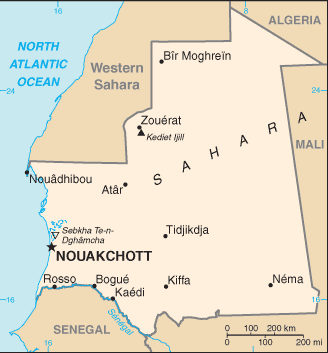
Area: 1,030,070 sq. km. (419,212 sq. mi.);
slightly larger than Texas and New Mexico
combined.
Cities (2004): Capital--Nouakchott
(pop. 708,000). Other
cities--Nouadhibou (72,000), Rosso (50,000),
Kaedi (34,000), Zouerate (34,000), Kiffa
(33,000), Atar (24,000).
Terrain: Northern four-fifths barren desert;
southern 20% mainly Sahelian with small-scale
irrigated and rain-fed agriculture in the
Senegal River basin.
Climate: Predominantly hot and dry.
People
Nationality: Noun
and adjective--Mauritanian(s).
Population (2007): 2,961,000.
Annual growth rate: 2.5%.
Ethnic groups: Arab-Berber (White Moor),
Arab-Berber-Negroid (Black Moor), Haalpulaar,
Soninke, Wolof (Black African Mauritanians).
Religion: Islam.
Languages: Arabic (official), Hassaniya (Arabic
dialect), French, Pulaar, Wolof, and Soninke.
Education: Years
compulsory--six. Attendance (student
population enrolled in primary school)--82%. Adult
literacy (%
of population age 15+)--59%.
Health: Infant
mortality rate--67/1,000. Life expectancy--64
yrs.
Work force: Agriculture
and fisheries--50%. Services
and commerce--20%. Government--20%. Industry
and transportation--10%.
Government
Type: Republic.
Independence: November 28, 1960.
Constitution: Approved 1991. Original
constitution promulgated 1961.
Branches: Executive--president
(head of state). Legislative--bicameral
national assembly, directly elected lower house
(81 members), and upper house (56 members)
chosen indirectly by municipal councilors. Judicial--a
supreme court and lower courts are nominally
independent but subject to control of executive
branch; judicial decisions are rendered mainly
on the basis of Shari'a (Islamic law) for
social/family matters and a western style legal
code, applied in commercial and some criminal
cases.
Political parties: 21.
Suffrage: Universal at 18.
National day: November 28, Independence Day.
Economy
GDP (2007): $2.8 billion.
Annual growth rate (2007): 1.9%.
Per capita income (2006): $952.
Natural resources: petroleum, fish, iron ore,
gypsum, copper, gum arabic, phosphates, salt and
gold.
Agriculture (13% of GDP 2007): Products--livestock,
traditional fisheries, millet, maize, wheat,
dates, rice.
Industry (47% of GDP 2007): Types--mining,
commercial fishing.
Services (41% of GDP 2007).
Trade: Exports (2006,
f.o.b.)--$1.4 billion: iron ore, fish and fish
products, gold, copper, petroleum. Export partners (2007)--China
30.5%, France 9.5%, Italy 8.6%, Spain 8.5%,
Japan 5.5%, Netherlands 5.3%, Belgium 5%, Cote
d'Ivoire 4.7%. Imports (2006)--$1.5
billion: machinery and equipment, petroleum
products, capital goods, foodstuffs, consumer
goods. Import
partners (2007)--France
16.7%, China 8.2%, Spain 6.8%, U.S. 6.2%,
Belgium 5.8%, Brazil 5.5%.
Currency: Ouguiya (UM).
USAID: Total FY 2008 USAID humanitarian and
development assistance to
Mauritania--$21,106,735.
HISTORY
From the 3rd to 7th centuries, the migration of
Berber tribes from North Africa displaced the
Bafours, the original inhabitants of present-day
Mauritania and the ancestors of the Soninke.
Continued Arab-Berber migration drove indigenous
black Africans south to the Senegal River or
enslaved them. By 1076, Islamic warrior monks (Almoravid
or Al Murabitun) completed the conquest of
southern Mauritania, defeating the ancient Ghana
empire. Over the next 500 years, Arabs overcame
fierce Berber resistance to dominate Mauritania.
The Mauritanian Thirty-Year War (1644-74) was
the unsuccessful final Berber effort to repel
the Maqil Arab invaders led by the Beni Hassan
tribe. The descendants of Beni Hassan warriors
became the upper stratum of Moorish society.
Berbers retained influence by producing the
majority of the region's Marabouts--those who
preserve and teach Islamic tradition. Hassaniya,
a mainly oral, Berber-influenced Arabic dialect
that derives its name from the Beni Hassan
tribe, became the dominant language among the
largely nomadic population. Within Moorish
society, aristocratic and servant classes
developed, yielding "white" (aristocracy) and
"black" Moors (the enslaved indigenous class).
French colonization at the beginning of the 20th
century brought legal prohibitions against
slavery and an end to interclan warfare. During
the colonial period, the population remained
nomadic, but sedentary black Africans, whose
ancestors had been expelled centuries earlier by
the Moors, began to trickle back into southern
Mauritania. As the country gained independence
in 1960, the capital city of Nouakchott was
founded at the site of a small colonial village.
Ninety percent of the population was still
nomadic. With independence, larger numbers of
ethnic Sub-Saharan Africans (Haalpulaar,
Soninke, and Wolof) entered Mauritania, moving
into the area north of the Senegal River.
Educated in French, many of these recent
arrivals became clerks, soldiers, and
administrators in the new state.
Moors reacted to this change by trying to
Arabicize much of Mauritanian life, such as law
and language. A schism developed between those
who considered Mauritania to be an Arab country
(mainly Moors) and those who sought a dominant
role for the Sub-Saharan peoples. The discord
between these two conflicting visions of
Mauritanian society was evident during
intercommunal violence that broke out in April
1989 (the "1989 Events").
The country's first president, Moktar Ould
Daddah, served from independence until ousted in
a bloodless coup on July 10, 1978. Mauritania
was under military rule from 1978 to 1992, when
the country's first multi-party elections were
held following the July 1991 approval by
referendum of a constitution.
The Democratic and Social Republican Party (PRDS),
led by President Maaouiya Ould Sid'Ahmed Taya,
dominated Mauritanian politics from April 1992
until he was overthrown in August 2005.
President Taya, who won elections in 1992 and
1997, first became chief of state through a
December 12, 1984 bloodless coup which made him
chairman of the committee of military officers
that governed Mauritania from July 1978 to April
1992. A group of current and former Army
officers launched a bloody but unsuccessful coup
attempt on June 8, 2003.
On November 7, 2003, Mauritania's third
presidential election since adopting the
democratic process in 1992 took place. Incumbent
President Taya was reelected. Several opposition
groups alleged that the government had used
fraudulent means to win the elections, but did
not elect to pursue their grievances via
available legal channels. The elections
incorporated safeguards first adopted in 2001
municipal elections--published voter lists and
hard-to-falsify voter identification cards.
On August 3, 2005, President Taya was deposed in
a bloodless coup. Military commanders, led by
Colonel Ely Ould Mohammed Fal (alternative
spelling: Vall) seized power while President
Taya was attending the funeral of Saudi Arabia's
King Fahd. Colonel Fal established the ruling
Military Council for Justice and Democracy to
run the country. The council dissolved the
Parliament and appointed a transitional
government. The Transitional Government quickly
established a timetable for the establishment of
democratic rule within two years' time that led
to successful parliamentary elections in
November 2006, and free and transparent
presidential elections in March 2007. A new
democratically elected government under
President Sidi Mohamed Ould Cheikh Abdallahi was
inaugurated on April 19, 2007.
On August 6, 2008, President Abdallahi was
overthrown in a bloodless coup. General Mohamed
Ould Abdel Aziz seized power after President
Abdallahi issued a decree dismissing General
Aziz and three other senior military officers.
The country is currently run by a 12-member
"High State Council" composed entirely of
military officers. As of mid-December 2008,
President Abdallahi remained under house arrest
in his native village of Lemden.
GOVERNMENT AND POLITICAL CONDITIONS
Mauritania held a series of elections that began
in November 2006 with a parliamentary vote and
culminated March 25, 2007 with the second round
of the presidential election. Sidi Ould Cheikh
Abdellahi was elected President and took office
on April 19, 2007. After almost 16 months of
civilian rule, President Abdallahi was deposed
on August 6, 2008 by a military-led coup,
throwing the future of Mauritania's new-found
democracy into doubt.
The government bureaucracy is composed of
ministries, special agencies, and parastatal
companies. The Ministry of Interior controls a
system of regional governors and prefects
modeled on the French system of local
administration. Under this system, Mauritania is
divided into 13 regions (wilaya), including the
capital district, Nouakchott. Control is tightly
concentrated in the executive branch of the
central government, but a series of national and
municipal elections since 1992 have produced
some decentralization.
Politics in Mauritania have always been heavily
influenced by personalities, with any leader's
ability to exercise political power dependent
upon control over resources; perceived ability
or integrity; and tribal, ethnic, family, and
personal considerations. Conflict among White
Moor, Black Moor, and Black African Mauritanian
groups, centering on language, land tenure, and
other issues, continues to be a major challenge
to national unity. Political parties, illegal
during the military period, were legalized again
in 1991.
Principal Government Officials
President--Sidi Mohamed Ould Cheikh Abdallahi
Prime Minister--Yahya Ould Ahmed El Waghef
Minister of Foreign Affairs and Cooperation--Cheikh
El Avia Ould Mohamed Khouna
Minister of Economy and Finance--Sidi Ould Tah
Ambassador to the United Nations--Abdelrahim
Ould Elhadrami
Ambassador to the United States--Ibrahima Dia
Mauritania maintains an embassy in the United
States at 2129 Leroy Place NW, Washington, DC
20008 (tel. 202-232-5700, fax 202-232-5701) and
a Permanent Mission to the United Nations at 211
East 43rd Street, Suite 2000, New York, NY 10017
(tel. 212-986-7963, fax 212-986-8419).
U.S.-MAURITANIAN RELATIONS
The United States strongly condemns the military
coup that overthrew the legitimate and
democratically-elected president in 2008.
Furthermore, the United States considers the
"High State Council" and its cabinet to be
illegitimate and undemocratic. As a result,
non-humanitarian U.S. Government aid to
Mauritania has been suspended, and travel
restrictions have been placed on military and
civilian individuals who are obstructing the
return to democratic government. The United
States continues to call for the unconditional
release of President Abdallahi, and for an
immediate return to constitutional order.
The U.S. Government fully supported Mauritania's
transition to democracy, and congratulated
Mauritania on the successful series of 2006-2007
parliamentary and presidential elections. The
U.S. condemned the August 2005 coup and the
unconstitutional assumption of power by the
Military Council for Justice and Democracy, and
called for a return to a constitutional
government through free and fair elections as
soon as possible. The United States provided
election-related assistance for voter education,
political party training, and democracy
building.
Before the 2005 coup, U.S.-Mauritania relations
were excellent, but underwent several
transformations since Mauritania gained
independence. From 1960 to 1967, the United
States maintained cordial relations with
Mauritania and provided a small amount of
economic assistance. During the June 1967 Middle
East war, Mauritania broke diplomatic and
consular relations with the United States but
restored ties 2 years later and maintained
relatively friendly relations until the late
1980s, despite disagreement over the
Arab-Israeli issue.
The 1989 rupture between Mauritania and Senegal
(the "1989 Events") that resulted in
Mauritania's deportation of tens of thousands of
its own citizens to Senegal, negatively affected
U.S.-Mauritanian relations. (The Mauritanian
Government, assisted by the United Nations High
Commissioner for Refugees (UNHCR), began
repatriating refugees in early 2008.) Moreover,
Mauritania's perceived support of Iraq prior to
and during the 1991 Gulf war further weakened
the strained ties.
Relations between the U.S. and Mauritania
reached a low in the spring of 1991, as details
of the Mauritanian military's role in widespread
human rights abuses surfaced. The U.S. responded
by formally halting USAID operations and all
military assistance to Mauritania. Relations
also suffered in the 1990s as a result of
repeated reports that slavery continued in some
parts of Mauritania despite legal proscriptions.
By the late 1990s, the Mauritanian Government:
adopted policies facilitating the return of
those expelled or who fled during the 1989
Events; turned away from Iraq and toward the
West; and initiated a poverty reduction strategy
while securing debt relief under the Heavily
Indebted Poor Countries (HIPC)
initiative. (See also Fact
Sheet.) Improved relations with the United
States, including the return of military
cooperation and training programs, accompanied
these changes. Mauritania formally opened
diplomatic relations with Israel in 2000 and
remains one of only three Arab League
member-nations to have done so.
Principal U.S. Officials
Ambassador--Mark
M. Boulware
Deputy Chief of Mission--Dennis Hankins
Regional Security Officer--Robert Castro
Political Officer--Robert Lester
Economic-Consular Officer--Lindsay Kiefer
Public Affairs Officer--Heather Fabrikant
Management Officer--Susan N'Garnim
Peace Corps Country Director--Obie Shaw
The address of the U.S.
Embassy in
Mauritania is Rue Abdallaye, BP 222, Nouakchott,
Islamic Republic of Mauritania. Tel. (222)
525-2660/525-2663; fax (222) 525-1592.
 Information
on Countries from Around the World
Information
on Countries from Around the World