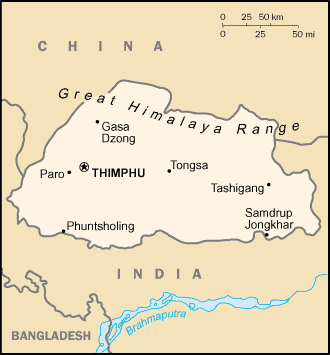
Area: 46,500 sq. km.
Cities: Capital--Thimphu
(pop. approx. 55,000) Other
significant cities--Paro, Phoentsholing,
Punakha, Bumthong.
Terrain: Mountainous, from the Himalayas to
lower-lying foothills and some savannah.
Climate: Alpine to temperate to subtropical with
monsoon season from June to September.
People
Nationality: Noun
and adjective--Bhutanese.
Population: Approximately 672,425 (according to
the 2005 census). Domestic and international
estimates of the population vary greatly.
Annual population growth rate: 2.082% (2007
est.). Density--45
per sq. km.
Ethnic groups: Drukpa 50% (which is also
inclusive of Sharchops), as well as ethnic
Nepalese (Lhotsampas) 35%, and indigenous or
migrant tribes 15%.
Religions: Lamaistic Buddhist 75% (state
religion), Indian- and Nepalese-influenced
Hinduism 25%.
Languages: Dzongkha (official language),
Bumthang-kha, English (medium of instruction),
Sharchop-kha, Nepali.
Education: Years
compulsory--11. Literacy--59.5%
(Ministry of Education General Statistics 2007). Primary
school net enrollment
rate 82.1%
(UNDP). Women's
literacy--59.5% (2007).
Health: Infant
mortality rate (2007
est.)--total: 96.37 deaths/1,000 live births; male: 94.09
deaths/1,000 live births; female: 98.77
deaths/1,000 live births. Life
expectancy --total
population 67 years; male 69.1 years; female
59.5 years (Ministry of Education General
Statistics 2007).
Work force (2005): Agriculture--94%; industry--1%; services--5%.
The unemployment rate is 3.1% (2005 est.).
Government
Type: Constitutional monarchy.
Constitution: The Royal Government, prompted by
the King, initiated a draft constitution in
2003, which was published in 2005. On July 18,
2008, the parliament formally adopted the
constitution, marking the final step in Bhutan's
historic transition from absolute monarchy to
parliamentary democracy.
Branches: Executive--prime
minister, cabinet. Legislative--parliament
(National Council and National Assembly). The
king appoints five members of the National
Council and the remaining members are elected.
Elections for the National Council (upper house)
took place in December 2007. The 47-member
National Assembly (lower house) was elected in
March 2008. Judicial--High
Court (Thrimkhang Gogma), District Courts, and
local area arbitration.
National Day: December 17 (1907).
Administrative subdivisions (dzongkhags): 20.
Political parties: Two. Druk Phuensum Tshogpa
(DPT) and People's Democratic Party (PDP).
Suffrage: Registered resident with legitimate
citizenship, age 18 and above.
Economy
GDP (purchasing power parity 2007 est.): U.S.
$3.359 billion.
Real growth rate (2007): 8.5%.
Per capita GDP PPP (2007 est.): U.S. $5,200.
Natural resources: hydroelectricity, timber,
limestone, clay, and slate.
Sectors as percent of GDP (all figures,
2006-2007): Agriculture--22.3%; industry--37.9%; services--39.8%.
Trade: Principal exports (2006-2007)--electricity
26.5%, recorded media 16.8%, palm oil 7.4%,
copper wire 6.2%. Principal imports (2006-2007)--diesel
fuel 7.9%, copper wires 7.3%, crude palm oil
5.5%, petrol 3.1%. Major
trade partners--India, Hong Kong, Japan,
Germany, Singapore, and Thailand.
PEOPLE
The people of Bhutan can be divided into three
broad ethnic categories--Ngalops, Sharchops, and
Lhotsampas. The Ngalops make up the majority of
the population, living mostly in the western and
central areas. The Ngalops are thought to be of
Tibetan origin, arriving in Bhutan during the
8th and 9th centuries A.D. and bringing Buddhism
with them. Most Ngalops follow the Drukpa
Kagyupa discipline of Mahayana Buddhism. In a
country that is deeply rooted within the
Buddhist religion, many people's sect of
religion, as opposed to their ethnic group,
characterizes them. The Ngalops predominate in
the government, and the civil service and their
cultural norms have been declared by the
monarchy to be the standard for all citizens.
The Sharchops, who live in the eastern section
of Bhutan, are considered to be descendants of
the earliest major group to inhabit Bhutan. Most
follow the Ningmapa discipline of Mahayana
Buddhism. Sharchop is translated as "people of
the east." The Ngalops, Sharchops, and the
indigenous tribal people are collectively known
as Drukpas and account for about 65% of the
population. The national language is Dzongkha,
but English is the language of instruction in
schools and an official working language for the
government.
The Lhotsampas are people of Nepali descent,
currently making up 35% of the population. They
came to Bhutan in the 19th and 20th centuries,
mostly settling in the southern foothills to
work as farmers. They speak a variety of Nepali
dialects and are predominantly Hindu.
HISTORY
Bhutan's early history is steeped in mythology
and remains obscure. It may have been inhabited
as early as 2000 B.C., but not much was known
until the introduction of Tibetan Buddhism in
the 9th century A.D. when turmoil in Tibet
forced many monks to flee to Bhutan. In the 12th
century A.D., the Drukpa Kagyupa school was
established and remains the dominant form of
Buddhism in Bhutan today. The country's
political history is intimately tied to its
religious history and the relations among the
various monastic schools and monasteries.
The consolidation of Bhutan occurred in 1616
when Ngawana Namgyal, a lama from Tibet,
defeated three Tibetan invasions, subjugated
rival religious schools, codified an intricate
and comprehensive system of law, and established
himself as ruler (shabdrung) over a system of
ecclesiastical and civil administrators. After
his death, infighting and civil war eroded the
power of the shabdrung for the next 200 years
when in 1885, Ugyen Wangchuck was able to
consolidate power and cultivated closer ties
with the British in India.
In 1907, Ugyen Wangchuck was elected as the
hereditary ruler of Bhutan, crowned on December
17, 1907, and installed as the head of state
Druk Gyalpo (Dragon King). In 1910, King Ugyen
and the British signed the Treaty of Punakha
which provided that British India would not
interfere in the internal affairs of Bhutan if
the country accepted external advice in its
external relations. When Ugyen Wangchuck died in
1926, his son Jigme Wangchuck became the next
ruler, and when India gained independence in
1947, the new Indian Government recognized
Bhutan as an independent country. In 1949, India
and Bhutan signed the Treaty of Peace and
Friendship, which provided that India would not
interfere in Bhutan's internal affairs but would
be guided by India in its foreign policy.
Succeeded in 1952 by his son Jigme Dorji
Wangchuck, Bhutan began to slowly emerge from
its isolation and began a program of planned
development. Bhutan became a member of the
United Nations in 1971, and during his tenure
the National Assembly was established and a new
code of law, as well as the Royal Bhutanese Army
and the High Court.
In 1972, Jigme Singye Wangchuck ascended the
throne at age 16. He emphasized modern
education, decentralization of governance, the
development of hydroelectricity and tourism and
improvements in rural developments. He was
perhaps best known internationally for his
overarching development philosophy of "Gross
National Happiness." It recognizes that there
are many dimensions to development and that
economic goals alone are not sufficient.
Satisfied with Bhutan's transitioning
democratization process, he abdicated in
December 2006 rather than wait until the
promulgation of the new constitution in 2008.
His son, Jigme Khesar Namgyel Wangchuck, became
King upon his abdication.
GOVERNMENT AND POLITICAL CONDITIONS
Traditionally a decentralized theocracy and,
since 1907, a monarchy, Bhutan completed its
successful transition to a constitutional
monarchy in 2008. Bhutanese officials began
preparations for the first-ever elections in
2006, shortly before King Jigme Singye Wangchuck
abdicated in December 2006. The National Council
of the new bicameral parliament was elected in
December 2007, and National Assembly elections
followed in March 2008. The Druk Phuensum
Tshogpa (DPT) won 44 out of 47 seats in the
latter election in which 80% of the 320,000
registered voters cast a ballot.
Migration by Nepalis into southern Bhutan began
in the early 19th century. Currently these and
other ethnic Nepalis, referred to as Lhotsampas,
comprise 35% of Bhutan's population. In 1988,
the government census led to the branding of
many ethnic Nepalis as illegal immigrants. Local
Lhotshampa leaders responded with
anti-government rallies demanding citizenship
and attacks against government institutions.
Between 1998-1993, thousands of ethnic Nepalis
fled to refugee camps in Nepal alleging ethnic
and political repression. Currently, 107,000
refugees reside in seven camps. Bhutan and Nepal
have been working for over seven years to
resolve the refugee problem and repatriate
certain refugees living in Nepal. The
resettlement of Bhutanese refugees from the
camps in Nepal to the U.S., Australia, and New
Zealand is proceeding. The transition to
democracy may improve the situation: of its 47
candidates, the DPT fielded nine
Nepali-speakers. Officials from both the DPT and
PDP have said that resolving the grievances of
ethnic Nepalis is a priority.
The spiritual head of Bhutan, the Je Khempo--the
only person besides the king who wears the
saffron scarf, an honor denoting his authority
over all religious institutions--is nominated by
monastic leaders and appointed by the king. The
Monk Body is involved in advising the government
on many levels.
Bhutan is divided into 20 districts or
dzongkhags, each headed by a district officer
(dzongda) who must be elected. Larger dzongkhags
are further divided into subdistricts called
dungkhags. A group of villages are grouped to
form a constituency called gewog, administered
by a locally elected leader entitled a gup.
There are 201 elected gups. In 2002, the
National Assembly created a new structure for
local governance at the geog level. Each local
area is responsible for creating and
implementing its own development plan, in
coordination with the district.
Principal Government Officials
Head of State--King Jigme Khesar Namgyel
Wangchuck
Prime Minister--Jigme Y. Thinley
Minister of Foreign Affairs--Ugyen Tshering
Minister for Economic Affairs--Khandu Wangchuk
Minister for Trade and Industry--Lyonpo Yeshey
Zimba
Minister for Home and Cultural Affairs--Minjur
Dorji
Minister for Finance--Wangdi Norbu
Minister for Education--Thakur Singh Powdyel
Minister for Health--Zangley Dukpa
Minister for Labor and Human Resources--Dorji
Wangdi
Minister for Works and Human Settlements--Yeshey
Zimba
Minister for Information and
Communications--Nandalal Rai
Minister for Agriculture--Pema Gyamtsho
Ambassador to the United Nations
Headquarters--Lyonpo Daw Penjo
The United States and the Kingdom of Bhutan have
not established formal diplomatic relations;
however, the two governments have warm informal
relations.
Bhutan maintains a Permanent Mission to the
United Nations in New York. The address is 763
First Avenue, New York, NY 10017; tel:
212-682-2268, fax: 212-661-0551.
ECONOMY
The economy, one of the world's smallest and
least developed, is based on hydroelectricity,
tourism, agriculture, and forestry. Rugged
terrain makes it difficult to develop roads and
other infrastructure. Despite this constraint,
hydroelectricity and construction continue to be
the two major industries of growth for the
country. The Tala hydroelectric project,
completed March 2007, has bolstered government
revenue and exports, and will continue to do so
for the next several years. Additionally, India
has committed to funding three more
hydroelectric projects and other industrial
development. As these two economic sectors
contribute to increased productivity, Bhutan's
development prospects are positive.
The Bhutanese Government expects the tourism
sector to expand as well; however, restrictions
on visitor numbers and minimum per-day spending
requirements will impede rapid growth.
Bhutan's tenth five-year plan (2008-2013)
focuses on ways to manage the country's
new-found wealth with special emphasis on three
development areas: rural, regional, and
private-sector. India has pledged to support the
plan and promised to double the amount of aid
given to Bhutan in the previous five-year plan.
The parliament has not yet finalized the tenth
five-year plan; it intends to do so during the
next session later in 2008.
Bhutan's economy has been on an upturn due to
recent subregional economic cooperation efforts.
Already this plan has strengthened the current
trade relations with India, as well as opened an
avenue of trade with Bangladesh. In May 2003,
the Bilateral Free Trade Agreement between
Bangladesh and Bhutan was re-signed. Bangladesh
is Bhutan's second largest trade partner, after
India. In January 2004, as a member of the South
Asian Association for Regional Cooperation
(SAARC), Bhutan also joined the South Asian Free
Trade Agreement (SAFTA). In February 2004 Bhutan
joined the Bangladesh, Indian, Myanmar,
Singapore, and Thailand Economic Cooperation
Forum (BIMSTEC). Bhutan has applied for
membership in the World Trade Organization and
is in the process of developing clear legal and
regulatory systems designed to promote business
development
FOREIGN RELATIONS
India
India is Bhutan's largest trade and development
partner, providing significant amounts of
foreign aid and investment. Traditionally, the
1949 Treaty of Peace and Friendship governed
relations between the countries. In February
2007, India and Bhutan signed a new treaty
removing the clause that India will "guide"
Bhutan's foreign policy and allowing Bhutan to
purchase military equipment from other
countries. However, bilateral ties remain close,
demonstrated by Indian Prime Minister Manmohan
Singh's May 2008 visit to Thimpu during which he
addressed the newly elected parliament. Prime
Minister Jigme Thinley returned the gesture when
he made his first official trip abroad as prime
minister to New Delhi in July 2008.
In recent years, insurgents on the Indian side
of the border from the United Liberation Front
of Assam (ULFA) and the Bodos have used Bhutan
as a safe haven. In December 2003, Bhutan
military troops expelled Indian insurgents from
Assam. Through this joint effort with India,
Bhutan strengthened border security and
continued cooperation with the Indian military.
China
Bhutan and China do not have diplomatic
relations, although they have engaged in 17
rounds of high-level talks regarding a border
dispute over three Chinese-built roads which the
Bhutanese Government alleges encroach on its
territory. Although the current official trade
between the countries is minimal, the Chinese
Government announced that trade had increased by
3,000% from 2006 to 2007.
Nepal
Bhutan and Nepalestablished diplomatic
relations in 1983 and are still negotiating a
solution to a protracted refugee situation, in
which 107,000 refugees reside in seven UNHCR
camps in Nepal. Most of the refugees claim
Bhutanese citizenship, while Bhutan alleges that
they are non-nationals or "voluntary emigrants,"
who forfeited their citizenship rights. In 2003,
a joint Bhutan-Nepal verification team
categorized refugees from one camp into four
groups, but progress remains stalled. Out of
these refugee camps have arisen several
insurgent groups, such as the Bhutan Communist
Party (Marxist-Leninist-Maoist), the Bhutan
Tiger Force, and the United Revolutionary Front
of Bhutan. Bhutanese security forces blame these
groups for a series of bombings targeting the
country in the lead-up to the 2008 parliamentary
elections.
United Nations
Bhutan became a member of the United Nations in
1971. Bhutan does not have diplomatic relations
with any of the permanent members of the UN
Security Council. Bhutan was elected to the UN
Commission on Human Rights in 2003 and served
until 2006.
Other Countries
Bhutan enjoys diplomatic relations with
seven European nations, which form The "Friends
of Bhutan" group, together with Japan. These
countries are Switzerland, Denmark, Sweden,
Norway, the Netherlands, Finland, and Austria.
Also known as donor nations, they contribute
generously to Bhutanese development and social
programs. Bhutan also has diplomatic relations
with South Korea, Canada, Australia, Kuwait,
Thailand, Bahrain, Bangladesh, the Maldives, Sri
Lanka, and Pakistan.
DEFENSE
Bhutan has 8,000 members in five military
branches: the Royal Bhutan Army, Royal
Bodyguard, National Militia, Royal Bhutan
Police, and Forest Guards. In FY 2002, the
Bhutanese Government spent 1.9% of its GDP on
the military or U.S. $9.3 million. India
maintains a permanent military training presence
in Bhutan through IMTRAT, the Indian Military
Training Team.
U.S.-BHUTAN RELATIONS
The U.S. Embassy in New Delhi, India, has
consular responsibilities for Bhutan, but U.S.
citizens also may request assistance from U.S.
Embassies in Kathmandu, Nepal, or Dhaka,
Bangladesh. The United States and Bhutan do not
have diplomatic relations, and the United States
does not give foreign assistance to Bhutan.
Informal contact is maintained through the U.S.
Embassy and the Bhutanese Embassy in New Delhi.
Bhutan does participate in a regional program
for South Asia sponsored by the U.S. Agency for
International Development (USAID) that helps
countries develop their power infrastructure
(SARI-E). A few Bhutanese military officers have
attended courses at the Asia-Pacific Center for
Security Studies. The U.S. Government annually
brings several Bhutanese participants to United
States through its International Visitors
Program.
Principal U.S. Officials (U.S.
Embassy, India)
Ambassador--David
C. Mulford
Deputy Chief of Mission--Steven White
Public Affairs--Larry Schwartz
Political Affairs--Ted Osius
Economic Affairs--John Davison
Scientific Affairs--Satish V. Kulkarni
Commercial Affairs--Carmine D'Aloisio
Agricultural Affairs--Holly Higgins
Management Affairs--Gerri O'Brien
Consular Affairs--Peter Kaestner
USAID Mission, Director--George Deikun
 Information
on Countries from Around the World
Information
on Countries from Around the World