
PROFILE
OFFICIAL NAME:
Republic of Chad
Geography
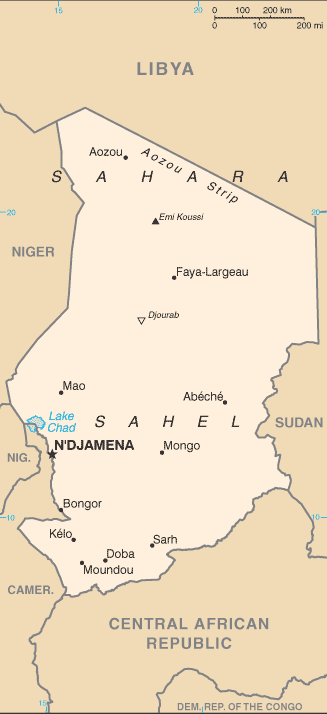
Area: 1,284,634 sq. km. (496,000 sq. mi.); about
twice the size of Texas.
Cities: Capital--N'Djamena
(pop. 1 million est.). Other
major cities--Moundou, Abeche, Sarh.
Terrain: Desert, mountainous north, large arid
central plain, fertile lowlands in extreme
southern regions.
Climate: Northern desert--very dry throughout
the year; central plain--hot and dry, with brief
rainy season mid-June to mid-September; southern
lowlands--warm and more humid with seasonal
rains from late May to early October.
People
Nationality: Noun
and adjective--Chadian(s).
Population (July 2008 est.): 10,111,337.
Annual growth rate (2008 est.): 2.195%.
Density: 6.6 per sq. km. (17 per sq. mi.).
Ethnic groups: 200 distinct groups. In the north
and center, Gorane (Toubou, Daza, Kreda),
Zaghawa, Kanembou, Ouaddai, Arabs, Baguirmi,
Hadjerai, Fulbe, Kotoko, Hausa, Boulala, and
Maba, most of whom are Muslim. In the south,
Sara (Ngambaye, Mbaye, Goulaye), Moudang,
Moussei, Massa, most of whom are Christian or
animist. About 1,000 French citizens live in
Chad.
Religions: Muslim 51%, Christian 35%, animist
7%, other indigenous beliefs 7%.
Languages: French and Arabic (official); Sara
(in the south), more than 120 indigenous Chadian
languages and dialects.
Education: Years
compulsory--6. Attendance--primary
school 68% (1998); secondary school 5.5% (1995);
higher education n/a. Literacy (age
15 and over can read and write French or Arabic,
2003 est.)--48%.
Health: Life
expectancy (2007
est.)--47.43 years. Infant
mortality rate (2008
est.)--100.36 deaths/1,000 live births.
Work force (2006 est.)--3.747 million. Agriculture--more
than 80%; largely subsistence agriculture.
Government
Type: Republic.
Independence: August 11, 1960 (from France).
Branches: Executive--president
(head of state), prime minister, Council of
Ministers. Legislative--National
Assembly (unicameral). Judicial--Supreme
Court; Court of Appeals; criminal courts;
magistrate courts president (head of state,
president of the council of ministers), council
of ministers.
Major political parties: About 60, of which
Patriotic Salvation Movement (MPS) is dominant.
Other major parties include the Federation
Action for the Republic (FAR); Party for Liberty
and Development (PLD); Rally for Development and
Progress (RNDP); Union for Democracy and the
Republic (UDR); National Union for Development
and Renewal (UNDR); Rally for Democracy and
Progress (RDP); Viva Rally for Development and
Progress, or Viva RNDP.
Suffrage: Universal over 18.
Administrative subdivisions: 18 regions.
Economy
GDP, current prices (2007 est.): $7.095 billion.
GDP per capita income (2007 est.): $1,500.
Population living below poverty line (2001
est.): 80%.
Natural resources: Petroleum, natron (sodium
carbonate), kaolin, gold, bauxite, tin,
tungsten, titanium, iron ore.
Agriculture (2007 est., 21.5% of GDP): Products--cotton,
gum arabic, livestock, fish, peanuts, millet,
sorghum, rice, sweet potatoes, cassava, dates,
manioc. Arable
land--30%.
Industry (2007 est., 47.8% of GDP): Types--meatpacking,
beer brewing, soap, cigarettes, construction
materials, natron mining, soft-drink bottling.
Services (2007 est.): 30.6% of GDP.
Trade: Exports--$4.201
billion (f.o.b., 2007 est.): oil, cotton,
livestock, gum arabic. Major
markets (1999)--Portugal,
Germany, Thailand, Costa Rica, South Africa,
France, Nigeria, Cameroon. Imports--$1,157.3
million (f.o.b., 2007 est.): petroleum products,
machinery and transportation equipment,
foodstuffs, industrial goods, textiles. Major
suppliers (2004)--U.S.,
France, Cameroon, Nigeria.
Central government budget (2006 est.): Revenues--$617.3
million. Expenditures--$877.6
million.
Defense (2002): $31 million.
National holiday: Independence Day, August 11.
Fiscal year: Calendar year.
U.S. aid received (FY 2007): Total USAID
and State humanitarian assistance to Chad--$19,970,000. Economic,
food relief--$238 million from all sources
(including $30 million committed by African
Development Bank).
GEOGRAPHY
Chad is a landlocked country in north
central Africa measuring 1,284,000 square
kilometers (496,000 sq. mi.), roughly three
times the size of California. Most of its
ethnically and linguistically diverse population
lives in the south, with densities ranging from
54 persons per square kilometers in the Logone
River basin to 0.1 persons in the northern B.E.T.
desert region, which is larger than France. The
capital city of N'Djaména, situated at the
confluence of the Chari and Logone Rivers, is
cosmopolitan in nature, with a current
population nearing one million people.
Chad has four bioclimatic zones. The
northernmost Saharan zone averages less than 200
mm (8") of rainfall annually. The sparse human
population is largely nomadic, with some
livestock, mostly small ruminants and camels.
The central Sahelian zone receives between 200
and 600 mm (24") rainfall and has vegetation
ranging from grass/shrub steppe to thorny, open
savanna. The southern zone, often referred to as
the Sudanian zone, receives between 600 and
1,000 mm (39"), with woodland savanna and
deciduous forests for vegetation. Rainfall in
the Guinea zone, located in Chad's southwestern
tip, ranges between 1,000 and 1,200 mm (47").
The country's topography is generally flat, with
the elevation gradually rising as one moves
north and east away from Lake Chad. The highest
point in Chad is Emi Koussi, a mountain that
rises 3,100 meters (10,200 ft.) in the northern
Tibesti Mountains. The Ennedi Plateau and the
Ouaddaï highlands in the east complete the image
of a gradually sloping basin, which descends
toward Lake Chad. There also are central
highlands in the Guera region rising to 1,500
meters (4,900 ft.).
Lake Chad is the second-largest lake in West
Africa and is one of the most important wetlands
on the continent. Home to 120 species of fish
and at least that many species of birds, the
lake has shrunk dramatically in the last four
decades due to the increased water use and low
rainfall. Bordered by Chad, Niger, Nigeria, and
Cameroon, Lake Chad currently covers only 1,350
square kilometers, down from 25,000 square
kilometers in 1963. The Chari and Logone Rivers,
both of which originate in the Central African
Republic and flow northward, provide most of the
water entering Lake Chad.
PEOPLE
There are more than 200 ethnic groups in Chad.
Those in the north and east are generally
Muslim; most southerners are Christians or
animists. Through their long religious and
commercial relationships with Sudan and Egypt,
many of the peoples in Chad's eastern and
central regions have become more or less
Arabized, speaking Arabic and engaging in many
other Arab cultural practices as well. More than
three-quarters of the Chadian population is
rural. Near the eastern border there are over
250,000 refugees from the Sudanese conflict in
Darfur and 56,000 Central African Republic
refugees in the south. Due to internal rebel
activity, there are also approximately 185,000
internally displaced persons in Chad.
HISTORY
Chad has a long and rich history. A humanoid
skull found in Borkou was dated to be more than
3 million years old. Because in ancient times
the Saharan area was not totally arid, Chad's
population was more evenly distributed than it
is today. For example, 7,000 years ago, the
north central basin, now in the Sahara, was
still filled with water, and people lived and
farmed around its shores. Cliff paintings in
Borkou and Ennedi depict elephants,
rhinoceroses, giraffes, cattle, and camels; only
camels survive there today. The region has been
known to traders and geographers since the late
Middle Ages. Since then, Chad has served as a
crossroads for the Muslim peoples of the desert
and savanna regions, and the animist Bantu
tribes of the tropical forests.
Sao people lived along the Chari River for
thousands of years, but their relatively weak
chiefdoms were overtaken by the powerful chiefs
of what were to become the Kanem-Bornu and
Baguirmi kingdoms. At their peak, these two
kingdoms and the kingdom of Ouaddai controlled a
good part of what is now Chad, as well as parts
of Nigeria and Sudan. From 1500 to 1900, Arab
slave raids were widespread. The French first
penetrated Chad in 1891, establishing their
authority through military expeditions primarily
against the Muslim kingdoms. The first major
colonial battle for Chad was fought in 1900
between the French Major Lamy and the African
leader Rabah, both of whom were killed in the
battle. Although the French won that battle,
they did not declare the territory pacified
until 1911; armed clashes between colonial
troops and local bands continued for many years
thereafter.
In 1905, administrative responsibility for Chad
was placed under a governor general stationed at
Brazzaville in what is now Congo. Although Chad
joined the French colonies of Gabon,
Oubangui-Charo, and Moyen Congo to form the
Federation of French Equatorial Africa (AEF) in
1910, it did not have colonial status until
1920. The northern region of Chad was occupied
by the French in 1914. In 1959, the territory of
French Equatorial Africa was dissolved, and four
states--Gabon, the Central African Republic,
Congo (Brazzaville), and Chad--became autonomous
members of the French Community. On August 11,
1960 Chad became an independent nation under its
first president, Francois Tombalbaye.
A long civil war began as a tax revolt in 1965
and soon set the Muslim north and east against
the southern-led government. Even with the help
of French combat forces, the Tombalbaye
government was never able to quell the
insurgency. Tombalbaye's rule became more
irrational and brutal, leading the military to
carry out a coup in 1975 and to install Gen.
Felix Malloum, a southerner, as head of state.
In 1978, Malloum's government was broadened to
include more northerners. Internal dissent
within the government led the northern prime
minister, Hissein Habre, to send his forces
against the national army in the capital city of
N'Djamena in February 1979. The resulting civil
war amongst the 11 emergent factions was so
widespread that it rendered the central
government largely irrelevant. At that point,
other African governments decided to intervene.
A series of four international conferences held
first under Nigerian and then Organization of
African Unity (OAU) sponsorship attempted to
bring the Chadian factions together. At the
fourth conference, held in Lagos, Nigeria, in
August 1979, the Lagos accord was signed. This
accord established a transitional government
pending national elections. In November 1979,
the National Union Transition Government (GUNT)
was created with a mandate to govern for 18
months. Goukouni Oueddei, a northerner, was
named President; Colonel Kamougue, a southerner,
Vice President; and Habre, Minister of Defense.
This coalition proved fragile; in January 1980,
fighting broke out again between Goukouni's and
Habre's forces. With assistance from Libya,
Goukouni regained control of the capital and
other urban centers by year's end. However,
Goukouni's January 1981 statement that Chad and
Libya had agreed to work for the realization of
complete unity between the two countries
generated intense international pressure and
Goukouni's subsequent call for the complete
withdrawal of external forces. Libya's partial
withdrawal to the Aozou Strip in northern Chad
cleared the way for Habre's forces to enter
N'Djamena in June. French troops and an OAU
peacekeeping force of 3,500 Nigerian,
Senegalese, and Zairian troops (partially funded
by the United States) remained neutral during
the conflict.
Habre continued to face armed opposition on
various fronts, and was brutal in his repression
of suspected opponents, massacring and torturing
many during his rule. In the summer of 1983,
GUNT forces launched an offensive against
government positions in northern and eastern
Chad with Libyan support. In response to Libya's
direct intervention, French and Zairian forces
intervened to defend Habre, pushing Libyan and
rebel forces north of the 16th parallel. In
September 1984, the French and the Libyan
governments announced an agreement for the
mutual withdrawal of their forces from Chad. By
the end of the year, all French and Zairian
troops were withdrawn. Libya did not honor the
withdrawal accord, and its forces continued to
occupy the northern third of Chad.
Southern rebel commando groups (CODO) in
southern Chad were broken up by government
massacres in 1984. In 1985 Habre briefly
reconciled with some of his most powerful
opponents, including the Chadian Democratic
Front and the Coordinating Action Committee of
the Democratic Revolutionary Council. Goukouni
also began to rally toward Habre, and with his
support Habre successfully expelled Libyan
forces from most of Chadian territory. A
cease-fire between Chad and Libya held from 1987
to 1988, and negotiations over the next several
years led to the 1994 International Court of
Justice decision granting Chad sovereignty over
the Aouzou strip, effectively ending Libyan
occupation.
However, rivalry between Hadjerai, Zaghawa, and
Gorane groups within the government grew in the
late 1980s. In April 1989, Idriss Deby, one of
Habre's leading generals and a Zaghawa, defected
and fled to Darfur in Sudan, from which he
mounted a Zaghawa-supported series of attacks on
Habre (a Gorane). In December 1990, with Libyan
assistance and no opposition from French troops
stationed in Chad, Deby's forces successfully
marched on N'Djamena. After 3 months of
provisional government, Deby's Patriotic
Salvation Movement (MPS) approved a national
charter on February 28, 1991, with Deby as
president.
In the following 2 years, Deby faced at least
two coup attempts. Government forces clashed
violently with rebel forces (including the
Movement for Democracy and Development, MDD,
National Revival Committee for Peace and
Democracy (CSNPD), Chadian national Front (FNT),
and the Western Armed Forces, FAO) near Lake
Chad and in southern regions of the country.
Earlier French demands for the country to hold a
national conference resulted in the gathering of
750 delegates representing political parties
(legalized in 1992), the government, trade
unions, and the army to discuss creation of a
pluralist democratic regime.
Unrest continued, however, sparked in part by
large-scale killings of civilians in southern
Chad. The CSNPD, led by Kette Moise and other
southern groups, entered into a peace agreement
with government forces in 1994, which later
broke down. Two new groups, the Armed Forces for
a Federal Republic (FARF) led by former Kette
ally Laokein Barde and the Democratic Front for
Renewal (FDR), and a reformulated MDD clashed
with government forces 1994-95.
Talks with political opponents in early 1996 did
not go well, but Deby announced his intent to
hold presidential elections in June. Deby won
the country's first multi-party presidential
elections with support in the second round from
opposition leader Kebzabo, defeating General
Kamougue (leader of the 1975 coup against
Tombalbaye). Deby's MPS party won 63 of 125
seats in the January 1997 legislative elections.
International observers noted numerous serious
irregularities in presidential and legislative
election proceedings.
By mid-1997 the government signed peace deals
with FARF and the MDD leadership and succeeded
in cutting off the groups from their rear bases
in the Central African Republic and Cameroon.
Agreements also were struck with rebels from the
National Front of Chad (FNT) and Movement for
Social Justice and Democracy in October 1997.
However, peace was short-lived, as FARF rebels
clashed with government soldiers, finally
surrendering to government forces in May 1998.
Barde was killed in the fighting, as were
hundreds of other southerners, most civilians.
From 1998 to 2003, Chadian Movement for Justice
and Democracy (MDJT) rebels skirmished
periodically with government troops in the
Tibesti region, resulting in hundreds of
civilian, government, and rebel casualties, but
little ground won or lost. Following an accord
with the government in 2003, several hundred
rebels rejoined the Chadian Army. Armed remnants
of the MDJT linger in the Tibesti region, but no
active armed opposition has emerged in other
parts of Chad.
In May 2001, Deby won a flawed 63% first-round
victory in presidential elections after
legislative elections were postponed until
spring 2002. Six opposition leaders were
arrested (twice), and one opposition party
activist was killed following the announcement
of election results. However, despite claims of
government corruption, favoritism of Zaghawas,
and security forces abuses, opposition party and
labor union calls for general strikes and more
active demonstrations against the government
were unsuccessful.
In May 2004, the National Assembly voted in
favor of an amendment to the Constitution that
would allow President Deby to run again. The
amendment was approved in a national referendum
June 2005 and abolished presidential term
limits. In the last 3 years, Deby faced at least
three coup attempts. In April 2006, the capital
city of N'djamena was attacked by the United
Front for Democratic Change--which was led by
the Tama ethnic group--coordinating with another
Chadian rebel organization from President Deby's
Zaghawa ethnic group. The government put down
the attacks. On May 3, 2006 Deby was elected to
his third presidential term with a substantial
majority, according to Chadian election
officials. Provisional figures showed Deby
receiving 77.6% of the vote. More than 60% of
Chad's 5.8 million registered voters cast
ballots. Frequent bouts of fighting between
rebel groups characterized 2006. On October 26,
2007 a peace agreement was signed by four
Chadian rebel groups and the Government of Chad.
Hosted by Libyan leader Muammar Gaddafi, the
talks took place in the Libyan city of Sirte.
(See Foreign
Relations for
information about the 2008 rebel attacks.)
GOVERNMENT AND POLITICAL CONDITIONS
The constitutional basis for the government
is the 1996 Constitution. A strong executive
branch headed by the president dominates the
Chadian political system. Following his December
1990 military overthrow of Hissein Habre, Idriss
Deby in the mid-1990s gradually restored basic
functions of government and entered into
agreements with the World Bank and the
International Monetary Fund (IMF) intended to
carry out substantial economic reforms,
including the Doba Basin oil extraction project.
The president has the power to appoint the prime
minister and the Council of State (or cabinet),
and exercises considerable influence over
appointments of judges, generals, provincial
officials and heads of Chad's parastatal firms.
In cases of grave and immediate threat, the
president, in consultation with the National
Assembly President and Council of State, may
declare a state of emergency. Most of the Deby's
key advisers are members of the Zaghawa clan,
although some southern and opposition
personalities are represented in his government.
According to the 1996 Constitution, National
Assembly deputies are elected by universal
suffrage for 4-year terms. Parliamentary
elections were last held in April 2002, with
President Deby's MPS party winning a large
majority. The Assembly holds regular sessions
twice a year, starting in March and October, and
can hold special sessions as necessary and
called by the prime minister. Deputies elect a
president of the National Assembly every 2
years. Assembly deputies or members of the
executive branch may introduce legislation; once
passed by the Assembly, the president must take
action to either sign or reject the law within
15 days. The National Assembly must approve the
prime minister's plan of government and may
force the prime minister to resign through a
majority vote of no confidence. However, if the
National Assembly rejects the executive branch's
program twice in one year, the president may
disband the Assembly and call for new
legislative elections. In practice, the
president exercises considerable influence over
the National Assembly through the MPS party
structure.
Despite the Constitution's guarantee of judicial
independence from the executive branch, the
president names most key judicial officials. The
Supreme Court is made up of a chief justice,
named by the president, and 15 councilors chosen
by the president and National Assembly;
appointments are for life. The Constitutional
Council, with nine judges elected to 9-year
terms, has the power to review all legislation,
treaties and international agreements prior to
their adoption. The Constitution recognizes
customary and traditional law in locales where
it is recognized and to the extent it does not
interfere with public order or constitutional
guarantees of equality for all citizens.
Principal Government Officials
President--Idriss Deby
Prime Minister--Youssouf Saleh Abbas
Minister of Foreign Affairs and African
Integration--Moussa Faki
Minister of Finance and Budget--Gata Ngoulou
Minister of Mines and Energy--Yaya Dillo
President of the National Assembly--Nassour
Guelengdouksia Ouaidou
Ambassador to U.S.--Mahamat Adam Bechir
The Republic of Chad maintains an embassy in the
United States at 2002 R Street, NW, Washington,
DC 20009 (tel: 202-462-4009; fax 202-265-1937).
DEFENSE
Under President Hissein Habre, members of
Gourane, Zaghawa, Kanembou, Hadjerai, and Massa
ethnic groups dominated the military. Idriss
Deby, a member of the minority Zaghawa-related
Bidyate clan and a top military commander,
revolted and fled to Sudan, taking with him many
Zaghawa and Hadjerai soldiers in 1989. The
forces that Deby led into N'Djamena on December
1, 1990 to oust President Habre were mainly
Zaghawa (including a large number of Sudanese),
many of whom were recruited while Deby was in
the bush. Deby's coalition also included a small
number of Hadjerais and southerners.
Chad's armed forces numbered about 36,000 at the
end of the Habre regime but swelled to an
estimated 50,000 in the early days of Idriss
Deby. With French support, a reorganization of
the armed forces was initiated early in 1991
with the goal of reducing the size of the armed
forces. An essential element of this effort was
to make the ethnic composition of the armed
forces reflective of the country as a whole.
While the military's size has been reduced to
approximately 25,000 soldiers, leadership
positions are still dominated by the Zaghawa.
Following Idriss Deby's rise to power, Habre
loyalists continued to fight government troops
and rob civilians around Lake Chad. In the mid-
and late-1990s, a rebellion in the south by the
FARF delayed the promised oil development until
crushed by government forces. Most recently, the
Movement for Democracy and Justice in Tchad
(MDJT) launched the most serious threat to
Deby's hold on power, but little progress was
ever made on either side. In January 2002, the
government and the MDJT signed a formal peace
accord. Although remnants are still present in
the North, active rebellion there has been
negligible since late 2003.
Long, porous borders continue to render Chad
vulnerable to incursions. In March 2004, the
Algerian terrorist organization, the Salafist
Group for Preaching and Combat (GSPC), strayed
into Chadian territory, where they were engaged
by Chadian armed forces. Since the 2003 outbreak
of the Darfur crisis in Sudan, armed militias
have occasionally crossed into Chad, resulting
in small-scale skirmishes. In response to such
ongoing threats Chad has joined in the Pan Sahel
Initiative (PSI), a U.S. Government
military-to-military assistance program which
helps participant countries counter terrorist
operations, border incursions, and trafficking
of people, illicit materials, and other goods.
Initial PSI training was completed in Chad in
July 2004.
ECONOMY
In 2007, Chad's GDP was estimated at
approximately $7.095 billion. Oil, cotton,
cattle, and gum arabic are Chad's major exports.
The effects on foreign investment of years of
civil war are still felt today, as investors who
left Chad between 1979-82 have only recently
begun to regain confidence in the country's
future. The most important economic venture to
date is the Doba Basin oil extraction project in
southern Chad. The project included unique
mechanisms for World Bank, private sector,
government, and civil society collaboration to
guarantee that future oil revenues would benefit
local populations and result in poverty
alleviation.
Oil exploitation in the southern Doba region
began in June 2000, with U.S.-based Exxon Mobil
leading a consortium, with assisted funding from
the World Bank, in a $3.7 billion project to
export oil via a 1,000-km. buried pipeline
through Cameroon to the Gulf of Guinea.
Beginning in late 2000, development of Chad's
petroleum sector stimulated economic growth by
attracting major investment and increased levels
of U.S. trade. Oil revenue began trickling into
the country in July 2004. It was hoped that this
project would serve as a catalyst for the entire
economy by helping to reduce energy costs and
attracting additional trade and investment in
other sectors. Following the government's
decision to amend the oil revenue management law
in 2006, the World Bank froze the escrow account
that received the country's revenues. Later that
year, a memorandum of understanding was signed
between the World Bank and the Government of
Chad that agreed on a new percentage of oil
revenue to be used toward poverty reduction.
Unfortunately, due to rebel attacks on
N'djamena, Deby issued a "state of emergency"
placing oil revenue funds into his direct
command. The question remains whether Chad will
continue to invest its oil revenues wisely or
use the funds for other uses. This pipeline
project was officially suspended in September
2008 following World Bank accusations that oil
profits were not going toward poverty reduction
efforts, as outlined in the initial agreement.
Political controversy surrounding elections and
a rebellion in northern Chad also dampen Chad's
economic prospects somewhat by exposing the
weaknesses in Chad's political institutions.
The U.S. Government expressed both concern and
disappointment after the Government of Chad on
August 26, 2006 ordered Chevron Oil Corporation
and Petronas, members of the Exxon Mobil-led and
operated oil consortium, to cease operations and
leave Chad within 24 hours for alleged
non-payment of income taxes.
Chevron and Petronas entered into a tax
agreement in 2000 with the government,
represented by Petroleum Minister Mahamat Hassan
Nasser, when they replaced Elf and Shell as
minority members of the consortium. The
companies assert that the agreement authorizes
them to use a special depreciation schedule
allowing greater tax deductions than those
afforded consortium partner Exxon Mobil. The
Government of Chad, however, claimed that the
2000 tax agreement was illegal, because it was
negotiated by officials without proper authority
and was not vetted by the National Assembly. The
Government of Chad also announced plans to press
charges against negotiating officials, and on
August 28, 2006 replaced Nasser, as well as
Economic Minister Mahamat Ali Hassan and Farming
Minister Moucktar Moussa. Chevron and Petronas
consider the Government of Chad to have violated
its contractual obligations and planned to seek
recourse through all diplomatic and legal means.
While the U.S. takes no position on the merits
of the dispute, it has urged all parties
involved to respect any binding contractual
commitments.
Despite recent development of the petroleum
sector, more than 80% of the work force is
involved in agriculture (subsistence farming,
herding, and fishing). Like many other
developing countries, Chad has a small formal
sector and a large, thriving informal sector.
Statistics indicate the following distribution
as percentage of GDP: Agriculture--21.5%
(farming, livestock, fishing); industry--47.8%;
and services--30.6%. Chad is highly dependent on
foreign assistance. Its principal donors include
the European Union, France, and the multilateral
lending agencies.
Primary markets for Chadian exports include
neighboring Cameroon and Nigeria and France,
Germany, and Portugal. Aside from oil, cotton
remains a primary export, although exact figures
are not available. Rehabilitation of CotonTchad,
the major cotton company that suffered from a
decline in world cotton prices, has been
financed by France, the Netherlands, the
European Economic Community (EC), and the
International Bank for Reconstruction and
Development (IBRD). The parastatal is now being
privatized.
The other major export is livestock, herded to
neighboring countries. Herdsmen in the Sudanic
and Sahelian zones raise cattle, sheep, goats,
and, among the non-Muslims, a few pigs. In the
Saharan region, only camels and a few hardy
goats can survive. Chad also sells smoked and
dried fish to its neighbors and exports several
million dollars worth of gum arabic to Europe
and the United States each year. Other food
crops include millet, sorghum, peanuts, rice,
sweet potatoes, manioc, cassava, and yams.
After averaging 0.8% in 1999-2000, Chad's real
GDP growth was estimated at 8.9% in 2001, and
10% in 2002 and 2003 as the Doba oil project
accelerated. Inflation rose from 3.7% in 2000 to
12.4% in 2001, dropped to 5.2% in 2002, and was
estimated to level out at 3% in 2004. These
fluctuations were due in large part to
increasing demand from the Doba project but also
to fluctuations in agricultural production.
After a disappointing agricultural campaign in
2000, increased production during the 2001-02
timeframe helped reduce inflation in 2002. In
2003, the contraction in investments, the 7%
appreciation in the CFA Franc exchange rate, and
bumper harvests combined to generate a 1%
deflation in place of the projected 4.3%
inflation. Chad's economic performance, at least
until the onset of oil exports, continued to
depend on fluctuations in rainfall and in prices
of its principal export commodities, especially
cotton.
Since 1995, the Government of Chad has made
incremental progress in implementing structural
reforms and improving government finances under
two successive structural adjustment programs.
Most state enterprises have been partially or
completely privatized, non-priority public
spending has been lessened, and the government
has gradually liberalized some key sectors of
the economy. Liberalization of the
telecommunications, cotton, and energy sectors
is expected to proceed over the next several
years. Chad reached the enhanced Heavily
Indebted Poor Countries (HIPC) initiative
completion point in May 2001.
FOREIGN RELATIONS
Chad is officially nonaligned but has close
relations with France, the former colonial
power, and other members of the Western
community. It receives economic aid from
countries of the European Union, the United
States, and various international organizations.
Libya supplies aid and has an ambassador
resident in N'Djamena.
Other resident diplomatic missions in N'Djamena
include the embassies of Algeria, Cameroon,
Central African Republic, China, Democratic
Republic of the Congo, Egypt, France, Germany,
Nigeria, Russia, Sovereign Military Order of
Malta, South Africa, Sudan, Taiwan, the United
States, and the European Economic Community. A
number of other countries have nonresident
ambassadors. In 1988, Chad recognized the State
of Palestine, which maintains a mission in
N'Djamena. Chad has not recognized the State of
Israel.
Although relations with Libya improved with the
advent of the Deby government, strains persist.
Chad has been an active champion of regional
cooperation through the Central African Economic
and Customs Union, the Lake Chad and Niger River
Basin Commissions, and the Interstate Commission
for the Fight Against the Drought in the Sahel.
On February 8, 2006 the Tripoli Agreement, an
attempt to end border related disputes between
Chad and Sudan, was signed by Deby and Sudanese
leader Al-Bashir at a summit hosted by Libyan
leader Gaddafi. Following several violent
confrontations between Chadian Government troops
and rebels in the east, Deby broke off
diplomatic ties with Al-Bashir, who he accused
of backing Chadian rebels. Due to the gravity of
the humanitarian crisis caused by these violent
conflicts, the UN authorized the deployment of
an EU peacekeeping force of 3,700 on September
25, 2007. On February 2, 2008 rebels infiltrated
N'Djamena, surrounding the Presidential Palace,
forcing the evacuation of U.S. Embassy
personnel, and stalling the arrival of the
peacekeeping presence. A cease-fire agreement
was tentatively reached on February 5, 2008. On
March 12, both sides met in Dakar, Senegal and
signed a peace accord agreeing that they would
stop backing rebels hostile to each other.
Following that agreement, Sudan accused Chad of
continuing to back Sudanese rebels and then
severed ties with Chad. While relations between
the neighboring nations continued to
deteriorate, Chad experienced further rebel
attacks within its borders in June 2008. On July
18, President Al-Bashir expressed his desire to
restore diplomatic ties with Chad. In early
August, the Libyan Government helped to broker
an agreement between the Governments of Chad and
Sudan. In October 2008, representatives from
Chad and Sudan met in Tripoli to formally
restore diplomatic ties between their nations,
and an exchange of ambassadors occurred in
mid-November.
Chad belongs to the following international
organizations: UN and some of its specialized
and related agencies; African Union; Central
African Customs and Economic Union (UDEAC);
African Financial Community (Franc Zone); Agency
for the Francophone Community; African,
Caribbean and Pacific Group of States; African
Development Bank; Central African States
Development Bank; Economic and Monetary Union of
Central African (CEMAC); Economic Community of
Central African States (CEEAC); Economic
Commission for Africa; G-77; International Civil
Aviation Organization; International
Confederation of Free Trade Unions;
International Red Cross and Red Crescent
Movement; International Development Association;
Islamic Development Bank; International Fund for
Agricultural Development; International Finance
Corporation; International Federation of the Red
Cross and Red Crescent Societies; International
Labor Organization; International Monetary Fund;
Interpol; International Olympic Committee;
International Telecommunication Union; NAM;
Organization of the Islamic Conference;
Organization for the Prohibition of Chemical
Weapons; Universal Postal Union; World
Confederation of Labor; World Intellectual
Property Organization; World Meteorological
Organization; World Tourism Organization; World
Trade Organization.
U.S.-CHAD RELATIONS
Relations between the United States and Chad are
good. The American embassy in N'Djamena,
established at Chadian independence in 1960, was
closed from the onset of the heavy fighting in
the city in 1980 until the withdrawal of the
Libyan forces at the end of 1981. It was
reopened in January 1982. The U.S. Agency for
International Development (USAID) and the U.S.
Information Service (USIS) offices resumed
activities in Chad in September 1983.
The United States enjoys cordial relations with
the Deby government. Chad has proved a valuable
partner in the global war on terror, and in
providing shelter to approximately 250,000
refugees of Sudan's Darfur crisis along its
eastern border.
Before permanently closing its Chad mission in
1995 because of declining funds and security
concerns, USAID's development program in Chad
concentrated on the agricultural, health, and
infrastructure sectors. It also included
projects in road repair and maintenance,
maternal and child health, famine early warning
systems, and agricultural marketing. A number of
American voluntary agencies (notably AFRICARE
and VITA) continue to operate in Chad. Peace
Corps has traditionally had a large presence in
Chad, with volunteers arriving during the
postwar period in September 1987, then
withdrawing in 1998. Peace Corps operations
resumed in September 2003, with a group of 20
new volunteers. The second class of 17
volunteers arrived in September 2004. Both
groups focused on teaching English; expansion
into other areas was planned for 2005. Currently
the Peace Corps presence in Chad is inactive.
Principal U.S. Officials
Ambassador--Louis
Nigro
Deputy Chief of Mission--Lucy Tamlyn
Political/Economic Officer--Rebecca Daley
Consular/ Officer--Franklin Garcia
Management Officer--Brad Palmer
Public Affairs Officer--Solomon Atayi
Regional Security Officer--David Richeson
Defense Attache--Lt. Col. Nicholas Lovelace
The U.S.
Embassy in
Chad is located on Avenue Felix Eboue,
N'Djamena, (tel: 235-51-70-09, 235-51-90-52, or
235-51-92-33; fax 235-51-56-54).
 Information
on Countries from Around the World
Information
on Countries from Around the World