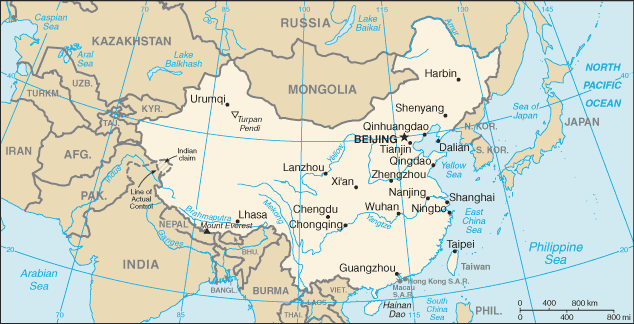
Geography
Total area: 9,596,960 sq. km. (about 3.7 million
sq. mi.).
Cities: Capital--Beijing. Other
major cities--Shanghai, Tianjin, Shenyang,
Wuhan, Guangzhou, Chongqing, Harbin, Chengdu.
Terrain: Plains, deltas, and hills in east;
mountains, high plateaus, deserts in west.
Climate: Tropical in south to subarctic in
north.
People
Nationality: Noun
and adjective--Chinese (singular and
plural).
Population (July 2007 est.): 1,321,851,888.
Population growth rate (2007 est.): 0.606%.
Health (2007 est.): Infant
mortality rate--22.12/1,000. Life
expectancy--72.88 years (overall); 71.13
years for males, 74.82 years for females.
Ethnic groups: Han Chinese--91.9%; Zhuang,
Manchu, Hui, Miao, Uygur, Yi, Mongolian,
Tibetan, Buyi, Korean, and other--8.1%.
Religions: Officially atheist; Taoism, Buddhism,
Christianity, Islam.
Language: Mandarin (Putonghua), plus many local
dialects.
Education: Years
compulsory--9. Literacy--90.9%.
Work force (2006 est., 798 million): Agriculture
and forestry--45%; industry--24%; services--31%.
Government
Type: Communist party-led state.
Constitution: December 4, 1982.
Independence: Unification under the Qin (Ch'in)
Dynasty 221 BC; Qing (Ch'ing or Manchu) Dynasty
replaced by a republic on February 12, 1912;
People's Republic established October 1, 1949.
Branches: Executive--president,
vice president, State Council, premier. Legislative--unicameral
National People's Congress. Judicial--Supreme
People's Court.
Administrative divisions: 23 provinces (the
P.R.C. considers Taiwan to be its 23rd
province); 5 autonomous regions, including
Tibet; 4 municipalities directly under the State
Council.
Political parties: Chinese Communist Party, 70.8
million members; 8 minor parties under Communist
Party supervision.
Suffrage: Universal at 18.
Economy
GDP (2007): $3.249 trillion (exchange
rate-based).
Per capita GDP (2007): $2,458 (exchange
rate-based).
GDP real growth rate (2007): 11.4%.
Natural resources: Coal, iron ore, crude oil,
mercury, tin, tungsten, antimony, manganese,
molybdenum, vanadium, magnetite, aluminum, lead,
zinc, uranium, hydropower potential (world's
largest).
Agriculture: Products--Among
the world's largest producers of rice, wheat,
potatoes, corn, peanuts, tea, millet, barley;
commercial crops include cotton, other fibers,
apples, oilseeds, pork and fish; produces
variety of livestock products.
Industry: Types--mining
and ore processing; iron; steel; aluminum; coal,
machinery; textiles and apparel; armaments;
petroleum; cement; chemicals; fertilizers;
consumer products including footwear, toys, and
electronics; automobiles and other
transportation equipment including rail cars and
locomotives, ships, and aircraft; and
telecommunications.
Trade (2007): Exports--$1.221
trillion: electronics; machinery; apparel;
optical, photographic, and medical equipment;
and furniture. Main
partners--United States, Hong Kong, Japan,
EU, South Korea, Singapore. Imports--$917.4
billion: electronics, machinery, mineral fuel
and oil, chemicals, plastic. Main
partners--Japan, EU, Taiwan, South Korea,
United States, Malaysia, Australia.
PEOPLE
Ethnic Groups
The largest ethnic group is the Han Chinese, who
constitute about 91.9% of the total population.
The remaining 8.1% are Zhuang (16 million),
Manchu (10 million), Hui (9 million), Miao (8
million), Uygur (7 million), Yi (7 million),
Mongolian (5 million), Tibetan (5 million), Buyi
(3 million), Korean (2 million), and other
ethnic minorities.
Language
There are seven major Chinese dialects and many
subdialects. Mandarin (or Putonghua), the
predominant dialect, is spoken by over 70% of
the population. It is taught in all schools and
is the medium of government. About two-thirds of
the Han ethnic group are native speakers of
Mandarin; the rest, concentrated in southwest
and southeast China, speak one of the six other
major Chinese dialects. Non-Chinese languages
spoken widely by ethnic minorities include
Mongolian, Tibetan, Uygur and other Turkic
languages (in Xinjiang), and Korean (in the
northeast).
The Pinyin System of Romanization
On January 1, 1979, the Chinese Government
officially adopted the pinyin system for
spelling Chinese names and places in Roman
letters. A system of Romanization invented by
the Chinese, pinyin has long been widely used in
China on street and commercial signs as well as
in elementary Chinese textbooks as an aid in
learning Chinese characters. Variations of
pinyin also are used as the written forms of
several minority languages.
Pinyin has now replaced other conventional
spellings in China's English-language
publications. The U.S. Government also has
adopted the pinyin system for all names and
places in China. For example, the capital of
China is now spelled "Beijing" rather than
"Peking."
Religion
Religion plays a significant part in the life of
many Chinese. Buddhism is most widely practiced,
with an estimated 100 million adherents.
Traditional Taoism also is practiced. Official
figures indicate there are 20 million Muslims,
15 million Protestants, and 5 million Catholics;
unofficial estimates are much higher.
While the Chinese constitution affirms religious
toleration, the Chinese Government places
restrictions on religious practice outside
officially recognized organizations. Only two
Christian organizations--a Catholic church
without official ties to Rome and the
"Three-Self-Patriotic" Protestant church--are
sanctioned by the Chinese Government.
Unauthorized churches have sprung up in many
parts of the country and unofficial religious
practice is flourishing. In some regions
authorities have tried to control activities of
these unregistered churches. In other regions,
registered and unregistered groups are treated
similarly by authorities and congregations
worship in both types of churches. Most Chinese
Catholic bishops are recognized by the Pope, and
official priests have Vatican approval to
administer all the sacraments.
Population Policy
With a population officially just over 1.3
billion and an estimated growth rate of about
0.6%, China is very concerned about its
population growth and has attempted with mixed
results to implement a strict birth limitation
policy. China's 2002 Population and Family
Planning Law and policy permit one child per
family, with allowance for a second child under
certain circumstances, especially in rural
areas, and with guidelines looser for ethnic
minorities with small populations. Enforcement
varies, and relies largely on "social
compensation fees" to discourage extra births.
Official government policy opposes forced
abortion or sterilization, but in some
localities there are instances of forced
abortion. The government's goal is to stabilize
the population in the first half of the 21st
century, and current projections are that the
population will peak at around 1.6 billion by
2050.
HISTORY
Dynastic Period
China is the oldest continuous major world
civilization, with records dating back about
3,500 years. Successive dynasties developed a
system of bureaucratic control that gave the
agrarian-based Chinese an advantage over
neighboring nomadic and hill cultures. Chinese
civilization was further strengthened by the
development of a Confucian state ideology and a
common written language that bridged the gaps
among the country's many local languages and
dialects. Whenever China was conquered by
nomadic tribes, as it was by the Mongols in the
13th century, the conquerors sooner or later
adopted the ways of the "higher" Chinese
civilization and staffed the bureaucracy with
Chinese.
The last dynasty was established in 1644, when
the Manchus overthrew the native Ming dynasty
and established the Qing (Ch'ing) dynasty with
Beijing as its capital. At great expense in
blood and treasure, the Manchus over the next
half century gained control of many border
areas, including Xinjiang, Yunnan, Tibet,
Mongolia, and Taiwan. The success of the early
Qing period was based on the combination of
Manchu martial prowess and traditional Chinese
bureaucratic skills.
During the 19th century, Qing control weakened,
and prosperity diminished. China suffered
massive social strife, economic stagnation,
explosive population growth, and Western
penetration and influence. The Taiping and Nian
rebellions, along with a Russian-supported
Muslim separatist movement in Xinjiang, drained
Chinese resources and almost toppled the
dynasty. Britain's desire to continue its
illegal opium trade with China collided with
imperial edicts prohibiting the addictive drug,
and the First Opium War erupted in 1840. China
lost the war; subsequently, Britain and other
Western powers, including the United States,
forcibly occupied "concessions" and gained
special commercial privileges. Hong Kong was
ceded to Britain in 1842 under the Treaty of
Nanking, and in 1898, when the Opium Wars
finally ended, Britain executed a 99-year lease
of the New Territories, significantly expanding
the size of the Hong Kong colony.
As time went on, the Western powers, wielding
superior military technology, gained more
economic and political privileges. Reformist
Chinese officials argued for the adoption of
Western technology to strengthen the dynasty and
counter Western advances, but the Qing court
played down both the Western threat and the
benefits of Western technology.
Early 20th Century China
Frustrated by the Qing court's resistance to
reform, young officials, military officers, and
students--inspired by the revolutionary ideas of
Sun Yat-sen--began to advocate the overthrow of
the Qing dynasty and creation of a republic. A
revolutionary military uprising on October 10,
1911, led to the abdication of the last Qing
monarch. As part of a compromise to overthrow
the dynasty without a civil war, the
revolutionaries and reformers allowed high Qing
officials to retain prominent positions in the
new republic. One of these figures, Gen. Yuan
Shikai, was chosen as the republic's first
president. Before his death in 1916, Yuan
unsuccessfully attempted to name himself
emperor. His death left the republican
government all but shattered, ushering in the
era of the "warlords" during which China was
ruled and ravaged by shifting coalitions of
competing provincial military leaders.
In the 1920s, Sun Yat-sen established a
revolutionary base in south China and set out to
unite the fragmented nation. With Soviet
assistance, he organized the Kuomintang (KMT or
"Chinese Nationalist People's Party"), and
entered into an alliance with the fledgling
Chinese Communist Party (CCP). After Sun's death
in 1925, one of his proteges, Chiang Kai-shek,
seized control of the KMT and succeeded in
bringing most of south and central China under
its rule. In 1927, Chiang turned on the CCP and
executed many of its leaders. The remnants fled
into the mountains of eastern China. In 1934,
driven out of their mountain bases, the CCP's
forces embarked on a "Long March" across some of
China's most desolate terrain to the
northwestern province of Shaanxi, where they
established a guerrilla base at Yan'an.
During the "Long March," the communists
reorganized under a new leader, Mao Zedong (Mao
Tse-tung). The bitter struggle between the KMT
and the CCP continued openly or clandestinely
through the 14-year long Japanese invasion
(1931-45), even though the two parties nominally
formed a united front to oppose the Japanese
invaders in 1937. The war between the two
parties resumed after the Japanese defeat in
1945. By 1949, the CCP occupied most of the
country.
Chiang Kai-shek fled with the remnants of his
KMT government and military forces to Taiwan,
where he proclaimed Taipei to be China's
"provisional capital" and vowed to re-conquer
the Chinese mainland. Taiwan still calls itself
the "Republic of China."
The People's Republic of China
In Beijing, on October 1, 1949, Mao Zedong
proclaimed the founding of the People's Republic
of China (P.R.C.). The new government assumed
control of a people exhausted by two generations
of war and social conflict, and an economy
ravaged by high inflation and disrupted
transportation links. A new political and
economic order modeled on the Soviet example was
quickly installed.
In the early 1950s, China undertook a massive
economic and social reconstruction program. The
new leaders gained popular support by curbing
inflation, restoring the economy, and rebuilding
many war-damaged industrial plants. The CCP's
authority reached into almost every aspect of
Chinese life. Party control was assured by
large, politically loyal security and military
forces; a government apparatus responsive to
party direction; and the placement of party
members into leadership positions in labor,
women's, and other mass organizations.
The "Great Leap Forward" and the Sino-Soviet
Split
In 1958, Mao broke with the Soviet model and
announced a new economic program, the "Great
Leap Forward," aimed at rapidly raising
industrial and agricultural production. Giant
cooperatives (communes) were formed, and
"backyard factories" dotted the Chinese
landscape. The results were disastrous. Normal
market mechanisms were disrupted, agricultural
production fell behind, and China's people
exhausted themselves producing what turned out
to be shoddy, un-salable goods. Within a year,
starvation appeared even in fertile agricultural
areas. From 1960 to 1961, the combination of
poor planning during the Great Leap Forward and
bad weather resulted in one of the deadliest
famines in human history.
The already strained Sino-Soviet relationship
deteriorated sharply in 1959, when the Soviets
started to restrict the flow of scientific and
technological information to China. The dispute
escalated, and the Soviets withdrew all of their
personnel from China in August 1960. In 1960,
the Soviets and the Chinese began to have
disputes openly in international forums.
The Cultural Revolution
In the early 1960s, State President Liu Shaoqi
and his protege, Party General Secretary Deng
Xiaoping, took over direction of the party and
adopted pragmatic economic policies at odds with
Mao's revolutionary vision. Dissatisfied with
China's new direction and his own reduced
authority, Party Chairman Mao launched a massive
political attack on Liu, Deng, and other
pragmatists in the spring of 1966. The new
movement, the "Great Proletarian Cultural
Revolution," was unprecedented in communist
history. For the first time, a section of the
Chinese communist leadership sought to rally
popular opposition against another leadership
group. China was set on a course of political
and social anarchy that lasted the better part
of a decade.
In the early stages of the Cultural Revolution,
Mao and his "closest comrade in arms," National
Defense Minister Lin Biao, charged Liu, Deng,
and other top party leaders with dragging China
back toward capitalism. Radical youth
organizations, called Red Guards, attacked party
and state organizations at all levels, seeking
out leaders who would not bend to the radical
wind. In reaction to this turmoil, some local
People's Liberation Army (PLA) commanders and
other officials maneuvered to outwardly back Mao
and the radicals while actually taking steps to
rein in local radical activity.
Gradually, Red Guard and other radical activity
subsided, and the Chinese political situation
stabilized along complex factional lines. The
leadership conflict came to a head in September
1971, when Party Vice Chairman and Defense
Minister Lin Biao reportedly tried to stage a
coup against Mao; Lin Biao allegedly later died
in a plane crash in Mongolia.
In the aftermath of the Lin Biao incident, many
officials criticized and dismissed during
1966-69 were reinstated. Chief among these was
Deng Xiaoping, who reemerged in 1973 and was
confirmed in 1975 in the concurrent posts of
Politburo Standing Committee member, PLA Chief
of Staff, and Vice Premier.
The ideological struggle between more pragmatic,
veteran party officials and the radicals
re-emerged with a vengeance in late 1975. Mao's
wife, Jiang Qing, and three close Cultural
Revolution associates (later dubbed the "Gang of
Four") launched a media campaign against Deng.
In January 1976, Premier Zhou Enlai, a popular
political figure, died of cancer. On April 5,
Beijing citizens staged a spontaneous
demonstration in Tiananmen Square in Zhou's
memory, with strong political overtones of
support for Deng. The authorities forcibly
suppressed the demonstration. Deng was blamed
for the disorder and stripped of all official
positions, although he retained his party
membership.
The Post-Mao Era
Mao's death in September 1976 removed a towering
figure from Chinese politics and set off a
scramble for succession. Former Minister of
Public Security Hua Guofeng was quickly
confirmed as Party Chairman and Premier. A month
after Mao's death, Hua, backed by the PLA,
arrested Jiang Qing and other members of the
"Gang of Four." After extensive deliberations,
the Chinese Communist Party leadership
reinstated Deng Xiaoping to all of his previous
posts at the 11th Party Congress in August 1977.
Deng then led the effort to place government
control in the hands of veteran party officials
opposed to the radical excesses of the previous
two decades.
The new, pragmatic leadership emphasized
economic development and renounced mass
political movements. At the pivotal December
1978 Third Plenum (of the 11th Party Congress
Central Committee), the leadership adopted
economic reform policies aimed at expanding
rural income and incentives, encouraging
experiments in enterprise autonomy, reducing
central planning, and attracting foreign direct
investment into China. The plenum also decided
to accelerate the pace of legal reform,
culminating in the passage of several new legal
codes by the National People's Congress in June
1979.
After 1979, the Chinese leadership moved toward
more pragmatic positions in almost all fields.
The party encouraged artists, writers, and
journalists to adopt more critical approaches,
although open attacks on party authority were
not permitted. In late 1980, Mao's Cultural
Revolution was officially proclaimed a
catastrophe. Hua Guofeng, a protege of Mao, was
replaced as premier in 1980 by reformist Sichuan
party chief Zhao Ziyang and as party General
Secretary in 1981 by the even more reformist
Communist Youth League chairman Hu Yaobang.
Reform policies brought great improvements in
the standard of living, especially for urban
workers and for farmers who took advantage of
opportunities to diversify crops and establish
village industries. Literature and the arts
blossomed, and Chinese intellectuals established
extensive links with scholars in other
countries.
At the same time, however, political dissent as
well as social problems such as inflation, urban
migration, and prostitution emerged. Although
students and intellectuals urged greater
reforms, some party elders increasingly
questioned the pace and the ultimate goals of
the reform program. In December 1986, student
demonstrators, taking advantage of the loosening
political atmosphere, staged protests against
the slow pace of reform, confirming party
elders' fear that the current reform program was
leading to social instability. Hu Yaobang, a
protege of Deng and a leading advocate of
reform, was blamed for the protests and forced
to resign as CCP General Secretary in January
1987. Premier Zhao Ziyang was made General
Secretary and Li Peng, former Vice Premier and
Minister of Electric Power and Water
Conservancy, was made Premier.
1989 Student Movement and Tiananmen Square
After Zhao became the party General Secretary,
the economic and political reforms he had
championed came under increasing attack. His
proposal in May 1988 to accelerate price reform
led to widespread popular complaints about
rampant inflation and gave opponents of rapid
reform the opening to call for greater
centralization of economic controls and stricter
prohibitions against Western influence. This
precipitated a political debate, which grew more
heated through the winter of 1988-89.
The death of Hu Yaobang on April 15, 1989,
coupled with growing economic hardship caused by
high inflation, provided the backdrop for a
large-scale protest movement by students,
intellectuals, and other parts of a disaffected
urban population. University students and other
citizens camped out in Beijing's Tiananmen
Square to mourn Hu's death and to protest
against those who would slow reform. Their
protests, which grew despite government efforts
to contain them, called for an end to official
corruption and for defense of freedoms
guaranteed by the Chinese constitution. Protests
also spread to many other cities, including
Shanghai, Chengdu, and Guangzhou.
Martial law was declared on May 20, 1989. Late
on June 3 and early on the morning of June 4,
military units were brought into Beijing. They
used armed force to clear demonstrators from the
streets. There are no official estimates of
deaths in Beijing, but most observers believe
that casualties numbered in the hundreds.
After June 4, while foreign governments
expressed horror at the brutal suppression of
the demonstrators, the central government
eliminated remaining sources of organized
opposition, detained large numbers of
protesters, and required political reeducation
not only for students but also for large numbers
of party cadre and government officials.
Following the resurgence of conservatives in the
aftermath of June 4, economic reform slowed
until given new impetus by Deng Xiaoping's
dramatic visit to southern China in early 1992.
Deng's renewed push for a market-oriented
economy received official sanction at the 14th
Party Congress later in the year as a number of
younger, reform-minded leaders began their rise
to top positions. Deng and his supporters argued
that managing the economy in a way that
increased living standards should be China's
primary policy objective, even if "capitalist"
measures were adopted. Subsequent to the visit,
the Communist Party Politburo publicly issued an
endorsement of Deng's policies of economic
openness. Though not completely eschewing
political reform, China has consistently placed
overwhelming priority on the opening of its
economy.
Post Deng Leadership
Deng's health deteriorated in the years prior to
his death in 1997. During that time, President
Jiang Zemin and other members of his generation
gradually assumed control of the day-to-day
functions of government. This "third generation"
leadership governed collectively with President
Jiang at the center.
In March 1998, Jiang was re-elected President
during the 9th National People's Congress.
Premier Li Peng was constitutionally required to
step down from that post. He was elected to the
chairmanship of the National People's Congress.
Zhu Rongji was selected to replace Li as
Premier.
In November 2002, the 16th Communist Party
Congress elected Hu Jintao, who in 1992 was
designated by Deng Xiaoping as the "core" of the
fourth generation leaders, the new General
Secretary. A new Politburo and Politburo
Standing Committee was also elected in November.
In March 2003, General Secretary Hu Jintao was
elected President at the 10th National People's
Congress. Jiang Zemin retained the chairmanship
of the Central Military Commission. At the
Fourth Party Plenum in September 2004, Jiang
Zemin retired from the Central Military
Commission, passing the Chairmanship and control
of the People's Liberation Army to President Hu
Jintao.
China is firmly committed to economic reform and
opening to the outside world. The Chinese
leadership has identified reform of state
industries and the establishment of a social
safety net as government priorities. Government
strategies for achieving these goals include
large-scale privatization of unprofitable
state-owned enterprises and development of a
pension system for workers. The leadership has
also downsized the government bureaucracy.
The Chinese Communist Party’s 17th Party
Congress, held in October 2007, saw the
elevation of key “fifth generation” leaders to
the Politburo and Standing Committee, including
Xi Jinping, Li Keqiang and Wang Yang. At the
National People’s Congress plenary held in March
2008, Xi was elected Vice President of the
government, and Li was elected Vice Premier.
GOVERNMENT
Chinese Communist Party
The 70.8 million member CCP, authoritarian in
structure and ideology, continues to dominate
government. Nevertheless, China's population,
geographical vastness, and social diversity
frustrate attempts to rule by fiat from Beijing.
Central leaders must increasingly build
consensus for new policies among party members,
local and regional leaders, influential
non-party members, and the population at large.
In periods of greater openness, the influence of
people and organizations outside the formal
party structure has tended to increase,
particularly in the economic realm. This
phenomenon is most apparent today in the rapidly
developing coastal region. Nevertheless, in all
important government, economic, and cultural
institutions in China, party committees work to
see that party and state policy guidance is
followed and that non-party members do not
create autonomous organizations that could
challenge party rule. Party control is tightest
in government offices and in urban economic,
industrial, and cultural settings; it is
considerably looser in the rural areas, where
the majority of the people live.
Theoretically, the party's highest body is the
Party Congress, which traditionally meets at
least once every 5 years. The 17th Party
Congress took place in fall 2007. The primary
organs of power in the Communist Party include:
- The Politburo Standing Committee, which
currently consists of nine members;
- The Politburo, consisting of 25 full
members, including the members of the
Politburo Standing Committee;
- The Secretariat, the principal
administrative mechanism of the CCP, headed
by the General Secretary;
- The Central Military Commission;
- The Discipline Inspection Commission,
which is charged with rooting out corruption
and malfeasance among party cadres.
State Structure
The Chinese Government has always been
subordinate to the Chinese Communist Party (CCP);
its role is to implement party policies. The
primary organs of state power are the National
People's Congress (NPC), the President (the head
of state), and the State Council. Members of the
State Council include Premier Wen Jiabao (the
head of government), a variable number of vice
premiers (now four), five state councilors
(protocol equivalents of vice premiers but with
narrower portfolios), and 25 ministers, the
central bank governor, and the auditor-general.
Under the Chinese constitution, the NPC is the
highest organ of state power in China. It meets
annually for about two weeks to review and
approve major new policy directions, laws, the
budget, and major personnel changes. These
initiatives are presented to the NPC for
consideration by the State Council after
previous endorsement by the Communist Party's
Central Committee. Although the NPC generally
approves State Council policy and personnel
recommendations, various NPC committees hold
active debate in closed sessions, and changes
may be made to accommodate alternate views.
When the NPC is not in session, its permanent
organ, the Standing Committee, exercises state
power.
Principal Government and Party Officials
President--Hu Jintao
Vice President--Xi Jinping
Premier, State Council--Wen Jiabao
State Councilors--Liu Yandong, Liang Guanglie,
Ma Kai, Meng Jianzhu, Dai Bingguo
Secretary General--Hua Jianmin
NPC Chair--Wu Bangguo
Vice Premiers--Li Keqiang, Hui Liangyu, Zhang
Dejiang, Wang Qishan
Politburo Standing Committee--Hu Jintao (General
Secretary), Wu Bangguo, Wen Jiabao, Jia Qinglin,
Li Changchun, Xi Jinping, Li Keqiang, He
Guoqiang, Zhou Yongkang
Other Politburo Members--Bo Xilai, Guo Boxiong,
Hui Liangyu, Li Yuanchao, Liu Qi, Liu Yandong,
Liu Yunshan, Wang Gang, Wang Lequan, Wang Qishan,
Wang Zhaoguo, Xu Caihou, Yu Zhengsheng, Zhang
Dejiang, Zhang Gaoli
Chairman, Central Military Commission--Hu Jintao
Foreign Minister--Yang Jiechi
Minister of Commerce--Chen Deming
Minister of Finance--Xie Xuren
Minister of Agriculture--Sun Zhengcai
Minister of Information Industry--Li Yizhong
Governor, People's Bank of China--Zhou Xiaochuan
Minister, State Development and Reform
Commission--Zhang Ping
Ambassador to the United States--Zhou Wenzhong
Ambassador to the United Nations--Wang Guangya
POLITICAL CONDITIONS
Legal System
The government's efforts to promote rule of law
are significant and ongoing. After the Cultural
Revolution, China's leaders aimed to develop a
legal system to restrain abuses of official
authority and revolutionary excesses. In 1982,
the National People's Congress adopted a new
state constitution that emphasized the rule of
law under which even party leaders are
theoretically held accountable.
Since 1979, when the drive to establish a
functioning legal system began, more than 300
laws and regulations, most of them in the
economic area, have been promulgated. The use of
mediation committees--informed groups of
citizens who resolve about 90% of China's civil
disputes and some minor criminal cases at no
cost to the parties--is one innovative device.
There are more than 800,000 such committees in
both rural and urban areas.
Legal reform became a government priority in the
1990s. Legislation designed to modernize and
professionalize the nation's lawyers, judges,
and prisons was enacted. The 1994 Administrative
Procedure Law allows citizens to sue officials
for abuse of authority or malfeasance. In
addition, the criminal law and the criminal
procedures laws were amended to introduce
significant reforms. The criminal law amendments
abolished the crime of "counter-revolutionary"
activity, although many persons are still
incarcerated for that crime. Criminal procedures
reforms also encouraged establishment of a more
transparent, adversarial trial process. The
Chinese constitution and laws provide for
fundamental human rights, including due process,
but these are often ignored in practice. In
addition to other judicial reforms, the
Constitution was amended in 2004 to include the
protection of individual human rights and
legally-obtained private property, but it is
unclear how those provisions will be
implemented. Although new criminal and civil
laws have provided additional safeguards to
citizens, previously debated political reforms,
including expanding elections to the township
level, and other legal reforms, including the
reform of the reeducation through labor system,
have been put on hold.
Human Rights
The China country reports in the State
Department's 2007 Human Rights Practices and
International Religious Freedom Reports noted
China's well-documented and continuing abuses of
human rights in violation of internationally
recognized norms, stemming both from the
authorities' intolerance of dissent and the
inadequacy of legal safeguards for basic
freedoms. Reported abuses have included
arbitrary and lengthy incommunicado detention,
forced confessions, torture, and mistreatment of
prisoners as well as severe restrictions on
freedom of speech, the press, assembly,
association, religion, privacy, worker rights,
and coercive birth limitation. In 2006, China
continued the monitoring, harassment,
intimidation, and arrest of journalists,
Internet writers, defense lawyers, religious
activists, and political dissidents. The
activities of non-governmental organizations
(NGOs), especially those relating to the rule of
law and expansion of judicial review, continue
to be restricted. The Chinese Government
recognizes five official religions--Buddhism,
Islam, Taoism, Catholicism, and
Protestantism--and seeks to regulate religious
groups and worship. Religious believers who seek
to practice their faith outside of
state-controlled religious venues and
unregistered religious groups and spiritual
movements are subject to intimidation,
harassment, and detention. In 2006, the
Secretary of State again designated China as a
"Country of Particular Concern" under the
International Religious Freedom Act for
particularly severe violations of religious
freedom.
At the same time, China's economic growth and
reform since 1978 has improved dramatically the
lives of hundreds of millions of Chinese,
increased social mobility, and expanded the
scope of personal freedom. This has meant
substantially greater freedom of travel,
employment opportunity, educational and cultural
pursuits, job and housing choices, and access to
information. In recent years, China has also
passed new criminal and civil laws that provide
additional safeguards to citizens. Village
elections have been carried out in over 90% of
China's one million villages.
We have conducted 12 rounds of human rights
dialogue with China since Tiananmen. During 2003
and 2004, no progress was made on the
commitments China made at the 2002 dialogue, and
we declined to schedule another round at that
time. In February 2008, the United States and
China agreed to resume our formal human rights
dialogue, with the understanding that the
discussions need to be constructive. Outside the
formal human rights dialogue, the U.S.
Government regularly raises human rights
concerns with Chinese officials at all levels of
government. In his September 2007 meeting with
President Hu and in subsequent discussions,
President Bush has emphasized U.S. interest in
human rights and religious freedom in China.
ECONOMY
Economic Reforms
Since 1979, China has reformed and opened its
economy. The Chinese leadership has adopted a
more pragmatic perspective on many political and
socioeconomic problems, and has reduced the role
of ideology in economic policy. China's ongoing
economic transformation has had a profound
impact not only on China but on the world. The
market-oriented reforms China has implemented
over the past two decades have unleashed
individual initiative and entrepreneurship. The
result has been the largest reduction of poverty
and one of the fastest increases in income
levels ever seen. China today is the
fourth-largest economy in the world. It has
sustained average economic growth of over 9.5%
for the past 26 years. In 2006 its $2.68
trillion economy was about one-fifth the size of
the U.S. economy.
In the 1980s, China tried to combine central
planning with market-oriented reforms to
increase productivity, living standards, and
technological quality without exacerbating
inflation, unemployment, and budget deficits.
China pursued agricultural reforms, dismantling
the commune system and introducing a
household-based system that provided peasants
greater decision-making in agricultural
activities. The government also encouraged
nonagricultural activities such as village
enterprises in rural areas, and promoted more
self-management for state-owned enterprises,
increased competition in the marketplace, and
facilitated direct contact between Chinese and
foreign trading enterprises. China also relied
more upon foreign financing and imports.
During the 1980s, these reforms led to average
annual rates of growth of 10% in agricultural
and industrial output. Rural per capita real
income doubled. China became self-sufficient in
grain production; rural industries accounted for
23% of agricultural output, helping absorb
surplus labor in the countryside. The variety of
light industrial and consumer goods increased.
Reforms began in the fiscal, financial, banking,
price-setting, and labor systems.
By the late 1980s, however, the economy had
become overheated with increasing rates of
inflation. At the end of 1988, in reaction to a
surge of inflation caused by accelerated price
reforms, the leadership introduced an austerity
program.
China's economy regained momentum in the early
1990s. During a visit to southern China in early
1992, China's paramount leader at the time, Deng
Xiaoping, made a series of political
pronouncements designed to reinvigorate the
process of economic reform. The 14th Party
Congress later in the year backed Deng's renewed
push for market reforms, stating that China's
key task in the 1990s was to create a "socialist
market economy." The 10-year development plan
for the 1990s stressed continuity in the
political system with bolder reform of the
economic system.
Following the Chinese Communist Party's Third
Plenum, held in October 2003, Chinese
legislators unveiled several proposed amendments
to the state constitution. One of the most
significant was a proposal to provide protection
for private property rights. Legislators also
indicated there would be a new emphasis on
certain aspects of overall government economic
policy, including efforts to reduce unemployment
(now in the 8-10% range in urban areas), to
rebalance income distribution between urban and
rural regions, and to maintain economic growth
while protecting the environment and improving
social equity. The National People's Congress
approved the amendments when it met in March
2004. The Fifth Plenum in October 2005 approved
the 11th Five-Year Economic Program aimed at
building a "harmonious society" through more
balanced wealth distribution and improved
education, medical care, and social security.
Agriculture
China is the world's most populous country and
one of the largest producers and consumers of
agricultural products. Over 40% of China's labor
force is engaged in agriculture, even though
only 10% of the land is suitable for cultivation
and agriculture contributes only 13% of China's
GDP. China's cropland area is only 75% of the
U.S. total, but China still produces about 30%
more crops and livestock than the United States
because of intensive cultivation, China is among
the world's largest producers of rice, corn,
wheat, soybeans, vegetables, tea, and pork.
Major non-food crops include cotton, other
fibers, and oilseeds. China hopes to further
increase agricultural production through
improved plant stocks, fertilizers, and
technology. Incomes for Chinese farmers are
stagnating, leading to an increasing wealth gap
between the cities and countryside. Government
policies that continue to emphasize grain
self-sufficiency and the fact that farmers do
not own--and cannot buy or sell--the land they
work have contributed to this situation. In
addition, inadequate port facilities and lack of
warehousing and cold storage facilities impede
both domestic and international agricultural
trade.
Industry
Industry and construction account for about 46%
of China's GDP. Major industries are mining and
ore processing; iron; steel; aluminum; coal,
machinery; textiles and apparel; armaments;
petroleum; cement; chemicals; fertilizers;
consumer products including footwear, toys, and
electronics; automobiles and other
transportation equipment including rail cars and
locomotives, ships, and aircraft; and
telecommunications.
China has become a preferred destination for the
relocation of global manufacturing facilities.
Its strength as an export platform has
contributed to incomes and employment in China.
The state-owned sector still accounts for about
40% of GDP. In recent years, authorities have
been giving greater attention to the management
of state assets--both in the financial market as
well as among state-owned-enterprises--and
progress has been noteworthy.
Regulatory Environment
Though China's economy has expanded rapidly,
its regulatory environment has not kept pace.
Since Deng Xiaoping's open market reforms, the
growth of new businesses has outpaced the
government's ability to regulate them. This has
created a situation where businesses, faced with
mounting competition and poor oversight, will be
willing to take drastic measures to increase
profit margins, often at the expense of consumer
safety. This issue acquired more prominence in
2007, with the United States placing a number of
restrictions on problematic Chinese exports. The
Chinese Government recognizes the severity of
the problem, recently concluding that up to 20%
of the country's products are substandard or
tainted, and undertaking efforts in coordination
with the United States and others to better
regulate the problem.
Energy
Together with strong economic growth, China's
demand for energy is surging rapidly. In 2003,
China surpassed Japan to become the
second-largest consumer of primary energy, after
the United States. China is the world's
second-largest consumer of oil, after the United
States, and for 2006, China's increase in oil
demand represented 38% of the world total
increase in oil demand. China is also the
third-largest energy producer in the world,
after the United States and Russia. China's
electricity consumption is expected to grow by
over 4% a year through 2030, which will require
more than $2 trillion in electricity
infrastructure investment to meet the demand.
China expects to add approximately 15,000
megawatts of generating capacity a year, with
20% of that coming from foreign suppliers.
Coal makes up the bulk of China's energy
consumption (70% in 2005), and China is the
largest producer and consumer of coal in the
world. As China's economy continues to grow,
China's coal demand is projected to rise
significantly. Although coal's share of China's
overall energy consumption will decrease, coal
consumption will continue to rise in absolute
terms. China's continued and increasing reliance
on coal as a power source has contributed
significantly to putting China on the path to
becoming the world's largest emitter of acid
rain-causing sulfur dioxide and green house
gases, including carbon dioxide.
The 11th Five-Year Program, announced in 2005,
calls for greater energy conservation measures,
including development of renewable energy
sources and increased attention to environmental
protection. Moving away from coal towards
cleaner energy sources including oil, natural
gas, renewable energy, and nuclear power is an
important component of China's development
program. China has abundant hydroelectric
resources; the Three Gorges Dam, for example,
will have a total capacity of 18 gigawatts when
fully on-line (projected for 2009). In addition,
the share of electricity generated by nuclear
power is projected to grow from 1% in 2000 to 5%
in 2030. China's renewable energy law, which
went into effect in 2006, calls for 10% of its
energy to come from renewable energy sources by
2020.
Since 1993, China has been a net importer of
oil, a large portion of which comes from the
Middle East. Net imports are expected to rise to
3.5 million barrels per day by 2010. China is
interested in diversifying the sources of its
oil imports and has invested in oil fields
around the world. Beijing also plans to increase
China's natural gas production, which currently
accounts for only 3% of China's total energy
consumption. Analysts expect China's consumption
of natural gas to more than double by 2010.
In May 2004, then-Secretary of Energy Spencer
Abraham signed a Memorandum of Understanding (MOU)
with China's National Development and Reform
Commission (NDRC) that launched the U.S.-China
Energy Policy Dialogue. The Dialogue has
strengthened energy-related interactions between
China and the United States, the world's two
largest energy consumers. The U.S.-China Energy
Policy Dialogue builds upon the two countries'
existing cooperative ventures in high energy
nuclear physics, fossil energy, energy
efficiency and renewable energy and energy
information exchanges. The NDRC and the
Department of Energy also exchange views and
expertise on Peaceful Uses of Nuclear
Technologies, and we convene an annual Oil and
Gas Industry Forum with China.
Environment
One of the serious negative consequences of
China's rapid industrial development has been
increased pollution and degradation of natural
resources. Some analysts estimate that China
surpassed the United States as the world's
largest emitter of carbon dioxide and other
greenhouse gases in 2007; many others project it
will do so in 2008. A World Health Organization
report on air quality in 272 cities worldwide
concluded that seven of the world's 10 most
polluted cities were in China. According to
China's own evaluation, two-thirds of the 338
cities for which air-quality data are available
are considered polluted--two-thirds of them
moderately or severely so. Respiratory and heart
diseases related to air pollution are the
leading cause of death in China. Almost all of
the nation's rivers are considered polluted to
some degree, and half of the population lacks
access to clean water. By some estimates, every
day approximately 300 million residents drink
contaminated water. Ninety percent of urban
water bodies are severely polluted. Water
scarcity also is an issue; for example, severe
water scarcity in Northern China is a serious
threat to sustained economic growth and the
government has begun working on a project for a
large-scale diversion of water from the Yangtze
River to northern cities, including Beijing and
Tianjin. Acid rain falls on 30% of the country.
Various studies estimate pollution costs the
Chinese economy 7%-10% of GDP each year.
China's leaders are increasingly paying
attention to the country's severe environmental
problems. In 1998, the State Environmental
Protection Administration (SEPA) was officially
upgraded to a ministry-level agency, reflecting
the growing importance the Chinese Government
places on environmental protection. In recent
years, China has strengthened its environmental
legislation and made some progress in stemming
environmental deterioration. In 2005, China
joined the Asia Pacific Partnership on Clean
Development, which brings industries and
governments together to implement strategies
that reduce pollution and address climate
change. During the 10th Five-Year Plan, China
plans to reduce total emissions by 10%. Beijing
in particular is investing heavily in pollution
control as part of its campaign to host a
successful Olympiad in 2008. Some cities have
seen improvement in air quality in recent years.
Additionally, China has pledged to hold the
first-ever carbon-neutral Olympic Games.
China is an active participant in climate change
talks and other multilateral environmental
negotiations, taking environmental challenges
seriously but pushing for the developed world to
help developing countries to a greater extent.
It is a signatory to the Basel Convention
governing the transport and disposal of
hazardous waste and the Montreal Protocol for
the Protection of the Ozone Layer, as well as
the Convention on International Trade in
Endangered Species and other major environmental
agreements.
The question of environmental impacts associated
with the Three Gorges Dam project has generated
controversy among environmentalists inside and
outside China. Critics claim that erosion and
silting of the Yangtze River threaten several
endangered species, while Chinese officials say
the dam will help prevent devastating floods and
generate clean hydroelectric power that will
enable the region to lower its dependence on
coal, thus lessening air pollution.
The United States and China are members of the
Asia Pacific Partnership on Clean Development
and Climate (APP). The APP is a public-private
partnership of six nations--Australia, China,
India, Japan, the Republic of Korea, and the
United States--committed to explore new
mechanisms to meet national pollution reduction,
energy security and climate change goals in ways
that reduce poverty and promote economic
development. APP members have undertaken
cooperative activities involving deployment of
clean technology in partner countries in eight
areas: cleaner fossil energy, renewable energy
and distributed generation, power generation and
transmission, steel, aluminum, cement, coal
mining, and buildings and appliances.
The United States and China have been engaged in
an active program of bilateral environmental
cooperation since the mid-1990s, with an
emphasis on clean energy technology and the
design of effective environmental policy. While
both governments view this cooperation
positively, China has often compared the U.S.
program, which lacks a foreign assistance
component, with those of Japan and several
European Union (EU) countries that include
generous levels of aid.
Science and Technology
Science and technology have always preoccupied
China's leaders; indeed, China's political
leadership comes almost exclusively from
technical backgrounds and has a high regard for
science. Deng called it "the first productive
force." Distortions in the economy and society
created by party rule have severely hurt Chinese
science, according to some Chinese science
policy experts. The Chinese Academy of Sciences,
modeled on the Soviet system, puts much of
China's greatest scientific talent in a large,
under-funded apparatus that remains largely
isolated from industry, although the reforms of
the past decade have begun to address this
problem.
Chinese science strategists see China's greatest
opportunities in newly emerging fields such as
biotechnology and computers, where there is
still a chance for China to become a significant
player. Most Chinese students who went abroad
have not returned, but they have built a dense
network of trans-Pacific contacts that will
greatly facilitate U.S.-China scientific
cooperation in coming years. The U.S. space
program is often held up as the standard of
scientific modernity in China. China's small but
growing space program, which successfully
completed their second manned orbit in October
2005, is a focus of national pride.
The U.S.-China Science and Technology Agreement
remains the framework for bilateral cooperation
in this field. A 5-year agreement to extend the
Science and Technology Agreement was signed in
April 2006. The Agreement is among the
longest-standing U.S.-China accords, and
includes over eleven U.S. Federal agencies and
numerous branches that participate in
cooperative exchanges under the Science and
Technology Agreement and its nearly 60
protocols, memoranda of understanding,
agreements and annexes. The Agreement covers
cooperation in areas such as marine
conservation, renewable energy, and health.
Biennial Joint Commission Meetings on Science
and Technology bring together policymakers from
both sides to coordinate joint science and
technology cooperation. Executive Secretaries
meetings are held biennially to implement
specific cooperation programs. Japan and the
European Union also have high profile science
and technology cooperative relationships with
China.
Trade
The U.S. trade deficit with China reached $256.3
billion in 2007, as imports grew 12%. China's
share of total U.S. imports has grown from 7% to
16% since 1997. At the same time, the share of
many other Asian countries' imports to the
United States and the U.S. trade deficit with
the Asia-Pacific region as a whole have fallen.
U.S. goods exports to China in 2007 accounted
for 5.7% of total U.S. goods exports, up from
1.9% in 1997. The top five U.S. exports to China
in 2007 were electrical machinery and equipment
(up 4.8% over 2006 levels), power generation
equipment (up 15%), air and spacecraft (up
18.2%), oil seeds and oleaginous fruits (up
61.7%), and plastics and plastic articles (up
32.6%).
In December 2007, Treasury Secretary Paulson met
with P.R.C. Vice Premier Wu Yi in Beijing for
the third round of the Strategic Economic
Dialogue (SED), which addresses bilateral issues
such as trade, currency, and foreign investment.
In November 1991, China joined the Asia-Pacific
Economic Cooperation (APEC) group, which
promotes free trade and cooperation in the
economic, trade, investment, and technology
spheres. China served as APEC chair in 2001, and
Shanghai hosted the annual APEC leaders meeting
in October of that year.
China formally joined the WTO in December 2001.
As part of this far-reaching trade
liberalization agreement, China agreed to lower
tariffs and abolish market impediments. Chinese
and foreign businessmen, for example, gained the
right to import and export on their own, and to
sell their products without going through a
government middleman. By 2005, average tariff
rates on key U.S. agricultural exports dropped
from 31% to 14% and on industrial products from
25% to 9%. The agreement also opens up new
opportunities for U.S. providers of services
like banking, insurance, and telecommunications.
China has made significant progress implementing
its WTO commitments, but serious concerns
remain, particularly in the realm of
intellectual property rights protection.
China is now one of the most important markets
for U.S. exports: in 2007, U.S. exports to China
totaled $65.2 billion, more than triple the $19
billion when China joined the WTO in 2001. U.S.
agricultural exports have increased
dramatically, making China our fourth-largest
agricultural export market (after Canada, Japan,
and Mexico). Over the same period (2001-2007),
U.S. imports from China rose from $102 billion
to $321.5 billion.
Export growth continues to be a major driver of
China's rapid economic growth. To increase
exports, China has pursued policies such as
fostering the rapid development of
foreign-invested factories, which assemble
imported components into consumer goods for
export, and liberalizing trading rights. In its
eleventh Five-Year Program, adopted in 2005,
China placed greater emphasis on developing a
consumer demand-driven economy to sustain
economic growth and address global imbalances.
The United States is one of China's primary
suppliers of power generating equipment,
aircraft and parts, computers and industrial
machinery, raw materials, and chemical and
agricultural products. However, U.S. exporters
continue to have concerns about fair market
access due to strict testing and standards
requirements for some imported products. In
addition, a lack of transparency in the
regulatory process makes it difficult for
businesses to plan for changes in the domestic
market structure. The April 11, 2006 U.S.-China
Joint Commission on Commerce and Trade (JCCT)
produced agreements on key U.S. trade concerns
ranging from market access to U.S. beef, medical
devices, and telecommunications; to the
enforcement of intellectual property rights,
including, significantly, software. The JCCT
also produced an agreement to establish a
U.S.-China High Technology and Strategic Trade
Working Group to review export control
cooperation and facilitate high technology
trade.
Foreign Investment
China's investment climate has changed
dramatically in a quarter-century of reform. In
the early 1980s, China restricted foreign
investments to export-oriented operations and
required foreign investors to form joint-venture
partnerships with Chinese firms. Foreign direct
investment (FDI) grew quickly during the 1980s,
but slowed in late 1989 in the aftermath of
Tiananmen. In response, the government
introduced legislation and regulations designed
to encourage foreigners to invest in
high-priority sectors and regions. Since the
early 1990s, China has allowed foreign investors
to manufacture and sell a wide range of goods on
the domestic market, and authorized the
establishment of wholly foreign-owned
enterprises, now the preferred form of FDI.
However, the Chinese Government's emphasis on
guiding FDI into manufacturing has led to market
saturation in some industries, while leaving
China's services sectors underdeveloped. China
is now one of the leading FDI recipients in the
world, receiving over $80 billion in 2007
according to the Chinese Ministry of Commerce.
As part of its WTO accession, China undertook to
eliminate certain trade-related investment
measures and to open up specified sectors that
had previously been closed to foreign
investment. New laws, regulations, and
administrative measures to implement these
commitments are being issued. Major remaining
barriers to foreign investment include opaque
and inconsistently enforced laws and regulations
and the lack of a rules-based legal
infrastructure.
Opening to the outside remains central to
China's development. Foreign-invested
enterprises produce about half of China's
exports, and China continues to attract large
investment inflows. Foreign exchange and gold
reserves were $1.493 trillion at the end of
2007, and have now surpassed those of Japan,
making China's foreign exchange reserves the
largest in the world.
FOREIGN RELATIONS
Since its establishment, the People's Republic
has worked vigorously to win international
support for its position that it is the sole
legitimate government of all China, including
Hong Kong, Macau, and Taiwan. In the early
1970s, Beijing was recognized diplomatically by
most world powers. Beijing assumed the China
seat in the United Nations in 1971 and has since
become increasingly active in multilateral
organizations. Japan established diplomatic
relations with China in 1972, and the United
States did so in 1979. As of March 2008, the
number of countries that had diplomatic
relations with Beijing had risen to 171, while
23 maintained diplomatic relations with Taiwan.
After the founding of the P.R.C., China's
foreign policy initially focused on solidarity
with the Soviet Union and other communist
countries. In 1950, China sent the People's
Liberation Army into North Korea to help North
Korea halt the UN offensive that was approaching
the Yalu River. After the conclusion of the
Korean conflict, China sought to balance its
identification as a member of the Soviet bloc by
establishing friendly relations with Pakistan
and other Third World countries, particularly in
Southeast Asia.
In the 1960s, Beijing competed with Moscow for
political influence among communist parties and
in the developing world generally. Following the
1968 Soviet invasion of Czechoslovakia and
clashes in 1969 on the Sino-Soviet border,
Chinese competition with the Soviet Union
increasingly reflected concern over China's own
strategic position.
In late 1978, the Chinese also became concerned
over Vietnam's efforts to establish open control
over Laos and Cambodia. In response to the
Vietnamese invasion of Cambodia, China fought a
brief border war with Vietnam (February-March
1979) with the stated purpose of "teaching
Vietnam a lesson."
Chinese anxiety about Soviet strategic advances
was heightened following the Soviet Union's
December 1979 invasion of Afghanistan. Sharp
differences between China and the Soviet Union
persisted over Soviet support for Vietnam's
continued occupation of Cambodia, the Soviet
invasion of Afghanistan, and Soviet troops along
the Sino-Soviet border and in Mongolia--the
so-called "three obstacles" to improved
Sino-Soviet relations.
In the 1970s and 1980s China sought to create a
secure regional and global environment for
itself and to foster good relations with
countries that could aid its economic
development. To this end, China looked to the
West for assistance with its modernization drive
and for help in countering Soviet expansionism,
which it characterized as the greatest threat to
its national security and to world peace.
China maintained its consistent opposition to
"superpower hegemony," focusing almost
exclusively on the expansionist actions of the
Soviet Union and Soviet proxies such as Vietnam
and Cuba, but it also placed growing emphasis on
a foreign policy independent of both the United
States and the Soviet Union. While improving
ties with the West, China continued to follow
closely economic and other positions of the
Third World nonaligned movement, although China
was not a formal member.
In the immediate aftermath of Tiananmen
crackdown in June 1989, many countries reduced
their diplomatic contacts with China as well as
their economic assistance programs. In response,
China worked vigorously to expand its relations
with foreign countries, and by late 1990, had
reestablished normal relations with almost all
nations. Following the collapse of the Soviet
Union in late 1991, China also opened diplomatic
relations with the republics of the former
Soviet Union.
In recent years, Chinese leaders have been
regular travelers to all parts of the globe, and
China has sought a higher profile in the UN
through its permanent seat on the United Nations
Security Council and other multilateral
organizations. Closer to home, China has made
efforts to reduce tensions in Asia, hosting the
Six-Party Talks on North Korea's nuclear weapons
program, cultivating a more cooperative
relationship with members of the Association of
Southeast Asian Nations (ASEAN), and
participating in the ASEAN Regional Forum. China
has also taken steps to improve relations with
countries in South Asia, including India.
Following Premier Wen's 2005 visit to India, the
two sides moved to increase commercial and
cultural ties, as well as to resolve
longstanding border disputes. The November 2006
visit of President Hu was the first state visit
by a Chinese head of state to India in 10 years.
China has likewise improved ties with Russia,
with Presidents Putin and Hu exchanging visits
to Beijing and Moscow in April 2006 and March
2007. A second round of Russia-China joint
military exercises was scheduled for fall 2007.
China has played a prominent role in the
Shanghai Cooperation Organization (SCO), a
regional grouping that includes Russia and the
Central Asian nations of Kazakhstan, Kyrgyzstan,
Tajikistan, and Uzbekistan. Beijing has resolved
many of its border and maritime disputes,
notably including a November 1997 agreement with
Russia that resolved almost all outstanding
border issues and a 2000 agreement with Vietnam
to resolve differences over their maritime
border, though disagreements remain over islands
in the South China Sea. Relations with Japan
improved following Japanese Prime Minister
Shinzo Abe's October 2006 visit to Beijing, and
continued to improve under Prime Minister Yasuo
Fukuda until his resignation in September 2008.,
Longstanding and emotionally charged disputes
over history and competing claims to portions of
the East China Sea remain sources of tension.
While in many ways Sudan's primary diplomatic
patron, China has played a constructive role in
support of peacekeeping operations in Southern
Sudan and pledged 315 engineering troops in
support of UN operations in Darfur, all of whom
have been deployed China has stated publicly
that it shares the international community's
concern over Iran's nuclear program and has
voted in support of UN sanctions resolutions on
Iran. Set against these positive developments
has been an effort on the part of China to
maintain close ties to countries such as Iran,
Sudan, Zimbabwe, and Venezuela, which are
sources of oil and other resources and which
welcome China's non-conditional assistance and
investment.
DEFENSE
Establishment of a professional military force
equipped with modern weapons and doctrine was
the last of the "Four Modernizations" announced
by Zhou Enlai and supported by Deng Xiaoping. In
keeping with Deng's mandate to reform, the
People's Liberation Army (PLA), which includes
the strategic nuclear forces, army, navy, and
air force, has demobilized millions of men and
women since 1978 and introduced modern methods
in such areas as recruitment and manpower,
strategy, and education and training.
Following the June 1989 Tiananmen crackdown,
ideological correctness was temporarily revived
as the dominant theme in Chinese military
affairs. Reform and modernization appear to have
since resumed their position as the PLA's
priority objectives, although the armed forces'
political loyalty to the CCP remains a leading
concern.
The Chinese military is in the process of
transforming itself from a land-based power,
centered on a vast ground force, to a smaller,
mobile, high-tech military eventually capable of
mounting limited operations beyond its coastal
borders.
China's power-projection capability is limited
but has grown over recent years. China has
acquired some advanced weapons systems from
abroad, including Sovremmeny destroyers, SU-27
and SU-30 aircraft, and Kilo-class diesel
submarines from Russia, and continued to develop
domestic production capabilities, such as for
the domestically-developed J-10 fighter
aircraft. However, much of its air and naval
forces continues to be based on 1960s-era
technology. As the Defense Department's
Quadrennial Defense Review, released February
2006, noted, the United States shares with other
countries a concern about the pace, scope, and
direction of China's military modernization. We
view military exchanges, visits, and other forms
of engagement are useful tools in promoting
transparency, provided they have substance and
are fully reciprocal. Regularized exchanges and
contact also have the significant benefit of
building confidence, reducing the possibility of
accidents, and providing the lines of
communication that are essential in ensuring
that episodes such as the April 2001 EP-3
aircraft incident do not escalate into major
crises. During their April 2006 meeting,
President Bush and President Hu agreed to
increase officer exchanges and to begin a
strategic nuclear dialogue between STRATCOM and
the Chinese military's strategic missile
command. U.S. and Chinese militaries are also
considering ways in which we might cooperate on
disaster assistance relief.
Nuclear Weapons. In
1955, Mao Zedong's Chinese Communist Party
decided to proceed with a nuclear weapons
program; it was developed with Soviet assistance
until 1960. After its first nuclear test in
October 1964, Beijing deployed a modest but
potent ballistic missile force, including land-
and sea-based intermediate-range and
intercontinental ballistic missiles.
China became a major international arms exporter
during the 1980s. Beijing joined the Middle East
arms control talks, which began in July 1991 to
establish global guidelines for conventional
arms transfers, but announced in September 1992
that it would no longer participate because of
the U.S. decision to sell F-16A/B aircraft to
Taiwan.
China was the first state to pledge "no first
use" of nuclear weapons. It joined the
International Atomic Energy Agency (IAEA) in
1984 and pledged to abstain from further
atmospheric testing of nuclear weapons in 1986.
China acceded to the nuclear Non-Proliferation
Treaty (NPT) in 1992 and supported its
indefinite and unconditional extension in 1995.
In 1996, it signed the Comprehensive Test Ban
Treaty (CTBT) and agreed to seek an
international ban on the production of fissile
nuclear weapons material. To date, China has not
ratified the CTBT.
In 1996, China committed not to provide
assistance to un-safeguarded nuclear facilities.
China became a full member of the NPT Exporters
(Zangger) Committee, a group that determines
items subject to IAEA inspections if exported by
NPT signatories. In September 1997, China issued
detailed nuclear export control regulations.
China began implementing regulations
establishing controls over nuclear-related
dual-use items in 1998. China also has committed
not to engage in new nuclear cooperation with
Iran (even under safeguards), and will complete
existing cooperation, which is not of
proliferation concern, within a relatively short
period. In May 2004, with the support of the
United States, China became a member of the
Nuclear Suppliers Group.
Based on significant, tangible progress with
China on nuclear nonproliferation, President
Clinton in 1998 took steps to bring into force
the 1985 U.S.-China Agreement on Peaceful
Nuclear Cooperation.
Chemical Weapons. China
is not a member of the Australia Group, an
informal and voluntary arrangement made in 1985
to monitor developments in the proliferation of
dual-use chemicals and to coordinate export
controls on key dual-use chemicals and equipment
with weapons applications. In April 1997,
however, China ratified the Chemical Weapons
Convention (CWC) and, in September 1997,
promulgated a new chemical weapons export
control directive. In October 2002, China
promulgated updated regulations on dual-use
chemical agents, and now controls all the major
items on the Australia Group control list.
Missiles. Although
it is not a member of the Missile Technology
Control Regime (MTCR), the multinational effort
to restrict the proliferation of missiles, in
March 1992 China undertook to abide by MTCR
guidelines and parameters. China reaffirmed this
commitment in 1994, and pledged not to transfer
MTCR-class ground-to-ground missiles. In
November 2000, China committed not to assist in
any way the development by other countries of
MTCR-class missiles. However, in August 29,
2003, the U.S. Government imposed missile
proliferation sanctions lasting two years on the
Chinese company China North Industries
Corporation (NORINCO) after determining that it
was knowingly involved in the transfer of
equipment and technology controlled under
Category II of the Missile Technology Control
Regime (MTCR) Annex that contributed to MTCR-class
missiles in a non-MTCR country.
In December 2003, the P.R.C. promulgated
comprehensive new export control regulations
governing exports of all categories of sensitive
technologies.
U.S.-CHINA RELATIONS
From Revolution to the Shanghai Communique
As the PLA armies moved south to complete the
communist conquest of China in 1949, the
American Embassy followed the Nationalist
government headed by Chiang Kai-shek, finally
moving to Taipei later that year. U.S. consular
officials remained in mainland China. The new
P.R.C. Government was hostile to this official
American presence, and all U.S. personnel were
withdrawn from the mainland in early 1950. Any
remaining hope of normalizing relations ended
when U.S. and Chinese communist forces fought on
opposing sides in the Korean conflict.
Beginning in 1954 and continuing until 1970, the
United States and China held 136 meetings at the
ambassadorial level, first at Geneva and later
at Warsaw. In the late 1960s, U.S. and Chinese
political leaders decided that improved
bilateral relations were in their common
interest. In 1969, the United States initiated
measures to relax trade restrictions and other
impediments to bilateral contact. On July 15,
1971, President Nixon announced that his
Assistant for National Security Affairs, Dr.
Henry Kissinger, had made a secret trip to
Beijing to initiate direct contact with the
Chinese leadership and that he, the President,
had been invited to visit China.
In February 1972, President Nixon traveled to
Beijing, Hangzhou, and Shanghai. At the
conclusion of his trip, the U.S. and Chinese
Governments issued the "Shanghai Communique," a
statement of their foreign policy views. (For
the complete text of the Shanghai Communique,
see the Department of State Bulletin, March 20,
1972.)
In the Communique, both nations pledged to work
toward the full normalization of diplomatic
relations. The United States acknowledged the
Chinese position that all Chinese on both sides
of the Taiwan Strait maintain that there is only
one China and that Taiwan is part of China. The
statement enabled the United States and China to
temporarily set aside the "crucial question
obstructing the normalization of
relations"--Taiwan--and to open trade and other
contacts.
Liaison Office, 1973-78
In May 1973, in an effort to build toward the
establishment of formal diplomatic relations,
the United States and China established the
United States Liaison Office (USLO) in Beijing
and a counterpart Chinese office in Washington,
DC. In the years between 1973 and 1978, such
distinguished Americans as David Bruce, George
H.W. Bush, Thomas Gates, and Leonard Woodcock
served as chiefs of the USLO with the personal
rank of Ambassador.
President Ford visited China in 1975 and
reaffirmed the U.S. interest in normalizing
relations with Beijing. Shortly after taking
office in 1977, President Carter again
reaffirmed the interest expressed in the
Shanghai Communique. The United States and China
announced on December 15, 1978, that the two
governments would establish diplomatic relations
on January 1, 1979.
Normalization
In the Joint Communique on the Establishment of
Diplomatic Relations dated January 1, 1979, the
United States transferred diplomatic recognition
from Taipei to Beijing. The United States
reiterated the Shanghai Communique's
acknowledgment of the Chinese position that
there is only one China and that Taiwan is a
part of China; Beijing acknowledged that the
American people would continue to carry on
commercial, cultural, and other unofficial
contacts with the people of Taiwan. The Taiwan
Relations Act made the necessary changes in U.S.
domestic law to permit such unofficial relations
with Taiwan to flourish.
U.S.-China Relations Since Normalization
Vice Premier Deng Xiaoping's January 1979 visit
to Washington, DC, initiated a series of
important, high-level exchanges, which continued
until the spring of 1989. This resulted in many
bilateral agreements--especially in the fields
of scientific, technological, and cultural
interchange and trade relations. Since early
1979, the United States and China have initiated
hundreds of joint research projects and
cooperative programs under the Agreement on
Cooperation in Science and Technology, the
largest bilateral program.
On March 1, 1979, the United States and China
formally established embassies in Beijing and
Washington, DC. During 1979, outstanding private
claims were resolved, and a bilateral trade
agreement was concluded. Vice President Walter
Mondale reciprocated Vice Premier Deng's visit
with an August 1979 trip to China. This visit
led to agreements in September 1980 on maritime
affairs, civil aviation links, and textile
matters, as well as a bilateral consular
convention.
As a consequence of high-level and working-level
contacts initiated in 1980, U.S. dialogue with
China broadened to cover a wide range of issues,
including global and regional strategic
problems, political-military questions,
including arms control, UN and other
multilateral organization affairs, and
international narcotics matters.
The expanding relationship that followed
normalization was threatened in 1981 by Chinese
objections to the level of U.S. arms sales to
Taiwan. Secretary of State Alexander Haig
visited China in June 1981 in an effort to
resolve Chinese questions about America's
unofficial relations with Taiwan. Eight months
of negotiations produced the U.S.-China joint
communique of August 17, 1982. In this third
communique, the United States stated its
intention to reduce gradually the level of arms
sales to Taiwan, and the Chinese described as a
fundamental policy their effort to strive for a
peaceful resolution to the Taiwan question.
Meanwhile, Vice President Bush visited China in
May 1982.
High-level exchanges continued to be a
significant means for developing U.S.-China
relations in the 1980s. President Reagan and
Premier Zhao Ziyang made reciprocal visits in
1984. In July 1985, President Li Xiannian
traveled to the United States, the first such
visit by a Chinese head of state. Vice President
Bush visited China in October 1985 and opened
the U.S. Consulate General in Chengdu, the
fourth U.S. consular post in China. Further
exchanges of cabinet-level officials occurred
between 1985-89, capped by President Bush's
visit to Beijing in February 1989.
In the period before the June 3-4, 1989
crackdown, a large and growing number of
cultural exchange activities undertaken at all
levels gave the American and Chinese peoples
broad exposure to each other's cultural,
artistic, and educational achievements. Numerous
Chinese professional and official delegations
visited the United States each month. Many of
these exchanges continued after Tiananmen.
Bilateral Relations After Tiananmen
Following the Chinese authorities' brutal
suppression of demonstrators in June 1989, the
United States and other governments enacted a
number of measures to express their condemnation
of China's blatant violation of the basic human
rights of its citizens. The United States
suspended high-level official exchanges with
China and weapons exports from the United States
to China. The United States also imposed a
number of economic sanctions. In the summer of
1990, at the G-7 Houston summit, Western nations
called for renewed political and economic
reforms in China, particularly in the field of
human rights.
Tiananmen disrupted the U.S.-China trade
relationship, and U.S. investors' interest in
China dropped dramatically. The U.S. Government
also responded to the political repression by
suspending certain trade and investment programs
on June 5 and 20, 1989. Some sanctions were
legislated; others were executive actions.
Examples include:
- The U.S. Trade and Development Agency
(TDA)--new activities in China were
suspended from June 1989 until January 2001,
when then-President Clinton lifted this
suspension.
- Overseas Private Insurance Corporation
(OPIC)--new activities suspended since June
1989.
- Development Bank Lending/IMF
Credits--the United States does not support
development bank lending and will not
support IMF credits to China except for
projects that address basic human needs.
- Munitions List Exports--subject to
certain exceptions, no licenses may be
issued for the export of any defense article
on the U.S. Munitions List. This restriction
may be waived upon a presidential national
interest determination.
- Arms Imports--import of defense articles
from China was banned after the imposition
of the ban on arms exports to China. The
import ban was subsequently waived by the
Administration and re-imposed on May 26,
1994. It covers all items on the Bureau of
Alcohol, Tobacco, Firearms, and Explosives'
Munitions Import List.
In 1996, the P.R.C. conducted military exercises
in waters close to Taiwan in an apparent effort
at intimidation, after Taiwan's former
President, Lee Teng-huei made a private visit to
the United States. The United States dispatched
two aircraft carrier battle groups to the
region. Subsequently, tensions in the Taiwan
Strait diminished, and relations between the
United States and China have improved, with
increased high-level exchanges and progress on
numerous bilateral issues, including human
rights, nonproliferation, and trade. Former
Chinese president Jiang Zemin visited the United
States in the fall of 1997, the first state
visit to the United States by a Chinese
president since 1985. In connection with that
visit, the two sides reached agreement on
implementation of their 1985 agreement on
peaceful nuclear cooperation, as well as a
number of other issues. Former President Clinton
visited China in June 1998. He traveled
extensively in China, and direct interaction
with the Chinese people included live speeches,
press conference and a radio show, allowing the
President to convey first-hand to the Chinese
people a sense of American ideals and values.
Relations between the United States and China
were severely strained by the tragic accidental
bombing of the Chinese Embassy in Belgrade in
May 1999. By the end of 1999, relations began to
gradually improve. In October 1999, the two
sides reached agreement on humanitarian payments
for families of those who died and those who
were injured as well as payments for damages to
respective diplomatic properties in Belgrade and
China. Relations further cooled when, in April
2001, a Chinese F-8 fighter collided with a U.S.
EP-3 reconnaissance aircraft flying over
international waters south of China. The EP-3
was able to make an emergency landing on China's
Hainan Island despite extensive damage; the
P.R.C. aircraft crashed with the loss of its
pilot. Following extensive negotiations, the
crew of the EP-3 was allowed to leave China 11
days later, but the U.S. aircraft was not
permitted to depart for another 3 months.
Subsequently, the relationship gradually
improved. President George W. Bush visited China
in February 2002 and met with President Jiang
Zemin in Crawford, Texas in October. President
Bush hosted Premier Wen Jiabao in Washington in
December 2003. President Bush first met Hu
Jintao in his new capacity as P.R.C. President
on the margins of the G-8 Summit in Evian in
June 2003, and at subsequent international fora,
such as the September 2004 APEC meeting in
Chile, the July 2005 G-8 summit in Scotland, and
the September 2005 UN General Assembly meetings
in New York. President Bush traveled to China in
November 2005, an official visit that was
reciprocated in April 2006 when President Hu met
with President Bush in Washington.
U.S. China policy has been consistent. For seven
consecutive administrations, Democratic and
Republican, U.S. policy has been to encourage
China's opening and integration into the global
system. As a result, China has moved from being
a relatively isolated and poor country to one
that is a key participant in international
institutions and a major trading nation. The
United States encourages China to play an active
role as a responsible stakeholder in the
international community, working with the United
States and other countries to support and
strengthen the international system that has
enabled China's success. As Secretary of State
Condoleezza Rice has noted, "America has reason
to welcome a confident, peaceful, and prosperous
China. We want China as a global partner, able
and willing to match its growing capabilities to
its international responsibilities." Deputy
Secretary John D. Negroponte and other senior
State Department officials engage in regular and
intensive discussions with their P.R.C.
counterparts through the U.S.-China Senior
Dialogue. The Senior Dialogue covers the entire
range of issues in the bilateral relationship,
as well as global issues of shared concern.
China has an important role to play in global,
regional, and bilateral counterterrorism
efforts, and has supported coalition efforts in
Afghanistan and Iraq. Following the September
11, 2001 terrorist attacks (9-11) in New York
City and Washington, DC, China offered strong
public support for the war on terrorism and has
been an important partner in U.S.
counterterrorism efforts. Shortly after 9-11,
the United States and China also commenced a
counterterrorism dialogue, the most recent round
of which was held in Washington in November 2005
and focused on the threat of WMD falling into
the hands of terrorists. Inspections under the
Container Security Initiative (CSI) are now
underway at the major ports of Shenzhen,
Shanghai, and Hong Kong. China has also agreed
to participate in the Department of Energy's
Megaports Initiative, a critical part of our
efforts to detect the flow of nuclear materials.
China voted in favor of UN Security Council
Resolution 1373, publicly supported the
coalition campaign in Afghanistan, and
contributed $150 million of bilateral assistance
to Afghan reconstruction following the defeat of
the Taliban. China participated in both the Iraq
Neighbors and International Compact with Iraq
meetings in 2007 and has voiced strong support
for the Government of Iraq following the
country's December 2005 parliamentary elections.
China has pledged $25 million to Iraqi
reconstruction and taken measures to forgive
Iraq's sovereign debt to China.
The United States and China have cooperated with
growing effectiveness on various aspects of law
enforcement, including computer crime,
intellectual property rights enforcement, human
smuggling, and corruption. The most recent
meeting of the U.S.-China Joint Liaison Group on
law enforcement cooperation took place in
Washington in June 2007.
China and the United States have also been
working closely with the international community
to address threats to global security, such as
those posed by North Korea and Iran's nuclear
programs. China has played a constructive role
in hosting the Six-Party Talks and in brokering
the February 2007 agreement on Initial Actions.
The United States looks to Beijing to use its
unique influence with Pyongyang to ensure that
North Korea implements fully its commitments
under the September 2005 Statement of
Principles. China has publicly stated that it
does not want Iran to acquire nuclear weapons
and has voted in support of sanctions
resolutions on Iran at UN Security Council. On
these and other important issues, such as the
ongoing humanitarian crisis in Darfur, the
United States expects China to join with the
international community in finding solutions.
China's participation is critical to efforts to
combat transnational health threats such as
avian influenza and HIV/AIDS, and both the
United States and China play an important role
in new multilateral energy initiatives, such as
the Asia-Pacific Partnership.
While the United States looks forward to a
constructive and broad-based relationship with
China--a message reiterated by President Bush
when he met with President Hu in April 2006 in
Washington--there remain areas of potential
disagreement. The United States does not support
Taiwan independence and opposes unilateral
steps, by either side, to change the status quo.
At the same time, the United States has made it
clear that cross-strait differences should be
resolved peacefully and in a manner acceptable
to people on both sides of the Strait. At
various points in the past several years,
China's has expressed concern about the United
States making statements on the political
evolution of Hong Kong and has stressed that
political stability there is paramount for
economic growth. The NPC's passage of an
Anti-Secession law in March 2005 was viewed as
unhelpful to the cause of promoting cross-Strait
and regional stability by the United States and
precipitated critical high-level statements by
both sides.
U.S.-China Economic Relations
U.S. direct investment in China covers a wide
range of manufacturing sectors, several large
hotel projects, restaurant chains, and
petrochemicals. U.S. companies have entered
agreements establishing more than 20,000 equity
joint ventures, contractual joint ventures, and
wholly foreign-owned enterprises in China. More
than 100 U.S.-based multinationals have projects
in China, some with multiple investments.
Cumulative U.S. investment in China is estimated
at $57 billion, through the end of 2007, making
the United States the sixth-largest foreign
investor in China.
Total two-way trade between China and the United
States grew from $33 billion in 1992 to over
$386 billion in 2007. The United States is
China's second-largest trading partner, and
China is now the third-largest trading partner
for the United States (after Canada and Mexico).
U.S. exports to China have been growing more
rapidly than to any other market (up 21% in
2005, 32% in 2006, and 18% in 2007). U.S.
imports from China grew 12% in 2007, bringing
the U.S. trade deficit with China to $256
billion. Some of the factors that influence the
U.S. trade deficit with China include:
- A shift of low-end assembly industries
to China from the newly industrialized
economies (NIEs) in Asia. China has
increasingly become the last link in a long
chain of value-added production. Because
U.S. trade data attributes the full value of
a product to the final assembler, Chinese
value-added gets over-counted.
- Strong U.S. demand for Chinese goods.
- China's restrictive trade practices,
which have included an array of barriers to
foreign goods and services, often aimed at
protecting state-owned enterprises. Under
its WTO accession agreement, China is
reducing tariffs and eliminating import
licensing requirements, as well as
addressing other trade barriers.
The U.S. approach to its economic relations with
China has two main elements:
First, the United States seeks to fully
integrate China into the global, rules-based
economic and trading system. China's
participation in the global economy will nurture
the process of economic reform, encourage China
to take on responsibilities commensurate with
its growing influence, and increase China's
stake in the stability and prosperity of East
Asia.
Second, the United States seeks to expand
U.S. exporters' and investors' access to the
Chinese market. As China grows and develops, its
needs for imported goods and services will grow
even more rapidly. The U.S. Government will
continue to work with China's leadership to
ensure full and timely conformity with China's
WTO commitments--including effective protection
of intellectual property rights--and to
encourage China to move to a flexible,
market-based exchange rate in order to further
increase U.S. exports of goods, agricultural
products, and services to the P.R.C.
In order to achieve these objectives, the United
States has engaged with China in the Strategic
Economic Dialogue (SED). The SED is a biannual
event, focusing on three major themes:
- Maintaining sustainable growth without
large trade imbalances;
- Continued opening of markets to trade,
competition, and investment;
- Cooperation on energy security, energy
efficiency, and the environmental and health
impacts.
The SED is based on recognition by both China
and the United States of our mutual interest in
strengthening the global economy, addressing
global imbalances, and promoting energy security
and environmentally sustainable growth.
Secretary of the Treasury Hank Paulson led the
U.S. delegation during previous SEDs, while Vice
Premier Wu Yi led the Chinese delegation. The
third SED took place outside Beijing in December
2007.
Chinese Diplomatic Representation in the
United States
Ambassador--Zhou Wenzhong
In addition to China's Embassy in
Washington, DC, there are Chinese Consulates
General in Chicago, Houston, Los Angeles, New
York, and San Francisco.
Embassy of the People's Republic of China
2300 Connecticut Avenue, NW
Washington, DC 20008
Tel.: (202) 328-2500
Consulate General of the People's Republic of
China-New York
520 12th Avenue
New York, NY 10036
Tel.: (212) 868-7752
Consulate General of the People's Republic of
China-San Francisco
1450 Laguna Street
San Francisco, California 94115
Tel.: (415) 563-4885
Consulate General of the People's Republic of
China-Houston
3417 Montrose Blvd.
Houston, Texas 77006
Tel.: (713) 524-4311
Consulate General of the People's Republic of
China-Chicago
100 West Erie St.
Chicago, Illinois 60610
Tel.: (312) 803-0098
Consulate General of the People's Republic of
China-Los Angeles
502 Shatto Place, Suite 300
Los Angeles, California 90020
Tel.: (213) 807-8088
U.S. Diplomatic
Representation in China
Ambassador--Clark
Randt
In addition to the U.S.
Embassy in
Beijing, there are U.S. Consulates General in
Chengdu, Guangzhou, Shanghai, Shenyang, and
Wuhan.
American Embassy Beijing
Xiu Shui Bei Jie 3
Beijing 100600
People's Republic of China
Tel.: (86) (10) 6532-3831, FAX: (86) (10)
6532-3178
 Information
on Countries from Around the World
Information
on Countries from Around the World