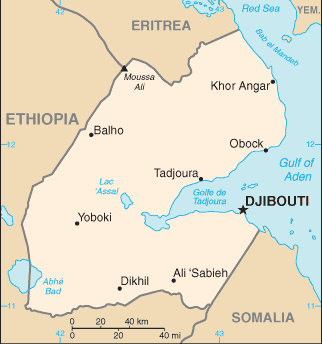
Terrain: Coastal desert.
Climate: Torrid and dry.
People
Nationality: Noun and adjective--Djiboutian(s).
Population (est.): Between 466,900 and 650,000.
Annual growth rate (2005 est.): 2.6%.
Ethnic groups: Somali, Afar, Ethiopian, Arab,
French, and Italian.
Religions: Muslim 94%, Christian 6%.
Languages: French and Arabic (official); Somali
and Afar widely used.
Education: Literacy--46.2%.
Health: Infant
mortality rate--100 to 150/1,000. Life
expectancy (2005
est.)--43.1 years.
Work force: Low employment rate; estimates run
well under 50% of the work force. The largest
employers are the Government of Djibouti,
including telecommunications and electricity;
Port of Djibouti; and airport. The U.S.
Government, including the military camp and the
embassy, is the second largest employer.
Able-bodied unemployed population (est.
2006)--60%.
Government
Type: Republic.
Constitution: Ratified September 1992 by
referendum.
Independence: June 27, 1977.
Branches: Executive--president. Legislative--65-member
parliament, cabinet, prime minister. Judicial--based
on French civil law system, traditional
practices, and Islamic law.
Administrative subdivisions: 6 cercles
(districts)--Ali-Sabieh, Arta, Dikhil, Djibouti,
Obock, and Tadjoura.
Political parties: People's Rally for Progress (RPP)
established in 1981; New Democratic Party (PRD)
and the National Democratic Party (PND) were
both established in 1992; and the Front For The
Restoration of Unity and Democracy (FRUD) was
legally recognized in 1994. Five additional
parties were established in 2002: Djibouti
Development Party (PDD); Peoples Social
Democratic Party (PPSD); Republican Alliance for
Democracy (ARD); Union for Democracy and Justice
(UDJ); Movement for Democratic Renewal (MRD).
Suffrage: Universal at 18.
National holiday: Independence Day, June 27
(1977).
Economy
GDP (2006 est.): $768 million.
Adjusted per capita income: $850 per capita for
expatriates, $450 for Djiboutians.
Natural resources: Minerals (salt, perlite,
gypsum, limestone) and energy resources
(geothermal and solar).
Agriculture (less than 3% of GDP): Products--livestock,
fishing, and limited commercial crops, including
fruits and vegetables.
Industry: Types--banking
and insurance (12.5% of GDP), public
administration (22% of GDP), construction and
public works, manufacturing, commerce, and
agriculture.
Trade (2004 est.): Imports--$987
million: consists of basic commodities,
including food and beverages, pharmaceutical
drugs, transport equipment, chemicals, and
petroleum products. Exports--$250
million: re-exports, hides and skins, and coffee
(in-transit). Major
markets (2004)--France,
Ethiopia, Somalia, India, China, and Saudi
Arabia and other Arabian peninsula countries.
PEOPLE
About two-thirds of the Republic of Djibouti's
650,000 inhabitants live in the capital city.
The indigenous population is divided between the
majority Somalis (predominantly of the Issa
tribe, with minority Issaq and Gadabursi
representation) and the Afars (Danakils). All
are Cushitic-speaking peoples, and nearly all
are Muslim. Among the 15,000 foreigners residing
in Djibouti, the French are the most numerous.
Among the French are 3,000 troops.
HISTORY
The Republic of Djibouti gained its independence
on June 27, 1977. It is the successor to French
Somaliland (later called the French Territory of
the Afars and Issas), which was created in the
first half of the 19th century as a result of
French interest in the Horn of Africa. However,
the history of Djibouti, recorded in poetry and
songs of its nomadic peoples, goes back
thousands of years to a time when Djiboutians
traded hides and skins for the perfumes and
spices of ancient Egypt, India, and China.
Through close contacts with the Arabian
Peninsula for more than 1,000 years, the Somali
and Afar tribes in this region became the first
on the African continent to adopt Islam.
It was Rochet d'Hericourt's exploration into
Shoa (1839-42) that marked the beginning of
French interest in the African shores of the Red
Sea. Further exploration by Henri Lambert,
French Consular Agent at Aden, and Captain
Fleuriot de Langle led to a treaty of friendship
and assistance between France and the sultans of
Raheita, Tadjoura, and Gobaad, from whom the
French purchased the anchorage of Obock (1862).
Growing French interest in the area took place
against a backdrop of British activity in Egypt
and the opening of the Suez Canal in 1869. In
1884-85, France expanded its protectorate to
include the shores of the Gulf of Tadjoura and
the Somaliland. Boundaries of the protectorate,
marked out in 1897 by France and Emperor Menelik
II of Ethiopia, were affirmed further by
agreements with Ethiopian Emperor Haile Selassie
I in 1945 and 1954.
The administrative capital was moved from Obock
to Djibouti in 1892. In 1896, Djibouti was named
French Somaliland. Djibouti, which has a good
natural harbor and ready access to the Ethiopian
highlands, attracted trade caravans crossing
East Africa as well as Somali settlers from the
south. The Franco-Ethiopian railway, linking
Djibouti to the heart of Ethiopia, was begun in
1897 and reached Addis Ababa in June 1917,
further facilitating the increase of trade.
During the Italian invasion and occupation of
Ethiopia in the 1930s and during World War II,
constant border skirmishes occurred between
French and Italian forces. The area was ruled by
the Vichy (French) government from the fall of
France until December 1942, and fell under
British blockade during that period. Free French
and the Allied forces recaptured Djibouti at the
end of 1942. A local battalion from Djibouti
participated in the liberation of France in
1944.
On July 22, 1957, the colony was reorganized to
give the people considerable self-government. On
the same day, a decree applying the Overseas
Reform Act (Loi Cadre) of June 23, 1956,
established a territorial assembly that elected
eight of its members to an executive council.
Members of the executive council were
responsible for one or more of the territorial
services and carried the title of minister. The
council advised the French-appointed governor
general.
In a September 1958 constitutional referendum,
French Somaliland opted to join the French
community as an overseas territory. This act
entitled the region to representation by one
deputy and one senator in the French Parliament,
and one counselor in the French Union Assembly.
The first elections to the territorial assembly
were held on November 23, 1958, under a system
of proportional representation. In the next
assembly elections (1963), a new electoral law
was enacted. Representation was abolished in
exchange for a system of straight plurality vote
based on lists submitted by political parties in
seven designated districts. Ali Aref Bourhan,
allegedly of Turkish origin, was selected to be
the president of the executive council. French
President Charles de Gaulle's August 1966 visit
to Djibouti was marked by 2 days of public
demonstrations by Somalis demanding
independence. On September 21, 1966, Louis Saget,
appointed governor general of the territory
after the demonstrations, announced the French
Government's decision to hold a referendum to
determine whether the people would remain within
the French Republic or become independent. In
March 1967, 60% chose to continue the
territory's association with France.
In July of that year, a directive from Paris
formally changed the name of the region to the
French Territory of Afars and Issas. The
directive also reorganized the governmental
structure of the territory, making the senior
French representative, formerly the governor
general, a high commissioner. In addition, the
executive council was redesignated as the
council of government, with nine members.
In 1975, the French Government began to
accommodate increasingly insistent demands for
independence. In June 1976, the territory's
citizenship law, which favored the Afar
minority, was revised to reflect more closely
the weight of the Issa Somali. The electorate
voted for independence in a May 1977 referendum.
The Republic of Djibouti was established on June
27, 1977, and Hassan Gouled Aptidon became the
country's first president. In 1981, he was again
elected president of Djibouti. He was
re-elected, unopposed, to a second 6-year term
in April 1987 and to a third 6-year term in May
1993 multiparty elections.
In early 1992, the constitution permitted the
legalization of four political parties for a
period of 10 years, after which a complete
multiparty system would be installed. By the
time of the December 1992 national assembly
elections, only three had qualified. They were
the Rassemblement Populaire Pour le Progres
(People's Rally for Progress--RPP), which was
the only legal party from 1981 until 1992; the
Parti du Renouveau Democratique (The Party for
Democratic Renewal--PRD); and the Parti National
Democratique (National Democratic Party--PND).
Only the RPP and the PRD contested the national
assembly elections, and the PND withdrew,
claiming that there were too many unanswered
questions on the conduct of the elections and
too many opportunities for government fraud. The
RPP won all 65 seats in the national assembly,
with a turnout of less than 50% of the
electorate.
In early November 1991, civil war erupted in
Djibouti between the government and a
predominantly Afar rebel group, the Front for
the Restoration of Unity and Democracy (FRUD).
The FRUD signed a peace accord with the
government in December 1994, ending the
conflict. Two FRUD members were made cabinet
members, and in the presidential elections of
1999 the FRUD campaigned in support of the RPP.
In 1999, Ismail Omar Guelleh--President Hassan
Gouled Aptidon's chief of staff, head of
security, and key adviser for over 20 years--was
elected to the presidency as the RPP candidate.
He received 74% of the vote, with the other 26%
going to opposition candidate Moussa Ahmed
Idriss, of the Unified Djiboutian Opposition (ODU).
For the first time since independence, no group
boycotted the election. Moussa Ahmed Idriss and
the ODU later challenged the results based on
election "irregularities" and the assertion that
"foreigners" had voted in various districts of
the capital; however, international and locally
based observers considered the election to be
generally fair, and cited only minor technical
difficulties. Ismail Omar Guelleh took the oath
of office as the second President of the
Republic of Djibouti on May 8, 1999, with the
support of an alliance between the RPP and the
government-recognized section of the Afar-led
FRUD.
In February 2000, another branch of FRUD signed
a peace accord with the government. On May 12,
2001, President Ismail Omar Guelleh presided
over the signing of what was termed the final
peace accord officially ending the decade-long
civil war between the government and the armed
faction of the FRUD. The peace accord
successfully completed the peace process begun
on February 7, 2000 in Paris. Ahmed Dini Ahmed
represented the FRUD.
GOVERNMENT AND POLITICAL CONDITIONS
Djibouti is a republic whose electorate approved
the current constitution in September 1992. Many
laws and decrees from before independence remain
in effect.
In the presidential election held April 8, 2005
Ismail Omar Guelleh was re-elected to a second
6-year term at the head of a multi-party
coalition that included the FRUD and other major
parties. A loose coalition of opposition parties
again boycotted the election. Currently,
political power is shared by a Somali president
and an Afar prime minister, with an Afar career
diplomat as Foreign Minister and other cabinet
posts roughly divided. However, Issas are
predominate in the government, civil service,
and the ruling party. That, together with a
shortage of non-government employment, has bred
resentment and continued political competition
between the Somali Issas and the Afars. In March
2006, Djibouti held its first regional elections
and began implementing a decentralization plan.
The broad pro-government coalition, including
FRUD candidates, again ran unopposed when the
government refused to meet opposition
preconditions for participation. Parliamentary
elections were held in February 2008.
Djibouti has its own armed forces, including a
small army, which grew significantly with the
start of the civil war in 1991. With the 2001
final peace accord between the government and
the Afar-dominated FRUD, the armed forces have
been downsized. The country's security is
supplemented by a formal security accord with
the Government of France, which guarantees
Djibouti's territorial integrity against foreign
incursions. France maintains one of its largest
military bases outside France in Djibouti. There
are some 3,000 French troops stationed in
Djibouti, including units of the famed French
Foreign Legion.
The right to own property is respected in
Djibouti. The government has reorganized the
labor unions. While there have been open
elections of union leaders in the past, some
labor leaders allege interference in their
internal elections. Others voice opposition to
newly-implemented labor laws that apply to new
jobs created in free zones and that are less
favorable to labor.
In 2002, following a broad national debate,
Djibouti enacted a new "Family Law" enhancing
the protection of women and children, unifying
legal treatment of all women, and replacing
Sharia. The government established a
minister-designate for women's affairs and is
engaged in an ongoing effort to increase public
recognition of women's rights and to ensure
enforcement. In 2007, it began establishing a
network of new counseling offices to assist
women seeking to understand and protect their
rights. Women in Djibouti enjoy a higher public
status than in many other Islamic countries. The
government is leading efforts to stop illegal
and abusive traditional practices, including
female genital mutilation. As the result of a
three-year effort, the percentage of girls
attending primary school increased significantly
and is now more than 50%. However, women's
rights and family planning continue to face
difficult challenges, many stemming from acute
poverty in both rural and urban areas. With
female ministers and members of parliament, the
presence of women in government has increased.
Despite the gains, education of girls still lags
behind boys, and employment opportunities are
better for male applicants.
Principal Government Officials
President--Ismail Omar Guelleh
Prime Minister--Dileita Mohamed Dileita
Foreign Affairs--Mahamoud Ali Youssouf
Ambassador to the United Nations and the United
States--Roble Olhaye Oudine
Djibouti's mission to the UN is located at 866
UN Plaza, Suite 4011, New York, NY 10017 (tel.
212-753-3163). Djibouti's embassy in Washington
is located at Suite 515, 1156 15th Street, NW,
Washington, DC 20005 (tel. 202- 331-0270; fax
202-331-0302).
ECONOMY
Djibouti's economy depends largely on
its proximity to the large Ethiopian market and
a large foreign expatriate community. Its main
economic activities are the Port of Djibouti,
the banking sector, the airport, and the
operation of the Addis Ababa-Djibouti railroad.
During the "lost decade" following the brunt of
its civil war (1991-94), there was a significant
diversion of government budgetary resources from
developmental and social services to military
needs. However, from 2001 on, Djibouti has
become a magnet for private sector capital
investment, attracting inflows that now average
more than $200 million. It has also
significantly improved its finances, paying
current salaries, maintaining reserves, and
generating a growth rate in 2006 of
approximately 4.5%. Djibouti has become a
significant regional banking hub, with
approximately $600 million in dollar deposits.
Its currency, the Djiboutian Franc, was linked
to the dollar (and to gold) in 1949 and
appreciated twice over the interim when the
dollar was devalued and then freed to float.
Agriculture and industry are little developed,
in part due to the harsh climate, high
production costs, unskilled labor, and limited
natural resources. Mineral deposits exist in the
country, but with the exception of an
extraordinary salt deposit at Lac Asal, the
lowest point in Africa, they have not been
exploited. The arid soil is unproductive--89% is
desert wasteland, 10% is pasture, and 1% is
forested. Deforestation for charcoal is a
significant problem, as it now replaces
expensive imported cooking gas in many urban
homes. Services and commerce provide most of the
gross domestic product.
Djibouti's most important economic asset is its
strategic location on the busy shipping route
between the Mediterranean Sea and the Indian
Ocean. Roughly 60% of all commercial ships in
the world use its waters from the Red Sea
through the Bab-el-Mandeb strait and into the
Gulf of Aden and the Indian Ocean. Its old port
is an increasingly important transshipment point
for containers as well as a destination port for
Ethiopian trade. Last year alone, private
investment in the old port totaled approximately
$50 million. Djibouti is now in the second of
three phases of a multi-year, $800 million,
privately-financed project to build a new port
with fueling, container, and free zone
components. The old port will continue serving
as a general shipping, bulk cargo, and
break-bulk facility and also as the host of a
small French naval facility.
Business soared at the Port of Djibouti when
hostilities between Eritrea and Ethiopia denied
Ethiopia access to the Eritrean Port of Assab.
Djibouti became the only significant port for
landlocked Ethiopia, handling all its imports
and exports, including huge shipments of U.S.
food aid in 2000 during the drought and famine.
In 2000, Dubai Ports World took over management
of Djibouti's port and later its customs and
airport operations. The result has been a
significant increase in investment, efficiency,
activity, and port revenues. The Addis
Ababa-Djibouti railroad is the only line serving
central and southeastern Ethiopia. The
single-track railway--a prime source of
employment--occupies a prominent place in
Ethiopia's internal distribution system for
domestic commodities such as cement, cotton
textiles, sugar, cereals, and charcoal. A weekly
train from Ethiopia brings in most of Djibouti's
fresh fruits and vegetables. In March 2006, the
Governments of Ethiopia and Djibouti (which
co-own the railway) selected the South African
firm COMAZAR to manage the line. They are still
in negotiations over the management agreement.
In addition, the European Union is considering a
$100 million project to upgrade a portion of the
rail line.
Principal exports from the region transiting
Djibouti are coffee, salt, live animals, hides,
dried beans, cereals, other agricultural
products, and wax. Djibouti itself has few
exports, and the majority of its imports come
from France. Most imports are consumed in
Djibouti, and the remainder go to Ethiopia and
northwestern Somalia. Djibouti's unfavorable
balance of trade is offset partially by
invisible earnings such as transit taxes and
harbor dues. In 2001, U.S. exports to Djibouti
totaled $18.7 million, while U.S. imports from
Djibouti were about $1 million.
The city of Djibouti has the only paved airport
in the republic. Djibouti has one of the most
liberal economic regimes in Africa, with almost
unrestricted banking and commerce sectors.
FOREIGN RELATIONS
Military and economic agreements with France
provide continued security and economic
assistance. Links with Arab states and East
Asian states, Japan and China in particular,
also are welcome. Djibouti is a member of the
Arab League, as well as the African Union, the
Inter-Governmental Authority on Development (IGAD),
and the Common Market for Eastern and Southern
Africa (COMESA).
Djibouti is greatly affected by events in
Somalia and Ethiopia, so relations are important
and, at times, delicate. The 1991 falls of the
Siad Barre and Mengistu governments in Somalia
and Ethiopia, respectively, caused Djibouti to
face national security threats due to
instability in the neighboring states and a
massive influx of refugees estimated at 100,000
from Somalia and Ethiopia. In 2000, after 3
years of insufficient rain, 50,000 drought
victims entered Djibouti. In 1996, a revitalized
organization of seven East African states, the
Inter-Governmental Authority on Development (IGAD),
established its secretariat in Djibouti. IGAD's
mandate is for regional cooperation and economic
integration, and it has also sought to play a
positive role promoting regional stability,
including its efforts in support of Somalia's
Transitional Federal Government.
Djibouti seeks to play the role of neutral in
the frequently tense regional politics of the
Horn of Africa. It became Ethiopia's sole link
to the sea when fighting broke out between
Ethiopia and Eritrea in 1998. Aside from a
two-year break in relations from 1998-2000,
Djibouti has maintained a cordial relationship
with Eritrea. Eritrea's President Isaias and
Djibouti's President Guelleh exchanged visits in
2001, and Isaias returned to Djibouti in 2006
for the regional summit of the Common Market for
Eastern and Southern Africa (COMESA), hosted by
President Guelleh in his capacity as incoming
COMESA President. Djibouti continues to
cultivate cordial relations with Ethiopia,
reflecting the fundamental economic ties between
the two countries and a long tradition of
interchanges. However, rising tensions in
Somalia and Ethiopian military involvement in
Somalia in 2007 fueled widespread criticism of
Ethiopia among Djibouti's majority
Somali-speaking population. President Guelleh
attended the 2007 Africa Union summit in
Ethiopia and supports the African Union
peacekeeping operation for Somalia (AMISOM).
U.S.-DJIBOUTIAN RELATIONS
In April 1977, the United States established a
Consulate General in Djibouti and upon
independence in June 1977 raised the status of
its mission to an embassy. The first U.S.
Ambassador to the Republic of Djibouti arrived
in October 1980. Over the past decade, the
United States has been a principal provider of
humanitarian assistance for famine relief, and
has sponsored health care, education, good
governance, and security assistance programs.
Djibouti has allowed the U.S. military, as well
as other nations, access to its port and airport
facilities. The Djiboutian Government has been
very supportive of U.S. and Western interests,
particularly during the Gulf crisis of 1990-91
and after the terrorist attacks of September 11,
2001. In 2002, Djibouti agreed to host a U.S.
military presence at Camp Lemonier, a former
French Foreign Legion base outside the capital
that now houses approximately 1,800 American
personnel. U.S. service members provide
humanitarian support and development and
security assistance to people and governments of
the Horn of Africa and Yemen. They support
freedom and oppose terrorism. As a victim of
past international terrorist attacks, President
Guelleh continues to take a very proactive
position against terrorism.
Principal U.S. Officials
Ambassador--James
Swan
Deputy Chief of Mission--Eric Wong
Consular Officer--Solange Garvey
Public Affairs Officer--Niles Cole
Political and Economic Officer--Rebecca Hunter
United States Military Liaison Officer--Matt
Romagnuolo
Management Officer--Robert Osborne
Regional Security Officer--Ellen Tannor
The U.S.
Embassy in
Djibouti is located at Villa Plateau du Serpent,
Blvd. Marechal Joffre (Boite Postal 185),
Djibouti (tel. 253 35-39-95; fax 253 35-39-40).
 Information
on Countries from Around the World
Information
on Countries from Around the World