
PROFILE
OFFICIAL NAME:
Gabonese Republic
Geography
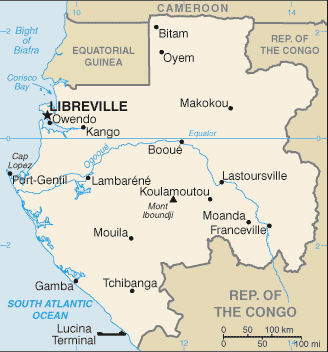
Area: 267,667 sq. km. (103,347 sq. mi.); about
the size of Colorado.
Cities: Capital--Libreville
(pop. 673,995). Other
cities--Port-Gentil (118,940), Franceville.
Terrain: Narrow coastal plain; hilly, heavily
forested interior (about 80% forested); some
savanna regions in east and south.
Climate: Hot and humid all year with two rainy
and two dry seasons.
People
Nationality: Noun
and adjective--Gabonese (sing. and pl.).
Population (July 2007 est.): 1,454,867.
Annual growth rate (2007 est.): 2.036%.
Ethnic groups: Fang (largest), Myene, Bapounou,
Eshira, Bandjabi, Bakota, Nzebi, Bateke/Obamba.
Religions: Christian (55%-75%), Muslim, animist.
Languages: French (official), Fang, Myene,
Bateke, Bapounou/Eschira, Bandjabi.
Education: Years
compulsory--to age 16. Attendance--60%. Literacy--63%.
Health: Infant
mortality rate--91/1,000. Life
expectancy--56.2 yrs.
Work force (500,000 est.): Agriculture--52%; industry
and commerce--16%; services
and government--33%.
Government
Type: Republic.
Independence: August 17, 1960.
Constitution: February 21, 1961 (revised April
15, 1975; rewritten March 26, 1991; revised July
29, 2003).
Branches: Executive--president
(head of state); prime minister (head of
government) and appointed Council of Ministers. Legislative--bicameral
legislature (National Assembly and Senate). Judicial--Supreme
Court.
Administrative subdivisions: 9 provinces, 36
prefectures, and 8 subprefectures.
Political parties: Parti
Democratique Gabonais (PDG)
holds the largest number of seats in the
National Assembly; there are several others.
Suffrage: Universal, direct.
Central government budget (2001 est.): Receipts--$1.6
billion; expenses--$1.2
billion; defense (1999)--3.0%
of government budget.
Economy
Real GDP (2007 est.): $5.915 billion.
Annual real growth rate (2007 est.): 5.6%.
Per capita income (2007 est.): $7,887.
Avg. inflation rate: 1.2%.
Natural resources: Petroleum, timber, manganese,
uranium.
Agriculture and forestry (6% of GDP): Products--cocoa,
coffee, rubber, sugar, and pineapples.
Cultivated land--1%.
Industry (59% of GDP): Types--petroleum
related, wood processing, food and beverage
processing.
Services (36% of GDP).
Trade (2007): $8.499 billion. Exports--61%
of GDP (f.o.b.): petroleum, wood, manganese. Major
markets--U.S. 53%, China 8.5%, France 7.4%,
EU, Asia. Imports--30%
of GDP (f.o.b.): construction equipment,
machinery, food, automobiles, manufactured
goods.Major suppliers--France 43%, U.S.
6.3%, U.K. 5.8%, Netherlands 4%. Current account
balance with U.S. (2007 est.)--$1.689 billion.
PEOPLE
Almost all Gabonese are of Bantu origin. Gabon
has at least 40 ethnic groups, with separate
languages and cultures. The largest is the Fang
(about 30%). Other ethnic groups include the
Myene, Bandjabi, Eshira, Bapounou, Bateke/Obamba,
Nzebi, and Bakota. Ethnic group boundaries are
less sharply drawn in Gabon than elsewhere in
Africa. French, the official language, is a
unifying force. More than 12,000 French people
live in Gabon, including an estimated 2,000 dual
nationals, and France dominates foreign cultural
and commercial influences. Historical and
environmental factors caused Gabon's population
to decline between 1900 and 1940. It is one of
the least densely inhabited countries in Africa,
and a labor shortage is a major obstacle to
development and a draw for foreign workers. The
population is generally accepted to be just over
1 million but remains in dispute.
HISTORY
During the last seven centuries, Bantu ethnic
groups arrived in the area from several
directions to escape enemies or find new land.
Little is known of tribal life before European
contact, but tribal art suggests rich cultural
heritages. Gabon's first European visitors were
Portuguese traders who arrived in the 15th
century and named the country after the
Portuguese word "gabao," a coat with sleeve and
hood resembling the shape of the Komo River
estuary. The coast became a center of the slave
trade. Dutch, British, and French traders came
in the 16th century. France assumed the status
of protector by signing treaties with Gabonese
coastal chiefs in 1839 and 1841. American
missionaries from New England established a
mission at Baraka (now Libreville) in 1842. In
1849, the French captured a slave ship and
released the passengers at the mouth of the Komo
River. The slaves named their settlement
Libreville--"free town." An American, Paul du
Chaillu, was among the first foreigners to
explore the interior of the country in the
1850s. French explorers penetrated Gabon's dense
jungles between 1862 and 1887. The most famous,
Savorgnan de Brazza, used Gabonese bearers and
guides in his search for the headwaters of the
Congo River. France occupied Gabon in 1885 but
did not administer it until 1903. In 1910, Gabon
became one of the four territories of French
Equatorial Africa, a federation that survived
until 1959. The territories became independent
in 1960 as the Central African Republic, Chad,
Congo (Brazzaville), and Gabon.
At the time of Gabon's independence in 1960, two
principal political parties existed: the Bloc
Democratique Gabonais (BDG),
led by Leon M'Ba, and the Union Democratique
et Sociale Gabonaise (UDSG),
led by J.H. Aubame. In the first
post-independence election, held under a
parliamentary system, neither party was able to
win a majority. The BDG obtained support from
three of the four independent legislative
deputies, and M'Ba was named Prime Minister.
Soon after concluding that Gabon had an
insufficient number of people for a two-party
system, the two party leaders agreed on a single
list of candidates. In the February 1961
election, held under the new presidential
system, M'Ba became President and Aubame became
Foreign Minister.
This one-party system appeared to work until
February 1963, when the larger BDG element
forced the UDSG members to choose between a
merger of the parties or resignation. The UDSG
cabinet ministers resigned, and M'Ba called an
election for February 1964 and a reduced number
of National Assembly deputies (from 67 to 47).
The UDSG failed to muster a list of candidates
able to meet the requirements of the electoral
decrees. When the BDG appeared likely to win the
election by default, the Gabonese military
toppled M'Ba in a bloodless coup on February 18,
1964. French troops re-established his
government the next day. Elections were held in
April 1964 with many opposition participants.
BDG-supported candidates won 31 seats and the
opposition 16. Late in 1966, the constitution
was revised to provide for automatic succession
of the vice president should the president die
in office. In March 1967, Leon M'Ba and Omar
Bongo (then Albert Bongo) were elected President
and Vice President. M'Ba died later that year,
and Omar Bongo became President.
In March 1968, Bongo declared Gabon a one-party
state by dissolving the BDG and establishing a
new party--the Parti
Democratique Gabonais (PDG).
He invited all Gabonese, regardless of previous
political affiliation, to participate. Bongo was
elected President in February 1975; in April
1975, the office of vice president was abolished
and replaced by the office of prime minister,
who had no right to automatic succession. Bongo
was re-elected President in December 1979 and
November 1986 to 7-year terms. Using the PDG as
a tool to submerge the regional and tribal
rivalries that divided Gabonese politics in the
past, Bongo sought to forge a single national
movement in support of the government's
development policies.
Economic discontent and a desire for political
liberalization provoked violent demonstrations
and strikes by students and workers in early
1990. In response to grievances by workers,
Bongo negotiated with them on a sector-by-sector
basis, making significant wage concessions. In
addition, he promised to open up the PDG and to
organize a national political conference in
March-April 1990 to discuss Gabon's future
political system. The PDG and 74 political
organizations attended the conference.
Participants essentially divided into two loose
coalitions, the ruling PDG and its allies, and
the United Front of Opposition Associations and
Parties, consisting of the breakaway Morena
Fundamental and the Gabonese Progress Party.
The April 1990 conference approved sweeping
political reforms, including creation of a
national Senate, decentralization of the
budgetary process, freedom of assembly and
press, and cancellation of the exit visa
requirement. In an attempt to guide the
political system's transformation to multiparty
democracy, Bongo resigned as PDG chairman and
created a transitional government headed by a
new Prime Minister, Casimir Oye-Mba. The
Gabonese Social Democratic Grouping (RSDG), as
the resulting government was called, was smaller
than the previous government and included
representatives from several opposition parties
in its cabinet. The RSDG drafted a provisional
constitution in May 1990 that provided a basic
bill of rights and an independent judiciary but
retained strong executive powers for the
president. After further review by a
constitutional committee and the National
Assembly, this document came into force in March
1991. Under the 1991 constitution, in the event
of the president's death, the prime minister,
the National Assembly president, and the defense
minister were to share power until a new
election could be held.
Opposition to the PDG continued, however, and in
September 1990, two coup d'etat attempts were
uncovered and aborted. Despite anti-government
demonstrations after the untimely death of an
opposition leader, the first multiparty National
Assembly elections in almost 30 years took place
in September-October 1990, with the PDG
garnering a large majority.
Following President Bongo's re-election in
December 1993 with 51% of the vote, opposition
candidates refused to validate the election
results. Serious civil disturbances led to an
agreement between the government and opposition
factions to work toward a political settlement.
These talks led to the Paris Accords in November
1994, under which several opposition figures
were included in a government of national unity.
This arrangement soon broke down, however, and
the 1996 and 1997 legislative and municipal
elections provided the background for renewed
partisan politics. The PDG won a landslide
victory in the legislative election, but several
major cities, including Libreville, elected
opposition mayors during the 1997 local
election.
Facing a divided opposition, President Bongo
coasted to easy re-election in December 1998,
with large majorities of the vote. While Bongo's
major opponents rejected the outcome as
fraudulent, some international observers
characterized the results as representative
despite any perceived irregularities, and there
were none of the civil disturbances that
followed the 1993 election. Peaceful though
flawed legislative elections held in 2001-02,
which were boycotted by a number of smaller
opposition parties and were widely criticized
for their administrative weaknesses, produced a
National Assembly almost completely dominated by
the PDG and allied independents. In November
2005, President Bongo was elected for his sixth
term. He won re-election easily, but opponents
claim that the balloting process was marred by
irregularities. There were some instances of
violence following the announcement of Bongo's
win, but Gabon generally remained peaceful.
National Assembly elections were held again in
December 2006. Several seats contested because
of voting irregularities were overturned by the
Constitutional Court, but the subsequent run-off
elections in early 2007 again yielded a PDG-controlled
National Assembly.
GOVERNMENT AND POLITICAL CONDITIONS
Under the 1961 constitution (revised in 1975,
rewritten in 1991, and revised in 2003), Gabon
is a republic with a presidential form of
government. The National Assembly has 120
deputies elected for a 5-year term. The
president is elected by universal suffrage for a
7-year term. The president can appoint and
dismiss the prime minister, the cabinet, and
judges of the independent Supreme Court. The
president also has other strong powers, such as
authority to dissolve the National Assembly,
declare a state of siege, delay legislation, and
conduct referenda. A 2003 constitutional
amendment removed presidential term limits and
facilitated a presidency for life.
In 1990 the government made major changes to
Gabon's political system. A transitional
constitution was drafted in May 1990 as an
outgrowth of the national political conference
in March-April and later revised by a
constitutional committee. Among its provisions
were a Western-style bill of rights, creation of
a National Council of Democracy to oversee the
guarantee of those rights, a governmental
advisory board on economic and social issues,
and an independent judiciary. After approval by
the National Assembly, the PDG Central
Committee, and the President, the Assembly
unanimously adopted the constitution in March
1991. Multiparty legislative elections were held
in 1990-91, despite the fact that opposition
parties had not been declared formally legal.
The elections produced the first representative,
multiparty National Assembly. In January 1991,
the Assembly passed by unanimous vote a law
governing the legalization of opposition
parties. After President Bongo was re-elected in
a disputed election in 1993 with 51% of votes
cast, social and political disturbances led to
the 1994 Paris Conference and Accords, which
provided a framework for the next elections.
Local and legislative elections were delayed
until 1996-97. In 1997, constitutional
amendments were adopted to create an appointed
Senate and the position of vice president, and
to extend the president's term to 7 years.
For administrative purposes, Gabon is divided
into 9 provinces, which are further divided into
36 prefectures and 8 separate subprefectures.
The president appoints the provincial governors,
the prefects, and the subprefects.
Principal Government Officials
President of the Republic, Founder of the
Gabonese Democratic Party--El Hadj Omar Bongo
Vice President--Didjob Divungi Di Ndinge
Prime Minister, Head of Government--Jean Eyeghe
Ndong
Minister of Foreign Affairs and
Cooperation--Paul Toungui
Minister of Finance--Blaise Louembe
Minister of Energy--Casimir Oye Mba
Ambassador to the United States--Carlos Boungou
Ambassador to the United Nations--Denis Dangue
Rewaka
Gabon maintains an embassy in the United States
at 2034 20th Street NW, Washington, DC 20009
(tel. 202-797-1000).
ECONOMY
Gabon's economy is dominated by oil. Oil
revenues comprise 65% of the Government of Gabon
budget, 43% of gross domestic product (GDP), and
81% of exports. Oil production is now declining
rapidly from its high point of 370,000 barrels
per day in 1997. In spite of the decreasing oil
revenues, little planning has been done for an
after-oil scenario. Gabon public expenditures
from the years of significant oil revenues were
not spent efficiently. Overspending on the
Transgabonais railroad, the oil price shock of
1986, the CFA franc devaluation of 1994, and low
oil prices in the late 1990s caused serious debt
problems. Gabon has earned a poor reputation
with the Paris Club and the International
Monetary Fund (IMF) for the management of its
debt and revenues. Successive IMF missions have
criticized the government for overspending on
off-budget items (in good years and bad),
over-borrowing from the Central Bank, and
slipping on the schedule for privatization and
administrative reform. In September 2005, Gabon
successfully concluded a 15-month Stand-By
Arrangement with the IMF. Following this, Gabon
sought a multi-year successor arrangement that
was formally proposed to the IMF in 2007.
Gabon's oil revenues have given it a strong per
capita GDP of $7,800, extremely high for the
region. On the other hand, a skewed income
distribution and poor social indicators are
evident. The richest 20% of the population
receives over 90% of the income, and about a
third of Gabonese live in poverty. The economy
is highly dependent on extraction of abundant
primary materials. After oil, logging and
manganese mining are the other major sectors.
Foreign and Gabonese observers have consistently
lamented the lack of transformation of primary
materials in the Gabonese economy. Various
factors have so far stymied more
diversification--small market of 1 million
people, dependence on French imports, inability
to capitalize on regional markets, lack of
entrepreneurial zeal among the Gabonese, and the
fairly regular stream of oil "rent". The small
processing and service sectors are largely
dominated by just a few prominent local
investors. At World Bank and IMF insistence, the
government embarked on a program of
privatization of its state-owned companies and
administrative reform, including reducing public
sector employment and salary growth, but
progress has been slow.
DEFENSE
Gabon has a small, professional military of
about 10,000 personnel, divided into army, navy,
air force, gendarmerie, and national police.
Gabonese forces are oriented to the defense of
the country and have not been trained for an
offensive role. A well-trained, well-equipped
1,500-member guard provides security for the
president.
FOREIGN RELATIONS
Gabon has followed a nonaligned policy,
advocating dialogue in international affairs and
recognizing both parts of divided countries.
Since 1973, the number of countries establishing
diplomatic relations with Gabon has doubled. In
inter-African affairs, Gabon espouses
development by evolution rather than revolution
and favors regulated free enterprise as the
system most likely to promote rapid economic
growth. Concerned about stability in Central
Africa and the potential for intervention, Gabon
has been directly involved with mediation
efforts in Chad, the Central African Republic,
Angola, Congo/Brazzaville, the Democratic
Republic of the Congo, and Burundi. In December
1999, through the mediation efforts of President
Bongo, a peace accord was signed in
Congo/Brazzaville between the government and
most leaders of an armed rebellion. President
Bongo has remained involved in the continuing
Congolese peace process, and has also played a
role in mediating the crisis in Cote d'Ivoire.
Gabon has been a strong proponent of regional
stability, and Gabonese armed forces played an
important role in the Central African Economic
and Monetary Community (CEMAC) mission to the
Central African Republic.
Gabon is a member of the UN and some of its
specialized and related agencies, as well as of
the World Bank; the African Union (AU); the
Central African Customs Union/Central African
Economic and Monetary Community (UDEAC/CEMAC);
EU/ACP association under the Lome Convention;
the Communaute
Financiere Africaine (CFA);
the Organization of the Islamic Conference (OIC);
the Nonaligned Movement; and the Economic
Community of Central African States (ECCAS/CEEAC).
Gabon withdrew from the Organization of
Petroleum Exporting Countries (OPEC) in 1995.
U.S.-GABONESE RELATIONS
Relations between the United States and Gabon
are excellent. In 1987, President Bongo made an
official visit to Washington, DC. In September
2002, Secretary of State Colin Powell made a
brief but historic visit to Gabon to highlight
environmental protection and conservation in the
Central Africa region. This was followed by a
visit to the White House by President Bongo in
May 2004. The United States imports a
considerable percentage of Gabonese crude oil
and manganese and exports heavy construction
equipment, aircraft, and machinery to Gabon.
Through a modest International Military
Education and Training program, the United
States provides military training to members of
the Gabonese armed forces each year. Other
bilateral assistance includes the funding of
small grants for qualified democracy and human
rights, self-help, and cultural preservation
projects. U.S. private capital has been
attracted to Gabon since before its
independence.
Principal U.S. Officials
Ambassador--Eunice
Reddick
Deputy Chief of Mission--Nathan Holt
Management Officer--Charles Morrill
Public Affairs/Economic/Commercial Officer--John
Corrao
Political Officer--Leslie Williams Doumbia
Defense Attach�--Rene Dechaine
Consular Officer--Grace Genuino
The U.S.
Embassy is
located on the Blvd. de la Mer, B.P. 4000,
Libreville, Gabon (tel: 241-762-003/004; fax:
241-745-507).
 Information
on Countries from Around the World
Information
on Countries from Around the World