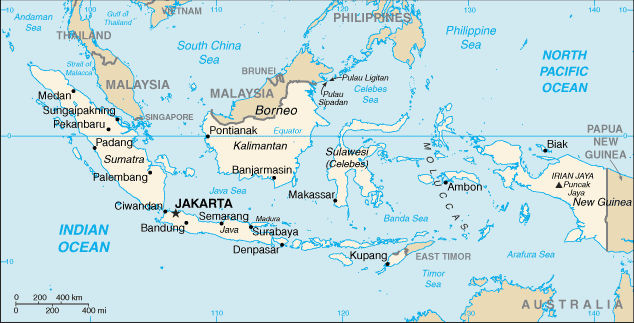
Geography
Area: 2 million sq. km. (736,000 sq. mi.), about
three times the size of Texas; maritime area:
7,900,000 sq. km.
Cities: Capital--Jakarta
(est. 8.8 million). Other
cities--Surabaya 3.0 million, Medan 2.5
million, Bandung 2.5 million.
Terrain: More than 17,500 islands; 6,000 are
inhabited; 1,000 of which are permanently
settled. Large islands consist of coastal plains
with mountainous interiors.
Climate: Equatorial but cooler in the highlands.
People
Nationality: Noun
and adjective--Indonesian(s).
Population (July 2008 est.): 237.5 million.
Annual population growth rate (2008 est.):
1.175%.
Ethnic groups (2000 census): Javanese 40.6%,
Sundanese 15%, Madurese 3.3%, Minangkabau 2.7%,
others 38.4%.
Religions (2000 census): Muslim 86.1%,
Protestant 5.7%, Catholic 3%, Hindu 1.8%, others
3.4%.
Languages: Indonesian (official), local
languages, the most prevalent of which is
Javanese.
Education: Years
compulsory--9. Enrollment--94%
of eligible primary school-age children. Literacy--90.4%
(2007).
Health: Infant
mortality rate--31.04/1,000
(2008 est.). Life
expectancy at birth--70.46
years (2008 est.).
Work force: 111.5 million (2008). Agriculture--42%, industry--12%, services--44%.
Government
Type: Independent republic.
Independence: August 17, 1945 proclaimed.
Constitution: 1945. Embodies five principles of
the state philosophy, called Pancasila, namely
monotheism, humanitarianism, national unity,
representative democracy by consensus, and
social justice.
Branches: Executive--president
(head of government and chief of state) elected
by direct popular vote. Legislative--The
People's Consultative Assembly (MPR), which
includes the 550-member House of Representatives
(DPR) and the 128-member Council of Regional
Representatives (DPD), both elected to five-year
terms. Judicial--Supreme
Court.
Suffrage: 17 years of age universal and married
persons regardless of age.
Economy
GDP (2007): $433 billion; (2008 est.): $500
billion.
Annual growth rate (2007): 6.3%; (2008 est.):
6.1%.
Inflation (2007): 6.6%; (2008 est.): 11.5-12.5%
(end-period).
Per capita income (2007): $3,700 (est., PPP).
Natural resources (11.1% of GDP): Oil and gas,
bauxite, silver, tin, copper, gold, coal.
Agriculture (13.8% of GDP): Products--timber,
rubber, rice, palm oil, coffee. Land--17%
cultivated.
Manufacturing (27% of GDP): Garments, footwear,
electronic goods, furniture, paper products.
Trade: Exports (2007)--$118.1
billion including oil, natural gas, appliances,
textiles. Major
exporters--Japan, U.S., Singapore, Republic
of Korea, China. Imports (2007)--$84
billion including food, chemicals, capital
goods, consumer goods. Major
importers--Singapore, Japan, China.
PEOPLE
Indonesia's approximately 237.5 million people
make it the world's fourth-most populous nation.
The island of Java, roughly the size of New York
State, is the most populous island in the world
(124 million, 2005 est.) and one of the most
densely populated areas in the world. Indonesia
includes numerous related but distinct cultural
and linguistic groups, many of which are
ethnically Malay. Since independence, Bahasa
Indonesia (the national language, a form of
Malay) has spread throughout the archipelago and
has become the language of most written
communication, education, government, business,
and media. Local languages are still important
in many areas, however. English is the most
widely spoken foreign language. Education is
compulsory for children through grade 9. In
primary school, 94% of eligible children are
enrolled whereas 57% of eligible children are
enrolled in secondary school.
Constitutional guarantees of religious freedom
apply to the six religions recognized by the
state, namely Islam (86.1%), Protestantism
(5.7%), Catholicism (3%), Hinduism (1.8%),
Buddhism (about 1%), and Confucianism (less than
1%). On the resort island of Bali, over 90% of
the population practices Hinduism. In some
remote areas, animism is still practiced.
HISTORY
By the time of the Renaissance, the islands of
Java and Sumatra had already enjoyed a
1,000-year heritage of advanced civilization
spanning two major empires. During the 7th-14th
centuries, the Buddhist kingdom of Srivijaya
flourished on Sumatra. At its peak, the
Srivijaya Empire reached as far as West Java and
the Malay Peninsula. Also by the 14th century,
the Hindu Kingdom of Majapahit had risen in
eastern Java. Gadjah Mada, the empire's chief
minister from 1331 to 1364, succeeded in gaining
allegiance from most of what is now modern
Indonesia and much of the Malay archipelago as
well. Legacies from Gadjah Mada's time include a
codification of law and an epic poem. Islam
arrived in Indonesia sometime during the 12th
century and, through assimilation, supplanted
Hinduism by the end of the 16th century in Java
and Sumatra. Bali, however, remains
overwhelmingly Hindu. In the eastern
archipelago, both Christian and Islamic
proselytizing took place in the 16th and 17th
centuries, and, currently, there are large
communities of both religions on these islands.
Beginning in 1602, the Dutch slowly established
themselves as rulers of Indonesia, exploiting
the weakness of the small kingdoms that had
replaced that of Majapahit. The only exception
was East Timor, which remained under Portugal's
control until 1975. During 300 years of rule,
the Dutch developed the Netherlands East Indies
into one of the world's richest colonial
possessions.
During the first decade of the 20th century, an
Indonesian independence movement began and
expanded rapidly, particularly between the two
World Wars. Its leaders came from a small group
of young professionals and students, some of
whom had been educated in the Netherlands. Many,
including Indonesia's first president, Soekarno
(1945-67), were imprisoned for political
activities.
The Japanese occupied Indonesia for three years
during World War II (1942-1945). On August 17,
1945, three days after the Japanese surrender to
the Allies, a small group of Indonesians, led by
Soekarno and Mohammad Hatta, proclaimed
independence and established the Republic of
Indonesia. They set up a provisional government
and adopted a constitution to govern the
republic until elections could be held and a new
constitution written. Dutch efforts to
reestablish complete control met strong
resistance. After four years of warfare and
negotiations, the Dutch transferred sovereignty
to a federal Indonesian Government. In 1950,
Indonesia became the 60th member of the United
Nations.
Shortly after hostilities with the Dutch ended
in 1949, Indonesia adopted a new constitution,
providing for a parliamentary system of
government in which the executive was chosen by
and accountable to parliament. Parliament was
divided among many political parties before and
after the country's first nationwide election in
1955, and stable governmental coalitions were
difficult to achieve. The role of Islam in
Indonesia became a divisive issue. Soekarno
defended a secular state based on Pancasila,
five principles of the state
philosophy--monotheism, humanitarianism,
national unity, representative democracy by
consensus, and social justice--codified in the
1945 constitution, while some Muslim groups
preferred either an Islamic state or a
constitution that included a preambular
provision requiring adherents of Islam to be
subject to Islamic law. At the time of
independence, the Dutch retained control over
the western half of New Guinea (known as Irian
Jaya in the Soekarno and Soeharto eras and as
Papua since 2000) and permitted steps toward
self-government and independence.
Negotiations with the Dutch on the incorporation
of Irian Jaya into Indonesia failed, and armed
clashes broke out between Indonesian and Dutch
troops in 1961. In August 1962, the two sides
reached an agreement, and Indonesia assumed
administrative responsibility for Irian Jaya on
May 1, 1963. The Indonesian Government conducted
an "Act of Free Choice" in Irian Jaya under UN
supervision in 1969 in which 1,025 Papuan
representatives of local councils agreed by
consensus to remain a part of Indonesia. A
subsequent UN General Assembly resolution
confirmed the transfer of sovereignty to
Indonesia. Opposition to Indonesian
administration of Papua gave rise to small-scale
guerrilla activity in the years following
Jakarta's assumption of control. In the more
open atmosphere since 1998, there have been more
explicit expressions within Papua calling for
independence from Indonesia.
Unsuccessful rebellions on Sumatra, Sulawesi,
West Java, and other islands beginning in 1958,
plus a failure by the constituent assembly to
develop a new constitution, weakened the
parliamentary system. Consequently, in 1959,
when President Soekarno unilaterally revived the
provisional 1945 constitution that provided for
broad presidential powers, he met little
resistance. From 1959 to 1965, President
Soekarno imposed an authoritarian regime under
the label of "Guided Democracy." He also moved
Indonesia's foreign policy toward nonalignment,
a foreign policy stance supported by other
prominent leaders of former colonies who
rejected formal alliances with either the West
or Soviet bloc. Under Soekarno's auspices, these
leaders gathered in Bandung, West Java, in 1955
to lay the groundwork for what became known as
the Non-Aligned Movement. In the late 1950s and
early 1960s, President Soekarno moved closer to
Asian communist states and toward the Indonesian
Communist Party (PKI) in domestic affairs.
Though the PKI represented the largest communist
party outside the Soviet Union and China, its
mass support base never demonstrated an
ideological adherence typical of communist
parties in other countries.
By 1965, the PKI controlled many of the mass
civic and cultural organizations that Soekarno
had established to mobilize support for his
regime and, with Soekarno's acquiescence,
embarked on a campaign to establish a "Fifth
Column" by arming its supporters. Army leaders
resisted this campaign. Under circumstances that
have never been fully explained, on October 1,
1965, PKI sympathizers within the military,
including elements from Soekarno's palace guard,
occupied key locations in Jakarta and kidnapped
and murdered six senior generals. Major General
Soeharto, the commander of the Army Strategic
Reserve, rallied army troops opposed to the PKI
to reestablish control over the city. Violence
swept throughout Indonesia in the aftermath of
the October 1 events, and unsettled conditions
persisted through 1966. Right-wing gangs killed
tens of thousands of alleged communists in rural
areas. Estimates of the number of deaths range
between 160,000 and 500,000. The violence was
especially brutal in Java and Bali. During this
period, PKI members by the tens of thousands
turned in their membership cards. The emotions
and fears of instability created by this crisis
persisted for many years as the communist party
remains banned from Indonesia.
Throughout the 1965-66 period, President
Soekarno vainly attempted to restore his
political stature and shift the country back to
its pre-October 1965 position. Although he
remained President, in March 1966, Soekarno
transferred key political and military powers to
General Soeharto, who by that time had become
head of the armed forces. In March 1967, the
Provisional People's Consultative Assembly (MPRS)
named General Soeharto acting President.
Soekarno ceased to be a political force and
lived under virtual house arrest until his death
in 1970.
President Soeharto proclaimed a "New Order" in
Indonesian politics and dramatically shifted
foreign and domestic policies away from the
course set in Soekarno's final years. The New
Order established economic rehabilitation and
development as its primary goals and pursued its
policies through an administrative structure
dominated by the military but with advice from
Western-educated economic experts. In 1968, the
People's Consultative Assembly (MPR) formally
selected Soeharto to a full five-year term as
President, and he was reelected to successive
five-year terms in 1973, 1978, 1983, 1988, 1993,
and 1998. In mid-1997, Indonesia suffered from
the Asian financial and economic crisis,
accompanied by the worst drought in 50 years and
falling prices for oil, gas, and other commodity
exports. As the exchange rate changed from a
fixed to a managed float to fully floating, the
rupiah depreciated in value, inflation increased
significantly, and capital flight accelerated.
Demonstrators, initially led by students, called
for Soeharto's resignation. Amid widespread
civil unrest, Soeharto resigned on May 21, 1998,
three months after the MPR had selected him for
a seventh term. Soeharto's hand-picked Vice
President, B.J. Habibie, became Indonesia's
third President. President Habibie reestablished
International Monetary Fund (IMF) and donor
community support for an economic stabilization
program. He released several prominent political
and labor prisoners, initiated investigations
into the unrest, and lifted controls on the
press, political parties, and labor unions.
In January 1999, Habibie and the Indonesian
Government agreed to a process, with UN
involvement, under which the people of East
Timor would be allowed to choose between
autonomy and independence through a direct
ballot held on August 30, 1999. Some 98% of
registered voters cast their ballots, and 78.5%
of the voters chose independence over continued
integration with Indonesia. Many people were
killed by Indonesian military forces and
military-backed militias in a wave of violence
and destruction after the announcement of the
pro-independence vote.
Indonesia's first elections in the post-Soeharto
period were held for the national, provincial,
and sub-provincial parliaments on June 7, 1999.
Forty-eight political parties participated in
the elections. For the national parliament,
Partai Demokrasi Indonesia Perjuangan (PDI-P,
Indonesian Democratic Party of Struggle, led by
Megawati Soekarnoputri) won 34% of the vote;
Golkar ("Functional Groups" party) 22%; Partai
Kebangkitan Bangsa (PKB, National Awakening
Party, linked to the conservative Islamic
organization Nadhlatul Ulama headed by former
President Abdurrahman Wahid) 13%; and Partai
Persatuan Pembangunan (PPP, United Development
Party, led by Hamzah Haz) 11%. The MPR selected
Abdurrahman Wahid as Indonesia's fourth
President in November 1999 and replaced him with
Megawati Soekarnoputri in July 2001.
The constitution, as amended in the post-Soeharto
era, provides for the direct election by popular
vote of the president and vice president. Under
the 2004 amendment, only parties or coalitions
of parties that gained at least 3% of the House
of Representatives (DPR) seats or 5% of the vote
in national legislative elections were eligible
to nominate a presidential and vice presidential
ticket, though that threshold is undergoing
revision in advance of the 2009 election. The
2004 legislative elections took place on April 5
and were considered to be generally free and
fair. PDI-P lost its plurality in the House of
Representatives, dropping to under 19% of the
total vote, while Golkar remained near 1999
levels with 21% of the vote. Five other parties
won between 6 and 11% of the national vote. Of
the 18 other parties that participated, nine won
small numbers of seats in the DPR. The first
direct presidential election was held on July 5,
2004, contested by five tickets. As no candidate
won at least 50% of the vote, a runoff election
was held on September 20, 2004, between the top
two candidates, President Megawati Sukarnoputri
and retired General Susilo Bambang Yudhoyono. In
this final round, Yudhoyono won 60.6% of the
vote. Approximately 76.6% of the eligible voters
participated, a total of roughly 117 million
people, making Indonesia's presidential election
the largest single-day election in the world.
The Carter Center, which sent a delegation of
election observers, issued a statement
congratulating "the people and leaders of
Indonesia for the successful conduct of the
presidential election and the peaceful
atmosphere that has prevailed throughout the
ongoing democratic transition."
Natural disasters have devastated many parts of
Indonesia over the past few years. On December
26, 2004, a 9.1 to 9.3 magnitude earthquake took
place in the Indian Ocean, and the resulting
tsunami killed over 130,000 people in Aceh and
left more than 500,000 homeless. On March 26,
2005, an 8.7 magnitude earthquake struck between
Aceh and northern Sumatra, killing 905 people
and displacing tens of thousands. After much
media attention on the seismic activity on Mt.
Merapi in April and May 2006, a 6.2 magnitude
earthquake occurred 30 miles to the southwest.
It killed more than 5,000 people and left an
estimated 200,000 people homeless in the
Yogyakarta region.
GOVERNMENT AND POLITICAL CONDITIONS
Indonesia is a republic based on the 1945
constitution providing for a separation of
executive, legislative, and judicial power.
Substantial restructuring has occurred since
President Soeharto's resignation in 1998 and the
short, transitional Habibie administration in
1998 and 1999. The Habibie government
established political reform legislation that
formally set up new rules for the electoral
system, the House of Representatives (DPR), the
People's Consultative Assembly (MPR), and
political parties without changing the 1945
Indonesian constitution. After these reforms,
the constitution now limits the president to two
terms in office.
The president, elected for a five-year term, is
the top government and political figure. The
president and the vice president were elected by
popular vote for the first time on September 20,
2004. Previously, the MPR selected Indonesia's
president. In 1999, the MPR selected Abdurrahman
Wahid, also known as Gus Dur, as the fourth
President. The MPR removed Gus Dur in July 2001,
immediately appointing then-Vice President
Megawati Soekarnoputri as the fifth President.
Megawati brought a certain amount of stability
to Indonesia, yet there were concerns over
progress on combating corruption and encouraging
economic growth. In 2004, Susilo Bambang
Yudhoyono was elected to succeed Megawati.
National legislative and presidential elections
will be held in 2009.
The president, assisted by an appointed cabinet,
has the authority to conduct the administration
of the government. President Yudhoyono's
Democratic Party (PD) holds 55 of the 550 seats
in the House of Representatives (DPR), making it
the fourth-largest political party represented
in the legislature as of 2008. Yudhoyono,
however, also had the support of other political
parties that combined to hold a majority of the
seats in the DPR. The People's Consultative
Assembly (MPR) has 678 members, consisting of
the 550 members of the DPR and the 128
representatives of the Council of Regional
Representatives (DPD), which includes four
members from 32 of Indonesia's 33 provinces.
Since 2004, all seats in the DPR and DPD have
been held by legislators elected by the
citizenry. Previously, some seats had been
reserved for representatives of the armed
forces. The military has been a significant
political force throughout Indonesian history,
though it had ceded its formal political role by
2004.
The armed forces shaped the political
environment and provided leadership for
Soeharto's New Order from the time it came to
power in the wake of the abortive 1965 uprising.
Military officers, especially from the army,
were key advisers to Soeharto and Habibie and
had considerable influence on policy. Under the
dual function concept ("dwifungsi"), the
military asserted a continuing role in
socio-political affairs. This concept was used
to justify placement of officers in the civilian
bureaucracy at all government levels and in
regional and national legislatures. Although the
military retains influence and is one of the
only truly national institutions, the
wide-ranging democratic reforms instituted since
1999 abolished "dwifungsi" and ended the armed
forces' formal involvement in government
administration. The police have been separated
from the military, further reducing the
military's direct role in governmental matters.
Control of the military by the democratically
elected government has been strengthened.
As a reaction to Soeharto's centralization of
power and reflecting historically independent
sentiment, Hasan di Tiro established the Free
Aceh Movement (Gerakan Aceh Merdeka, GAM) in
December 1976 to seek independence for Aceh.
Some 15,000 died in military conflict in Aceh
over the following three decades. Through peace
talks led by former Finnish president Martti
Ahtisaari, a peace agreement between GAM and the
Indonesian Government that provided wide-ranging
autonomy for Aceh was signed on August 15, 2005.
By December 2005, GAM declared that it had
disbanded the military wing of its organization,
and the Indonesian Government had withdrawn the
bulk of its security forces down to agreed
levels. On December 11, 2006, Aceh held
gubernatorial and district administrative
elections, the first democratic elections in
over half a century in Aceh, resulting in the
election of a former separatist leader as
governor.
Principal Government Officials
President--Susilo Bambang Yudhoyono
Vice President--Jusuf Kalla
Minister of Foreign Affairs--Noer Hassan
Wirajuda
Ambassador to the United States--Sudjadnan
Parnohadiningrat
Ambassador to the United Nations--Marty
Natalegawa
The Embassy of
Indonesia is at 2020 Massachusetts Avenue NW,
Washington, DC 20036 (tel. 202-775-5200-5207;
fax: 202-775-5365). Consulates General are in
New York (5 East 68th Street, New York, NY
10021, tel. 212-879-0600/0615; fax:
212-570-6206); Los Angeles (3457 Wilshire Blvd.,
Los Angeles, CA 90010; tel. 213-383-5126; fax:
213-487-3971); Houston (10900 Richmond Ave.,
Houston, TX 77042; tel. 713-785-1691; fax:
713-780-9644). Consulates are in San Francisco
(1111 Columbus Avenue, San Francisco, CA 94133;
tel. 415-474-9571; fax: 415-441-4320); and
Chicago (2 Illinois Center, Suite 1422233 N.
Michigan Avenue, Chicago, IL 60601; tel.
312-938-0101/4; 312-938-0311/0312; fax:
312-938-3148).
ECONOMY
Indonesia has a market-based economy in which
the government plays a significant role. There
are 158 state-owned enterprises, and the
government administers prices on several basic
goods, including fuel, rice, and electricity.
In the mid-1980s, the government began
eliminating regulatory obstacles to economic
activity. The steps were aimed primarily at the
external and financial sectors and were designed
to stimulate employment and growth in the
non-oil export sector. Annual real gross
domestic product (GDP) growth averaged nearly 7%
from 1987-97 and most analysts recognized
Indonesia as a newly industrializing economy and
emerging major market. The Asian financial
crisis of 1997 altered the region's economic
landscape. With the depreciation of the Thai
currency, the foreign investment community
quickly reevaluated its investments in Asia.
Foreign investors dumped assets and investments
in Asia, leaving Indonesia the most affected in
the region. In 1998, Indonesia experienced a
negative GDP growth of 13.1% and unemployment
rose to 15-20%. In the aftermath of the 1997-98
financial crisis, the government took custody of
a significant portion of private sector assets
via debt restructuring, but subsequently sold
most of these assets, averaging a 29% return.
Indonesia has since recovered, albeit slower
than some of its neighbors, by recapitalizing
its banking sector, improving oversight of
capital markets, and taking steps to stimulate
growth and investment, particularly in
infrastructure. GDP growth has steadily risen
this decade, achieving real growth of 6.3% in
2007 and projected to exceed 6.0% growth in
2008.
Economic Policy: After
he took office on October 20, 2004, President
Yudhoyono moved quickly to implement a
"pro-growth, pro-poor, pro-employment" economic
program. He appointed a respected group of
economic ministers who announced a "100-Day
Agenda" of short-term policy actions designed to
energize the bureaucracy. President Yudhoyono
also announced an ambitious anti-corruption plan
in December 2004. The State Ministry of National
Development Planning (BAPPENAS) released in
early 2005 a Medium Term Plan focusing on four
broad objectives: creating a safe and peaceful
Indonesia; creating a just and democratic
Indonesia; creating a prosperous Indonesia; and
establishing a stable macroeconomic framework
for development. President Yudhoyono reshuffled
his cabinet in December 2005, appointing former
Finance Minister Boediono as Coordinating
Minister for Economic Affairs and moving Sri
Mulyani Indrawati from the National Development
Planning Agency to the Finance Ministry. In May
2008, President Yudhoyono appointed Boediono as
Governor of Bank Indonesia, the central bank. In
June 2008, President Yudhoyono appointed Finance
Minister Sri Mulyani Indrawati to also serve as
Coordinating Minister for Economic Affairs.
The Yudhoyono administration targeted average
growth of 6.6% from 2004-2009 to reduce
unemployment and poverty significantly.
Indonesia's overall macroeconomic picture is
stable and improving. By 2004, real GDP per
capita returned to pre-financial crisis levels.
In 2007, domestic consumption continued to
account for the largest portion of GDP, at 63%,
followed by investment at 24.8%, government
consumption at 8.3%, and net exports at 4%. By
all measures, investment realization has climbed
in each of the past several years.
Following a significant run-up in global energy
prices in 2007/2008, the Indonesian Government
raised fuel prices by an average of 29% on May
24, 2008 in an effort to reduce its fuel subsidy
burden. Fuel subsidies had been projected to
reach Rp 265 trillion ($29.4 billion) in 2008,
or 5.9% of GDP. The fuel price hikes, along with
rising food prices, led to consumer price
inflation of 11.9% in July 2008. To help its
citizens cope with higher fuel and food prices,
the Indonesian Government implemented a direct
cash compensation package for low-income
families and an extra range of benefits
including an expanded subsidized rice program
and additional subsidies aimed at increasing
food production.
Banking Sector: Indonesia
currently has 128 commercial banks, of which 11
are majority foreign-owned and 17 are foreign
joint venture banks. The top 15 banks control
about 70% of assets in the sector. Four
state-owned banks (Bank Mandiri, BNI, BRI, BTN)
control about 37.4% of assets. The Indonesian
central bank, Bank Indonesia (BI), announced
plans in January 2005 to strengthen the banking
sector by encouraging consolidation and
improving prudential banking and supervision. BI
hopes to encourage small banks with less than Rp
100 billion (about U.S. $11 million) in capital
to either raise more capital or merge with
healthier "anchor banks" before end-2010,
announcing the criteria for anchor banks in July
2005. In October 2006, BI announced a single
presence policy to further prompt consolidation.
The policy stipulates that a single party can
own a controlling interest in only one banking
organization. Controlling interest is defined as
25% or more of total outstanding shares or
having direct or indirect control of the
institution. BI plans to adopt Basel II
standards beginning in 2009 and to improve
operations of its credit bureau to centralize
data on borrowers. Another important banking
sector reform was the decision to eliminate the
blanket guarantee on bank third-party
liabilities. BI and the Indonesian Government
completed the process of replacing the blanket
guarantee with a deposit insurance scheme run by
the independent Indonesian Deposit Insurance
Agency (also known by its Indonesian acronym,
LPS) in March 2007. The removal of the blanket
guarantee did not produce significant deposit
outflows from or among Indonesian banks. Sharia
banking has grown considerably in Indonesia in
recent years, representing 2.15% of the banking
sector, about $4.78 billion in assets as of July
2008.
Exports and Trade: Indonesia's
exports grew to a record $118 billion in 2007,
an increase of 14% from 2006. The largest export
commodities for 2007 were oil and gas (19.4%),
minerals (18.8%), electrical appliances
(13.27%), rubber products (6.8%), and textiles
(3.6%). The top four destinations for exports
for 2007 were Japan (14.2%), the U.S. (12.3%),
Singapore (9.7%), and China (7.3%). Meanwhile,
total imports rose 15% to $84 billion in 2007.
The U.S. trade deficit with Indonesia increased
1.9% in 2007 to $10.1 billion ($4.2 billion in
exports versus $14.3 billion in imports).
Oil and Minerals Sector: Indonesia
announced that it would leave the Organization
of Petroleum Exporting Countries (OPEC) in 2008,
as it had been a net petroleum importer since
2004. Crude and condensate output averaged
954,000 barrels per day (bpd) in 2007. In 2006,
the oil and gas sector contributed $11.9 billion
of government revenues, or 15.5% of the total.
U.S. companies have invested heavily in the
petroleum sector. Indonesia ranked tenth in
world gas production. In early 2007, Qatar
passed Indonesia as the world's number one
exporter of liquefied natural gas (LNG). Despite
the declining trends, Indonesia's oil and gas
trade balance remained positive at $2.3 billion
for 2006 and $156 million in 2007, according to
unofficial statistics.
Although minerals production traditionally
centered on bauxite, silver, and tin, Indonesia
is expanding its copper, nickel, gold, and coal
output for export markets. In mid-1993, the
Energy Ministry reopened the coal sector to
foreign investment. Total coal production
reached 179 million metric tons in 2007,
including exports of 139.9 million tons. Two
U.S. firms operate two copper/gold mines in
Indonesia, with a Canadian and U.K. firm holding
significant investments in nickel and gold,
respectively. In 2007 Indonesia ranked fifth
among the world's top gold concentrate
producers. Indonesian gold production in 2006
was 171 tons. Indonesia achieved its peak output
in 2001 with 180 tons. Production mainly came
from Freeport's Grasberg mine, the world's
biggest gold-producing mine. Indonesia's share
of global hard rock mining exploration spending
has dropped from 3% to 1%. Since 1998, only
three new gold mines have opened. This decline
does not reflect Indonesia's mineral prospects,
which are high; rather, the decline reflects
uncertainty over mining laws and regulations,
low competitiveness in the tax and royalty
system, and investor concerns over divestment
policies and the sanctity of contracts.
Investment: Since
the late 1980s, Indonesia has made significant
changes to its regulatory framework to encourage
investment and economic growth. This growth was
financed largely from private investment, both
foreign and domestic. U.S. investors provided a
majority of the investment in the oil and gas
sector and undertook some of Indonesia's largest
mining projects. In addition, the presence of
U.S. banks, manufacturers, and service providers
expanded, especially after the industrial and
financial sector reforms of the 1980s. While
many petroleum and mining investors remained
after the 1997 financial crisis, the number of
U.S. investors in other sectors declined. Other
major foreign investors include Japan, the
United Kingdom, Singapore, the Netherlands, Hong
Kong, Taiwan, and South Korea. Infrastructure
investment declined steadily after the financial
crisis and has not yet recovered. In November
2006, however, the Indonesian Government
announced that it was opening up 110
infrastructure projects valued at $16.5 billion
and was working on 120 regulations to encourage
infrastructure investment.
President Yudhoyono and his economic ministers
have stated repeatedly their intention to
improve the climate for private sector
investment to raise the level of GDP growth and
reduce unemployment. In addition to general
corruption and legal uncertainty, businesses
have cited a number of specific factors that
have reduced the competitiveness of Indonesia's
investment climate, including: corrupt and
inefficient customs services; non-transparent
and arbitrary tax administration; inflexible
labor markets that have reduced Indonesia's
advantage in labor-intensive manufacturing;
increasing infrastructure bottlenecks; and
uncompetitive investment laws and regulations.
In each of the past three years, the Government
of Indonesia has announced a series of economic
policy packages aimed at stimulating investment
and infrastructure improvements and implementing
regulatory reform. A new investment law was
enacted in 2007, which contains provisions to
restrict the share of foreign ownership in a
range of industries. The government is
considering a review of Indonesia's negative
list, but no changes or revisions had been
announced as of September 2008.
On September 2, 2008, the DPR passed
long-awaited tax reform legislation. The
legislation, which awaits presidential
signature, will reduce corporate and personal
income tax rates as of January 1, 2009.
Corporate income tax rates will fall from 30% to
28% in 2009 and 25% in 2010, with additional
reductions for small and medium enterprises and
publicly listed companies. The legislation
raises the taxable income threshold for
individuals, cuts the maximum personal income
tax from 35% to 30%, and provides lower marginal
personal income tax rates across four income
categories. Taxes on dividends will also fall
from a maximum of 20% to a maximum of 10%.
Long-planned labor reforms have been delayed.
The passage of a new copyright law in July 2002
and accompanying optical disc regulations in
2004 greatly strengthened Indonesia's
intellectual property rights (IPR) regime.
Despite the government's significantly expanded
efforts to improve enforcement, IPR piracy
remains a major concern to U.S. intellectual
property holders and foreign investors,
particularly in the high-technology sector. In
March 2006, President Yudhoyono issued a decree
establishing a National Task Force for IPR
Violation Prevention. The IPR Task Force was
intended to formulate national policy to prevent
IPR violations and determine additional
resources needed for prevention, as well as to
help educate the public through various
activities and improve bilateral, regional, and
multilateral cooperation to prevent IPR
violations. It has yet to fully realize these
aims. In 2007, Indonesia was removed from the
U.S. Trade Representative's "Priority Watch"
list and placed on the "Watch" list.
Environment: President
Yudhoyono's administration has significantly
increased Indonesia's global profile on
environmental issues, and U.S.-Indonesia
cooperation on the environment has grown
substantially. Indonesia is particularly
vulnerable to the effects of climate change,
which include rising sea levels and erosion of
coastal areas, increased frequency and intensity
of extreme weather events, species extinction,
and the spread of vector-borne diseases. At the
same time, Indonesia faces challenges in
addressing the causes of climate change.
Indonesia has the world's second-largest
tropical forest and the fastest deforestation
rate, making it the third-largest contributor of
greenhouse gas emissions, behind the U.S. and
China. In December 2007, Indonesia hosted the
13th Conference of the Parties of the United
Nations Framework Convention on Climate Change
(UNFCCC), and led efforts to highlight the
importance of forests and deforestation in the
climate debate.
In 2004, President Yudhoyono initiated a
multi-agency drive against illegal logging that
has significantly decreased illegal logging
through stronger enforcement activities. The
State Department and the U.S. Trade
Representative have negotiated with the
Indonesian Ministries of Trade and Forestry the
U.S. Government's first Memorandum
of Understanding on Combating Illegal Logging
and Associated Trade. Presidents George W.
Bush and Yudhoyono announced the MOU during
President Bush's November 2006 visit to
Indonesia. Implementation of the MOU includes
collaboration on sustainable forest management,
improved law enforcement, and improved markets
for legally harvested timber products. This
effort will strengthen the enabling conditions
for avoiding deforestation, specifically
addressing the trade issues that are involved.
The U.S. Government contributed to the start of
the Heart of Borneo conservation initiative to
conserve a high-biodiversity, transboundary area
that includes parts of Indonesia, Malaysia, and
Brunei. The three countries launched the Heart
of Borneo initiative in February 2007. The
Governments of Indonesia and the U.S. are
currently negotiating a Tropical Forest
Conservation Act (TFCA) program. Under the
program, a portion of the Government of
Indonesia's debt to the U.S. Government may be
reduced and redirected toward tropical forest
conservation in Indonesia.
Indonesia is also home to the greatest marine
biodiversity on the planet. President Yudhoyono
called for a Coral Triangle Initiative (CTI) in
August 2007. The Coral Triangle Initiative is a
regional plan of action to enhance coral
conservation, promote sustainable fisheries, and
ensure food security in the face of climate
change. In December 2007, the U.S. Government
announced its support for the six CTI nations
(Indonesia, Malaysia, Philippines, Timor-Leste,
Papua New Guinea, and Solomon Islands). Since
then, the United States has provided $8.4
million to this initiative. With projected
funding of $32 million over five years, the U.S.
is the largest bilateral donor to CTI, and
President Bush endorsed the CTI proposal
formally at the 2007 Asia-Pacific Economic
Cooperation (APEC) Summit.
Indonesia will host the first-ever World Oceans
Conference in Manado, North Sulawesi, May 11-15,
2009. The
World Oceans Conference is also the launch venue
for the Coral Triangle Initiative. Top
government officials and other leaders will
discuss the scientific interplay between ocean
degradation, climate and weather patterns, and
fishing stocks.
NATIONAL SECURITY
Indonesia's armed forces (Tentara Nasional
Indonesia, or TNI) total approximately 350,000
members, including the army, navy, marines, and
air force. The army is the largest branch with
about 280,000 active-duty personnel. Defense
spending in the national budget accounts for
1.8% of GDP, but is supplemented by revenue from
many military businesses and foundations.
The Indonesian National Police were a branch of
the armed forces for many years. The police were
formally separated from the military in April
1999, a process that was completed in July 2000.
With 250,000 personnel, the police represent a
much smaller portion of the population than in
most nations.
Indonesia has peaceful relations with its
neighbors. Without a credible external threat in
the region, the military historically viewed its
prime mission as assuring internal security.
Military leaders have said that they wish to
transform the military to a professional,
external security force, providing domestic
support to civilian security forces as
necessary.
Throughout Indonesian history, the military
maintained a prominent role in the nation's
political and social affairs. A significant
number of cabinet members have had military
backgrounds, while active duty and retired
military personnel occupied a large number of
seats in the parliament. Commanders of the
various territorial commands played influential
roles in the affairs of their respective
regions. With the inauguration of the
newly-elected national parliament in October
2004, the military no longer has a formal
political role, although it retains important
political influence.
FOREIGN RELATIONS
Since independence in 1945, Indonesia has
espoused a "free and active" foreign policy,
seeking to play a role in regional affairs
commensurate with its size and location but
avoiding involvement in conflicts among major
powers. Indonesian foreign policy under the "New
Order" government of President Soeharto moved
away from the stridently anti-Western,
anti-American posturing that characterized the
latter part of the Soekarno era. Following
Soeharto's ouster in 1998, Indonesia's
Presidents have preserved the broad outlines of
Soeharto's independent, moderate foreign policy.
The traumatic separation of East Timor from
Indonesia after an August 1999 East Timor
referendum, and subsequent events in East and
West Timor, strained Indonesia's relations with
the international community.
A cornerstone of Indonesia's contemporary
foreign policy is its participation in the
Association of Southeast Asian Nations (ASEAN),
of which it was a founding member in 1967 with
Thailand, Malaysia, Singapore, and the
Philippines. Since then, Brunei, Vietnam, Laos,
Burma, and Cambodia also have joined ASEAN.
While organized to promote common economic,
social, and cultural goals, ASEAN acquired a
security dimension after Vietnam's invasion of
Cambodia in 1979. The security policy aspect of
ASEAN expanded with the establishment of the
ASEAN Regional Forum in 1994, in which 22
countries participate, including the United
States. At ASEAN's Singapore Summit in November
2007, the organization's members signed a new
charter, a small step toward the agreed goal of
creating an ASEAN Community to propel greater
integration in the areas of political and
security affairs, economics, and socio-cultural
affairs. Indonesia was a strong proponent of
further integration. Indonesia also was one of
the founders of the Non-Aligned Movement (NAM)
and has taken moderate positions in its
councils. As NAM Chairman in 1992-95, Indonesia
led NAM positions away from the rhetoric of
North-South confrontation, advocating instead
the broadening of North-South cooperation in the
area of development. Indonesia continues to be a
prominent leader of the Non-Aligned Movement.
Indonesia often supports NAM and Group of 77
(G-77) foreign policy views, taking positions
regarding human rights contrary to the United
States. In May 2005, the Yudhoyono
administration, in a major effort to
reinvigorate its leadership of the NAM and reset
the movement's future course, hosted an
Asia-Africa Summit to commemorate the founding
of the NAM in Bandung, Indonesia in 1955.
A secular state, Indonesia has the world's
largest Muslim population and is a member of the
Organization of the Islamic Conference (OIC). It
carefully considers the interests of Islamic
solidarity in its foreign policy decisions while
providing a moderating influence in the OIC.
President Wahid, for example, pursued better
relations with Israel; Foreign Minister Wirajuda
participated in the November 2007 Middle East
peace conference in Annapolis.
After 1966, Indonesia welcomed and maintained
close relations with the donor community,
particularly the United States, Western Europe,
Australia, and Japan, through the
Intergovernmental Group on Indonesia (IGGI) and
its successor, the Consultative Group on
Indonesia (CGI), which have provided substantial
foreign economic assistance. Donors in recent
years have expanded assistance to Indonesia, due
to its rapid democratic consolidation.
Indonesia has been a strong supporter of the
Asia-Pacific Economic Cooperation (APEC) forum.
Largely through the efforts of President
Soeharto at the 1994 meeting in Bogor,
Indonesia, APEC members agreed to implement free
trade in the region by 2010 for industrialized
economies and 2020 for developing economies.
In 2008, Indonesia finalized its Economic
Partnership Agreement (EPA) with Japan, a
significant trade partner and Indonesia's
biggest foreign investor. The agreement is
Indonesia's first bilateral free trade deal and
exempts Indonesia from 90% of Japanese import
duties.
President Yudhoyono has sought a higher
international profile for Indonesia. In March
2006, Yudhoyono traveled to Burma to discuss
democratic reform and visited several Middle
Eastern countries in April and May 2006.
Yudhoyono delivered a major speech in Saudi
Arabia, encouraging the Muslim world to embrace
globalization and technology for greater social
and economic progress. In November 2006,
Indonesia sent about 1,000 peacekeeping troops
to southern Lebanon to be part of the UN Interim
Force in Lebanon (UNIFIL) and replaced those
troops with a second contingent a year later. In
2007 and 2008, Indonesia holds a non-permanent
seat on the UN Security Council.
U.S.-INDONESIAN RELATIONS
The United States has important economic,
commercial, and security interests in Indonesia.
It remains a linchpin of regional security due
to its strategic location astride a number of
key international maritime straits, particularly
the Malacca Strait. Relations between Indonesia
and the U.S. are positive and have advanced
since the election of President Yudhoyono in
October 2004. The U.S. played a role in
Indonesian independence in the late 1940s and
appreciated Indonesia's role as an
anti-communist bulwark during the Cold War.
Cooperative relations are maintained today,
although no formal security treaties bind the
two countries. The United States and Indonesia
share the common goal of maintaining peace,
security, and stability in the region and
engaging in a dialogue on threats to regional
security. Cooperation between the U.S. and
Indonesia on counter-terrorism has increased
steadily since 2002, as terrorist attacks in
Bali (October 2002 and October 2005), Jakarta
(August 2003 and September 2004), and other
regional locations demonstrated the presence of
terrorist organizations, principally Jemaah
Islamiyah, in Indonesia. The United States has
welcomed Indonesia's contributions to regional
security, especially its leading role in helping
restore democracy in Cambodia and in mediating
territorial disputes in the South China Sea.
The U.S. is committed to consolidating
Indonesia's democratic transition and supports
the territorial integrity of the country.
Nonetheless, there are friction points in the
bilateral political relationship. These
conflicts have centered primarily on human
rights, as well as on differences in foreign
policy. The U.S. Congress cut off grant military
training assistance through International
Military Education and Training (IMET) to
Indonesia in 1992 in response to a November 12,
1991, incident in East Timor when Indonesian
security forces shot and killed East Timorese
demonstrators. This restriction was partially
lifted in 1995. Military assistance programs
were again suspended, however, in the aftermath
of the violence and destruction in East Timor
following the August 30, 1999, referendum
favoring independence.
Separately, the U.S. had urged the Indonesian
Government to identify and bring to justice the
perpetrators of the August 2002 ambush murders
of two U.S. teachers near Timika in Papua
province. In 2005, the Secretary of State
certified that Indonesian cooperation in the
murder investigation had met the conditions set
by Congress, enabling the resumption of full
IMET. Eight suspects were arrested in January
2006, and in November 2006 seven were convicted.
In November 2005, the Under Secretary of State
for Political Affairs, under authority delegated
by the Secretary of State, exercised a National
Security Waiver provision provided in the FY
2006 Foreign Operations Appropriations Act
(FOAA) to remove congressional restrictions on
Foreign Military Financing (FMF) and lethal
defense articles. These actions represented a
reestablishment of normalized military
relations, allowing the U.S. to provide greater
support for Indonesian efforts to reform the
military, increase its ability to respond to
disasters and participate in global peacekeeping
operations, and promote regional stability.
Under the terms of the FY 2008 FOAA, signed into
law in December 2007, Congress did not reimpose
restrictions. However, it prevented a portion of
U.S. security assistance from being released
before the Secretary of State reported on the
status of certain measures of military reform,
of accountability for past human rights abuses,
of public access to Papua, and of the
investigation into the 2004 murder of a
prominent human rights activist.
Regarding worker rights, Indonesia was the
target of several petitions filed under the
Generalized System of Preferences (GSP)
legislation arguing that Indonesia did not meet
internationally recognized labor standards. A
formal GSP review was suspended in February 1994
without terminating GSP benefits for Indonesia.
Since 1998, Indonesia has ratified all eight
International Labor Organization core
conventions on protecting internationally
recognized worker rights and allowed trade
unions to organize. However, enforcement of
labor laws and protection of workers' rights
remain inconsistent and weak in some areas.
Indonesia's slow economic recovery has pushed
more workers into the informal sector, which
reduces legal protection and could create
conditions for increases in child labor.
Development Assistance from the United States
to Indonesia
The U.S. Agency for International Development
(USAID) and its predecessors have provided
development assistance to Indonesia since 1950.
Initial assistance focused on the most urgent
needs, including food aid, infrastructure
rehabilitation, health care, and training.
Throughout the 1970s and 1980s, a time of great
economic growth in Indonesia, USAID played a
major role in helping the country achieve
self-sufficiency in rice production and in
reducing the birthrate. Today, USAID assistance
programs focus on basic education, democratic
and decentralized governance, economic growth,
education, health, water, sanitation, and the
environment. The United States was one of the
lead donors in the reconstruction efforts in the
tsunami-hit area of Aceh. Most of the U.S.
tsunami relief program is complete, although our
efforts toward the construction of the Aceh west
coast highway continues, and the U.S. remains
actively engaged in conflict prevention and
resolution efforts in Aceh.
Improving the Quality of Decentralized
Education: In
October 2003, President Bush announced a $157
million Indonesian Education Initiative for
2004-2009 to improve the quality of education in
Indonesia. This initiative is a cornerstone of
the U.S. Government assistance program in
Indonesia, directly responding to Indonesia's
priorities and reflecting a joint Indonesia-U.S.
commitment to revitalize education for the next
generation of Indonesia's leaders. Since the
initiative began, more than 1,476 primary and
junior secondary schools--secular and religious,
public and private--in eight provinces, have
participated. About 23,612 educators have been
trained to improve the quality of teaching and
learning, and more than 345,983 students are
reaping the benefits. The program serves as a
model for introducing useful pedagogical and
capacity-building techniques that facilitate the
smooth transition of the sector-based management
of basic education in a decentralized
environment. By 2010, the program will promote
ownership of a robust and replicable model and
ensure the sustainability of a very promising
innovation to Indonesia's education system.
Decentralized Basic Education (DBE): The
Indonesia Education Initiative will increase the
quality of basic education in primary and junior
secondary schools, both public and private, and
focus on three results: (DBE1) Local governments
and communities more effectively manage
education services; (DBE2) Enhance the quality
of teaching and learning to improve student
performance in key subjects such as math,
science, and reading; and (DBE3) Youth gain more
relevant skills needed for life, work, and
participation in the global community to better
compete for jobs in the future.
Opportunities for Vulnerable Children: This
program promotes inclusive education in
Indonesia. Children with special
needs--including visual and hearing impairments,
learning disabilities, autism, and multiple
disabilities--are provided the opportunity to be
educated in public schools. Replicable models
are being developed to expand the reach of the
program.
Sesame Street Indonesia: An Indonesian
co-production of the award-winning television
show targeting young children was developed and
produced by the Sesame Workshop in New York with
local Indonesian partners and USAID funding. The
program went on the air in 2007 and more than
1.8 million Indonesian children have viewed the
program.
Effective Democracy and Decentralized
Governance: This
objective aims to support democratic reforms by
supporting effective and accountable local
governance, addressing conflict and encouraging
pluralism, and consolidating national-level
democratic reforms.
Mitigation of Conflict and Support for Peace:
USAID remains a key donor working to mitigate
conflict and build peace in post-conflict areas,
such as Aceh, Papua, Central Sulawesi, and
Maluku. Assistance activities focus on: conflict
resolution/mitigation; civilian-military
affairs; livelihoods development in conflict
areas; drafting and monitoring of relevant
legislation; and emergency and post-conflict
transitional assistance to conflict-affected
persons.
Anti-Trafficking In Persons: USAID's
anti-trafficking programs work closely with the
Ministry of Women's Empowerment and civil
society groups in policy making, program
development, victim support, and dissemination
of information, which will contribute to
reducing the trafficking of women and children
in Indonesia.
Justice Sector Reforms: Through the Democratic
Reform Support Program and Justice Sector Reform
Program, USAID's current Justice Sector programs
provide technical assistance and training to
judges, prosecutors, and staff members at the
Supreme Court, the Constitutional Court, and the
Attorney General's Office. The program also
focuses on bureaucratic reform within the
Attorney General's Office.
Legislative Strengthening: Technical assistance
and training are provided to strengthen the
legislative and legal drafting skills of
parliamentarians as well as provide
institutional support to the National House of
Representatives, National Regional
Representative Council, and over 60
district-level legislative councils. Activities
include promoting constituency and media
outreach; developing the capacity to draft and
analyze legislation and operational budgets;
creating inter-party coalitions; and encouraging
legislative commissions to carry out their
functions and perform strategic planning.
The Local Governance Support Program: Currently
assisting more than 60 local governments, this
program works to increase governmental
accountability and transparency, strengthen the
local legislative process, promote citizen
engagement and civil service reform, and improve
the delivery of basic services.
Promoting Democratic Culture: USAID works with
civil society organizations and government
institutions to strengthen democratic civic
culture, focusing on respect for pluralism,
religious diversity, and the rights of women and
minority groups. Activities under this program
include civic education, advocacy, engaging
traditional leaders, building networks to
support tolerance and pluralism, and assisting
the government in reviewing policies that
conflict with the constitution and human rights
standards.
Tsunami Reconstruction: The
U.S. Government was one of the first donors to
respond to the disaster. Through numerous grants
to non-governmental organizations (NGOs),
international organizations, and UN agencies,
USAID has helped stabilize the humanitarian
situation in Aceh, avert a public health crisis,
and provide relief services to survivors.
Rebuilding Shelter and Key Infrastructure: USAID
is assisting communities by providing much
needed shelter, working with the Indonesian
Government to rebuild key infrastructure and
ensuring proper mapping and planning is
considered through local cooperation.
Restoring Livelihoods: USAID enables communities
to direct capacity building to benefit people at
the local level. USAID's Community Based
Recovery Initiative is working with 59 villages
to organize local capacity-building initiatives.
Strengthening Capacity and Governance: USAID is
providing assistance to restore local government
services in Aceh, working to increase
governmental accountability and transparency,
strengthen the local legislative process,
promote citizen engagement and civil service
reform, and improve the delivery of basic
services.
Economic Growth Strengthened and Employment
Created: Assistance
to the Indonesian Government and private sector
focuses on sustaining growth and creating jobs
by improving the trade and investment climate,
increasing competitiveness in key agribusiness
and industry sectors, and enhancing the safety
and soundness of the financial system. USAID is
working with Indonesians to ensure that future
generations enjoy an increasingly prosperous,
democratic, and stable country.
Trade and Investment Climate: Efforts to promote
a transparent and predictable legal and
regulatory business climate aim to reduce the
hidden costs of doing business, increase
certainty, promote good governance, enhance
trade and investment, and create jobs.
Agribusiness and Industry Competitiveness:
Assistance to leading agribusiness and industry
sub-sectors fuels growth, exports, jobs, and
prosperity. These efforts also drive increased
productivity and national competitiveness by
forging stronger public and private sector
partnerships.
Financial Sector Safety and Soundness:
Assistance to key financial and non-bank
financial institutions helps build a sound
financial infrastructure through improved
oversight, transparency, and governance.
Improving the Quality of Basic Human
Services: The
USAID Basic Human Services Office provides
assistance to Indonesia through an integrated
strategy that aims to improve the health of
local communities through support for maternal
and child health, disease surveillance and
control, food and nutrition, and access to safe
drinking water through better watershed
management and water treatment.
Environmental Services: This program supports
better health through improved water resources
management and expanded access to clean water
and sanitation services. With a ridge to reef
approach, partners improve water resource
management from watershed sources, along rivers,
through cities, and to coastal reefs. In the
upper watershed, the program promotes forest
management, biodiversity conservation, and land
use planning to protect a steady, year-round
source of clean water. Further downstream, the
program strengthens municipal water utilities to
improve and expand piped water and sanitation
services to communities. Stakeholder forums link
upstream and downstream communities to build
consensus on water and waste management issues.
Marginalized urban communities also benefit from
the introduction of safe drinking water through Air
Rahmat, a home chlorination product being
introduced to the market through a
public-private partnership.
Health Services: Women, newborns, and children
are the principal beneficiaries of this
integrated public health program. Working with
the government, NGOs, and other partners, USAID
focuses on maternal, neonatal, and child health;
reproductive health; nutrition; HIV/AIDS,
tuberculosis, malaria; and decentralization of
the health sector. Improved health-seeking
behaviors within communities link key hygiene
promotion interventions, such as hand-washing
with soap to reduce diarrheal disease, a major
cause of childhood death. USAID's avian
influenza (AI) program includes integrated
public and private sector AI surveillance and
response for both animal and human outbreaks and
behavior change communications to minimize
behaviors that facilitate the transmission of AI
to both poultry and people.
Food and Nutrition: Improving the nutritional
status of Indonesians, USAID food assistance
targets poor communities. These activities
directly affect women and children through
targeted supplemental feeding and nutritional
education activities. The food assistance
program works with villages to construct public
latrines, washing facilities, and protected
water stations and to organize solid waste
disposal efforts to better protect community
health. Over one million people will be direct
recipients of USAID food assistance under this
program.
Principal U.S. Embassy Officials
Ambassador--Cameron
R. Hume
Deputy Chief of Mission--John A. Heffern
Political Counselor--Joseph L. Novak
Economic Counselor--Peter D. Haas
Management Counselor--Michael C. Mullins
USAID Director--Walter E. North
Defense Attache--COL Kevin E. Richards
Consul General--William M. Howe
Public Affairs Officer--Michael H. Anderson
Commercial Counselor--Joseph B. Kaesshaefer
Department of Agriculture Office--Dennis Voboril
Regional Security Officer--Jeffrey D. Lischke
Office of Defense Cooperation--LTC James O.
Robinson
Legal Attache--(Acting) David C. Smith
Department of Justice Office--Gerald H. Heuett
Jr.
The U.S.
Embassy in
Indonesia is located at Jalan Medan Merdeka
Selatan 3-5, Jakarta (tel. (62-021) 3435-9000).
U.S. mail to the Embassy may be addressed to FPO
AP 96520.
 Information
on Countries from Around the World
Information
on Countries from Around the World