
PROFILE
OFFICIAL NAME:
Republic of Ghana
Geography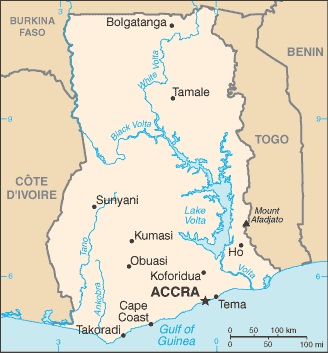
Area: 238,538 sq. km. (92,100 sq. mi.); about
the size of Illinois and Indiana combined.
Cities: Capital--Accra
(metropolitan area pop. 3 million est.). Other
cities--Kumasi (1 million est.), Tema
(500,000 est.), Sekondi-Takoradi (370,000 est.).
Terrain: Plains and scrubland, rainforest,
savanna.
Climate: Tropical.
People
Nationality: Noun
and adjective--Ghanaian(s).
Population (2007 est.): 23 million.
Density: 88/sq. km. (247/sq. mi.).
Annual growth rate (2007 est.): 2.7%.
Ethnic groups: Akan, Ewe, Ga, Moshi-Dagomba.
Religions: Christian 69%, Muslim 15.6%,
traditional and indigenous beliefs 8.5%.
Languages: English (official), Akan (which
includes Asante Twi, Akwapim Twi, Akyem, and
Fanti) 49%, Mole-Dagbani 16%, Ewe 13%,
Ga-Adangbe 8%, Guan 4%, others 10%.
Education: Years
compulsory--9. Literacy--53.7%.
Health: Infant
mortality rate (2003
est.)--64/1,000. Life
expectancy--59.2 yrs. for women, 55.5 yrs.
for men
Work force (11.1 million): Agriculture
and fishing--47.9%; industry
and transport--16.2%; sales
and clerical--19.3%; services--5.9%; professional--8.9%; other--1.8%.
Government
Type: Democracy.
Independence: March 6, 1957.
Constitution: Entered into force January 7,
1993.
Branches: Executive--president
popularly elected for a maximum of two 4-year
terms; Council of State, a presidential
appointed consultative body of 25 members
required by the constitution. Legislative--unicameral
Parliament popularly elected for 4-year terms. Judicial--independent
Supreme Court justices nominated by president
with approval of Parliament.
Subdivisions: Ten regions.
Political parties: New Patriotic Party, National
Democratic Congress, Convention People's Party,
People's National Convention, others.
Suffrage: Universal at 18.
Economy
GDP (2006): $12.5 billion.
Real GDP growth rate (2006): 6.2%.
Per capita GDP (2006): $540.
Inflation rate (consumer prices) (2006): 11%.
Natural resources: Gold, timber, diamonds,
bauxite, manganese, fish.
Agriculture: Products--cocoa,
coconuts, coffee, pineapples, cashews, pepper,
other food crops, rubber. Land--70%
arable and forested.
Business and industry: Types--mining,
lumber, light manufacturing, fishing, aluminum,
tourism.
Trade (2006): Exports--$3.9
billion: cocoa ($1.26 billion), gold, timber,
diamonds, manganese. Imports--$6.8
billion: petroleum ($1.3 billion), food,
industrial raw materials, machinery, equipment. Major
trade partners--Nigeria, China, U.S., U.K.,
Germany, Togo, France, Netherlands, Spain.
Fiscal year: Calendar year.
GEOGRAPHY
Ghana is located on West Africa's Gulf of
Guinea only a few degrees north of the Equator.
Half of the country lies less than 152 meters
(500 ft.) above sea level, and the highest point
is 883 meters (2,900 ft.). The 537-kilometer
(334-mi.) coastline is mostly a low, sandy shore
backed by plains and scrub and intersected by
several rivers and streams, most of which are
navigable only by canoe. A tropical rain forest
belt, broken by heavily forested hills and many
streams and rivers, extends northward from the
shore, near the Cote d'Ivoire frontier. This
area produces most of the country's cocoa,
minerals, and timber. North of this belt, the
country varies from 91 to 396 meters (300
ft.-1,300 ft.) above sea level and is covered by
low bush, park-like savanna, and grassy plains.
The climate is tropical. The eastern coastal
belt is warm and comparatively dry; the
southwest corner, hot and humid; and the north,
hot and dry. There are two distinct rainy
seasons in the south--May-June and
August-September; in the north, the rainy
seasons tend to merge. A dry, northeasterly
wind, the Harmattan, blows in January and
February. Annual rainfall in the coastal zone
averages 83 centimeters (33 in.).
Volta Lake, the largest manmade lake in the
world, extends from the Akosombo Dam in
southeastern Ghana to the town of Yapei, 520
kilometers (325 mi.) to the north. The lake
generates electricity, provides inland
transportation, and is a potentially valuable
resource for irrigation and fish farming.
PEOPLE
Ghana's population is concentrated along the
coast and in the principal cities of Accra and
Kumasi. Most Ghanaians descended from migrating
tribes that probably came down the Volta River
valley at the beginning of the 13th century.
Ethnically, Ghana is divided into small groups
speaking more than 50 languages and dialects.
Among the more important linguistic groups are
the Akans, which include the Fantis along the
coast and the Ashantis in the forest region
north of the coast; the Guans, on the plains of
the Volta River; the Ga- and Ewe-speaking
peoples of the south and southeast; and the
Moshi-Dagomba-speaking tribes of the northern
and upper regions. English, the official and
commercial language, is taught in all the
schools.
Education
Primary and junior secondary school
education is tuition-free and mandatory. The
Government of Ghana's support for basic
education is unequivocal. Article 39 of the
constitution mandates the major tenets of the
free, compulsory, universal basic education (FCUBE)
initiative. Launched in 1996, it is one of the
most ambitious pre-tertiary education programs
in West Africa. Since the early 1980s,
Government of Ghana expenditures on education
have risen from 1.5% to nearly 3.5% of GDP.
Since 1987, the share of basic education in
total education spending has averaged around
67%. The units of the Ministry of Education,
Science and Sports (MOESS) responsible for
education are: the Ghana Education Service
(GES), which administers pre-university
education; the National Council on Tertiary
Education; the National Accreditation Board; and
the National Board for Professional and
Technician Examinations (NABPTEX). The West
African Examinations Council (WAEC), a
consortium of five Anglophone West African
Countries (Ghana, Nigeria, Sierra Leone, Gambia,
and Liberia) is responsible for developing,
administering, and grading school-leaving
examinations at the secondary level.
Since 1986, pre-tertiary education in Ghana
includes six years of primary education, three
years at the junior secondary school level and
three years at the senior secondary school
level. A new educational reform, beginning
September 1, 2007, has introduced two years of
kindergarten education beginning at age four and
increased the three years senior secondary to
four years. Successful completion of senior
secondary school leads to admission eligibility
at training colleges, polytechnics, and
universities. In 2006 there were approximately
5.1 million students attending schools at these
three levels: 68% at the primary level, 23% at
the junior secondary level and 10% at the senior
secondary level. There are over six hundred
public senior secondary schools in Ghana that
graduated a total of 90,000 students in 2004,
representing a huge expansion over the old
system (which was transformed in 1987), which
consisted of three hundred institutions
graduating 27,000 students a year. However,
access to each successive level of education
remains severely limited by lack of facilities.
About 99.1% of junior secondary school graduates
are able to gain admission to senior secondary
schools, and only about 34.4% of senior
secondary school graduates are able to gain
admission to universities and polytechnics, plus
another 10-20% to diploma-level postsecondary
education. Private secondary schools play a very
small role in Ghana, with only a handful of
institutions offering international curricula
such as the British-based A-levels,
International Baccalaureate, and U.S. high
school. Combined, they graduate fewer than 200
students a year.
Entrance to one of the five Ghanaian public
universities is by examination following
completion of senior secondary school. There are
now five public and twelve private
degree-granting universities in Ghana, along
with ten public polytechnics offering the
British Higher National Diploma (HND), a
three-year tertiary system in applied fields of
study. Ghana's first private Catholic university
opened in 2003 in Sunyani. The polytechnics also
offer vocational, non-tertiary diploma programs.
In addition, there are approximately forty
teacher-training colleges and fifteen nurses'
training colleges. Private tertiary education is
a recent but rapid development in Ghana,
meticulously regulated by the National
Accreditation Board. Over 84,078 undergraduates
are now enrolled in secular degree-granting
programs in seventeen public and private
universities, 29,047 students enrolled in
polytechnics, and 26,025 trainees enrolled in
teacher training colleges.
HISTORY
The history of the Gold Coast before the
last quarter of the 15th century is derived
primarily from oral tradition that refers to
migrations from the ancient kingdoms of the
western Soudan (the area of Mauritania and
Mali). The Gold Coast was renamed Ghana upon
independence in 1957 because of indications that
present-day inhabitants descended from migrants
who moved south from the ancient kingdom of
Ghana. The first contact between Europe and the
Gold Coast dates from 1470, when a party of
Portuguese landed. In 1482, the Portuguese built
Elmina Castle as a permanent trading base.
Thomas Windham made the first recorded English
trading voyage to the coast in 1553. During the
next three centuries, the English, Danes, Dutch,
Germans, and Portuguese controlled various parts
of the coastal areas.
In 1821, the British Government took control of
the British trading forts on the Gold Coast. In
1844, Fanti chiefs in the area signed an
agreement with the British that became the legal
steppingstone to colonial status for the coastal
area.
From 1826 to 1900, the British fought a series
of campaigns against the Ashantis, whose kingdom
was located inland. In 1902, they succeeded in
establishing firm control over the Ashanti
region and making the northern territories a
protectorate. British Togoland, the fourth
territorial element eventually to form the
nation, was part of a former German colony
administered by the United Kingdom from Accra as
a League of Nations mandate after 1922. In
December 1946, British Togoland became a UN
Trust Territory, and in 1957, following a 1956
plebiscite, the United Nations agreed that the
territory would become part of Ghana when the
Gold Coast achieved independence.
The four territorial divisions were administered
separately until 1946, when the British
Government ruled them as a single unit. In 1951,
a constitution was promulgated that called for a
greatly enlarged legislature composed
principally of members elected by popular vote
directly or indirectly. An executive council was
responsible for formulating policy, with most
African members drawn from the legislature and
including three ex officio members appointed by
the governor. A new constitution, approved on
April 29, 1954, established a cabinet comprising
African ministers drawn from an all-African
legislature chosen by direct election. In the
elections that followed, the Convention People's
Party (CPP), led by Kwame Nkrumah, won the
majority of seats in the new Legislative
Assembly. In May 1956, Prime Minister Nkrumah's
Gold Coast government issued a white paper
containing proposals for Gold Coast
independence. The British Government stated it
would agree to a firm date for independence if a
reasonable majority for such a step were
obtained in the Gold Coast Legislative Assembly
after a general election. This election, held in
1956, returned the CPP to power with 71 of the
104 seats in the Legislative Assembly. Ghana
became an independent state on March 6, 1957,
when the United Kingdom relinquished its control
over the Colony of the Gold Coast and Ashanti,
the Northern Territories Protectorate, and
British Togoland.
In subsequent reorganizations, the country was
divided into 10 regions, which currently are
subdivided into 138 districts. The original Gold
Coast Colony now comprises the Western, Central,
Eastern, and Greater Accra Regions, with a small
portion at the mouth of the Volta River assigned
to the Volta Region; the Ashanti area was
divided into the Ashanti and Brong-Ahafo
Regions; the Northern Territories into the
Northern, Upper East, and Upper West Regions;
and British Togoland essentially is the same
area as the Volta Region.
Post-Independence Politics
After independence, the CPP government under
Nkrumah sought to develop Ghana as a modern,
semi-industrialized, unitary socialist state.
The government emphasized political and economic
organization, endeavoring to increase stability
and productivity through labor, youth, farmers,
cooperatives, and other organizations integrated
with the CPP. The government, according to
Nkrumah, acted only as "the agent of the CPP" in
seeking to accomplish these goals.
The CPP's control was challenged and criticized,
and Prime Minister Nkrumah used the Preventive
Detention Act (1958), which provided for
detention without trial for up to 5 years (later
extended to 10 years). On July 1, 1960, a new
constitution was adopted, changing Ghana from a
parliamentary system with a prime minister to a
republican form of government headed by a
powerful president. In August 1960, Nkrumah was
given authority to scrutinize newspapers and
other publications before publication. This
political evolution continued into early 1964,
when a constitutional referendum changed the
country to a one-party state. On February 24,
1966, the Ghanaian Army and police overthrew
Nkrumah's regime. Nkrumah and all his ministers
were dismissed, the CPP and National Assembly
were dissolved, and the constitution was
suspended. The new regime cited Nkrumah's
flagrant abuse of individual rights and
liberties, his regime's corrupt, oppressive, and
dictatorial practices, and the rapidly
deteriorating economy as the principal reasons
for its action.
Post-Nkrumah Politics
The leaders of the February 24, 1966 coup
established the new government around the
National Liberation Council (NLC) and pledged an
early return to a duly constituted civilian
government. Members of the judiciary and civil
service remained at their posts and committees
of civil servants were established to handle the
administration of the country. Ghana's
government returned to civilian authority under
the Second Republic in October 1969 after a
parliamentary election in which the Progress
Party, led by Kofi A. Busia, won 105 of the 140
seats. Until mid-1970, a presidential commission
led by Brigadier A.A. Afrifa held the powers of
the chief of state. In a special election on
August 31, 1970, former Chief Justice Edward
Akufo-Addo was chosen President, and Dr. Busia
became Prime Minister.
Faced with mounting economic problems, Prime
Minister Busia's government undertook a drastic
devaluation of the currency in December 1971.
The government's inability to control the
subsequent inflationary pressures stimulated
further discontent, and military officers seized
power in a bloodless coup on January 13, 1972.
The coup leaders, led by Col. I.K. Acheampong,
formed the National Redemption Council (NRC) to
which they admitted other officers, the head of
the police, and one civilian. The NRC promised
improvements in the quality of life for all
Ghanaians and based its programs on nationalism,
economic development, and self-reliance. In
1975, government reorganization resulted in the
NRC's replacement by the Supreme Military
Council (SMC), also headed by now-General
Acheampong.
Unable to deliver on its promises, the NRC/SMC
became increasingly marked by mismanagement and
rampant corruption. In 1977, General Acheampong
brought forward the concept of union government
(UNIGOV), which would make Ghana a non-party
state. Perceiving this as a ploy by Acheampong
to retain power, professional groups and
students launched strikes and demonstrations
against the government in 1977 and 1978. The
steady erosion in Acheampong's power led to his
arrest in July 1978 by his chief of staff, Lt.
Gen. Frederick Akuffo, who replaced him as head
of state and leader of what became known as the
SMC-2.
Akuffo abandoned UNIGOV and established a plan
to return to constitutional and democratic
government. A Constitutional Assembly was
established, and political party activity was
revived. Akuffo was unable to solve Ghana's
economic problems, however, or to reduce the
rampant corruption in which senior military
officers played a major role. On June 4, 1979,
his government was deposed in a violent coup by
a group of junior and noncommissioned
officers--Armed Forces Revolutionary Council
(AFRC)--with Flt. Lt. Jerry John Rawlings as its
chairman.
The AFRC executed eight senior military
officers, including former chiefs of state
Acheampong and Akuffo; established Special
Tribunals that, secretly and without due
process, tried dozens of military officers,
other government officials, and private
individuals for corruption, sentencing them to
long prison terms and confiscating their
property; and, through a combination of force
and exhortation, attempted to rid Ghanaian
society of corruption and profiteering. At the
same time, the AFRC accepted, with a few
amendments, the draft constitution that had been
submitted; permitted the scheduled presidential
and parliamentary elections to take place in
June and July; promulgated the constitution; and
handed over power to the newly elected President
and Parliament of the Third Republic on
September 24, 1979.
The 1979 constitution was modeled on those of
Western democracies. It provided for the
separation of powers between an elected
president and a unicameral Parliament, an
independent judiciary headed by a Supreme Court,
which protected individual rights, and other
autonomous institutions, such as the Electoral
Commissioner and the Ombudsman. The new
President, Dr. Hilla Limann, was a career
diplomat from the north and the candidate of the
People's National Party (PNP), the political
heir of Nkrumah's CPP. Of the 140 members of
Parliament, 71 were PNP. The PNP government
established the constitutional institutions and
generally respected democracy and individual
human rights. It failed, however, to halt the
continuing decline in the economy; corruption
flourished, and the gap between rich and poor
widened. On December 31, 1981, Flight Lt.
Rawlings and a small group of enlisted and
former soldiers launched a coup that succeeded
against little opposition in toppling President
Limann.
The PNDC Era
Rawlings and his colleagues suspended the
1979 constitution, dismissed the President and
his cabinet, dissolved the Parliament, and
proscribed existing political parties. They
established the Provisional National Defense
Council (PNDC), initially composed of seven
members with Rawlings as chairman, to exercise
executive and legislative powers. The existing
judicial system was preserved, but alongside it
the PNDC created the National Investigation
Committee to root out corruption and other
economic offenses; the anonymous Citizens'
Vetting Committee to punish tax evasion; and the
Public Tribunals to try various crimes. The PNDC
proclaimed its intent to allow the people to
exercise political power through defense
committees to be established in communities,
workplaces, and in units of the armed forces and
police. Under the PNDC, Ghana remained a unitary
government.
In December 1982, the PNDC announced a plan to
decentralize government from Accra to the
regions, the districts, and local communities,
but it maintained overall control by appointing
regional and district secretaries who exercised
executive powers and also chaired regional and
district councils. Local councils, however, were
expected progressively to take over the payment
of salaries, with regions and districts assuming
more powers from the national government. In
1984, the PNDC created a National Appeals
Tribunal to hear appeals from the public
tribunals; changed the Citizens' Vetting
Committee into the Office of Revenue Collection;
and replaced the system of defense committees
with Committees for the Defense of the
Revolution.
In 1984, the PNDC also created a National
Commission on Democracy to study ways to
establish participatory democracy in Ghana. The
commission issued a "Blue Book" in July 1987
outlining modalities for district-level
elections, which were held in late 1988 and
early 1989, for newly created district
assemblies. The government appointed one-third
of the assembly members.
The Fourth Republic
Under international and domestic pressure
for a return to democracy, the PNDC allowed the
establishment of a 258-member Consultative
Assembly made up of members representing
geographic districts as well as established
civic or business organizations. The assembly
was charged to draw up a draft constitution to
establish a Fourth Republic, using PNDC
proposals. The PNDC accepted the final product
without revision, and it was put to a national
referendum on April 28, 1992, in which it
received 92% approval. On May 18, 1992, the ban
on party politics was lifted in preparation for
multi-party elections. The PNDC and its
supporters formed a new party, the National
Democratic Congress (NDC), to contest the
elections. Presidential elections were held on
November 3 and parliamentary elections on
December 29, 1992. Members of the opposition
boycotted the parliamentary elections, however,
which resulted in a 200-seat Parliament with
only 17 opposition party members and two
independents.
The constitution entered into force on January
7, 1993, to found the Fourth Republic. On that
day, Flt. Lt. Jerry John Rawlings was
inaugurated as President and members of
Parliament swore their oaths of office. In 1996,
the opposition fully contested the presidential
and parliamentary elections, which were
described as peaceful, free, and transparent by
domestic and international observers. In that
election, President Rawlings was re-elected with
57% of the popular vote. In addition, Rawlings'
NDC party won 133 of the Parliament's 200 seats,
just one seat short of the two-thirds majority
needed to amend the constitution, although the
election returns of two parliamentary seats
faced legal challenges.
The December 2000 elections ushered in the first
democratic presidential change of power in
Ghana's history when John A. Kufuor of the New
Patriotic Party (NPP) defeated the NDC's John
Atta Mills--who was Rawling's Vice President and
hand-picked successor. Kufuor defeated Mills by
winning 56.73% of the vote, while the NPP picked
up 100 of 200 seats in Parliament. The elections
were declared free and fair by a large
contingent of domestic and international
monitors. After several by-elections were held
to fill vacated seats, the NPP majority stood at
103 of the 200 seats in Parliament, while the
NDC held 89 and independent and small party
members held eight.
In December 2004, eight political parties
contested parliamentary elections and four
parties, including the NPP and NDC, contested
presidential elections. This election was
reported to have a remarkable turnout of 85.12%
according to the Election Commission. Despite a
few incidents of intimidation and minor
irregularities, domestic and international
observers judged the elections generally free
and fair. There were several isolated incidents
of election-related violence, but the election
was generally peaceful in most of Ghana. John
Agyekum Kufuor was re-elected president with
52.45% of the vote against three other
presidential candidates, including former
Vice-President John Atta Mills of the NDC.
Thirty constituencies were created in the period
between the 2000 and 2004 elections, resulting
in a 230-member Parliament. Ghana's next
presidential election will be held in 2008, and
the race to succeed President Kufuor is well
underway, with more than 15 candidates seeking
the office.
On March 6, 2007, Ghana celebrated its 50th
anniversary since becoming independent. As the
first African nation to win its struggle for
independence, Ghana hosted delegations from
around the world during its year-long Jubilee
event.
GOVERNMENT AND POLITICAL CONDITIONS
The 1993 constitution that established the
Fourth Republic provided a basic charter for the
republican democratic government. It declares
Ghana to be a unitary republic with sovereignty
residing in the Ghanaian people. Intended to
prevent future coups, dictatorial government,
and one-party states, it is designed to
establish the concept of power sharing. The
document reflects lessons learned from the
abrogated constitutions of 1957, 1960, 1969, and
1979, and incorporates provisions and
institutions drawn from British and American
constitutional models. One controversial
provision of the constitution indemnifies
members and appointees of the PNDC from
liability for any official act or omission
during the years of PNDC rule. The constitution
calls for a system of checks and balances, with
power shared between a president, a unicameral
parliament, an advisory Council of State, and an
independent judiciary.
Executive authority is established in the Office
of the Presidency, together with his Council of
State. The president is head of state, head of
government, and commander in chief of the armed
forces. He also appoints the vice president.
According to the constitution, more than half of
the presidential-appointed ministers of state
must be appointed from among members of
Parliament.
Legislative functions are vested in Parliament,
which consists of a unicameral 230-member body
plus the Speaker. To become law, legislation
must have the assent of the president, who has a
qualified veto over all bills except those to
which a vote of urgency is attached. Members of
Parliament are popularly elected by universal
adult suffrage for terms of 4 years, except in
wartime, when terms may be extended for not more
than 12 months at a time beyond the 4 years.
The structure and the power of the judiciary are
independent of the two other branches of
government. The Supreme Court has broad powers
of judicial review. It is authorized by the
constitution to rule on the constitutionality of
any legislation or executive action at the
request of any aggrieved citizen. The hierarchy
of courts derives largely from British juridical
forms. The hierarchy, called the Superior Court
of Judicature, is composed of the Supreme Court
of Ghana, the Court of Appeal, the High Court of
Justice, regional tribunals, and such lower
courts or tribunals as Parliament may establish.
The courts have jurisdiction over all civil and
criminal matters.
The government of John A. Kufuor appears to
enjoy broad support among the Ghanaian
population as it pursues a domestic political
agenda based upon public commitment to the rule
of law, basic human rights, and free market
initiatives. So far, the government has taken
steps to strengthen freedoms of expression by
repealing colonial-era criminal libel laws,
dropping a number of libel suits against
journalists, abolishing sometimes abusive
community tribunals, and introducing legislation
to establish a juvenile justice system. As part
of its anti-corruption efforts the Kufuor
government has pursued some high-profile cases,
including the prosecution of its Minister of
Youth and Sports and several former high-level
government officials. On September 3, 2002,
Ghana inaugurated its National Reconciliation
Commission, a South Africa-style commission
established to investigate human rights abuses
under Ghana's former military regimes. The
National Reconciliation Commission completed its
hearings in July 2004 and submitted its final
report with recommendations in October 2004. The
government responded with a White Paper in April
2005, accepting the recommendation to establish
a Reparation and Rehabilitation Fund for victims
of abuse, as well as directing security forces
to study carefully the various recommendations
on recruitment, training and deployment.
Narcotics trafficked through Ghana to Western
Europe and North America also pose a significant
challenge for Ghana.
Principal Government Officials
President--John Agyekum Kufuor
Vice President--Alhaji Aliu Mahama
Minister of Foreign Affairs--Akwasi Osei-Adjei
Minister of Defense--Albert Ken-Dapaah
Minister of Finance and Economic
Planning--Kwadwo Baah-Wiredu
Minister of Trade & Industry--Joe Baidoe-Ansah
Minister of Justice and Attorney General--Joe
Ghartey
Minister of Interior--Kwamena Bartels
Chief Justice of the Supreme Court--Georgina
Theodora Wood
Speaker of Parliament--Ebenezer Begyina Sekyi
Hughes
Ambassador to the United States--Kwame
Bawuah-Edusei
Permanent Representative to the United
Nations--Nana Effah-Apenteng
Ghana maintains an embassy in
the United States at 3512 International Drive,
NW, Washington, DC 20008 (tel. 202-686-4500).
Its permanent mission to the United Nations is
located at 19 E. 47th Street, New York, NY 10017
(tel. 212-832-1300).
ECONOMY
By West African standards, Ghana has a
relatively diverse and rich natural resource
base Minerals--principally gold, diamonds,
manganese ore, and bauxite--are produced and
exported. Exploration for oil and gas resources
is ongoing. Timber and marine resources are
important but declining resources.
Agriculture remains a mainstay of the economy,
accounting for more than one-third of GDP and
about 55% of formal employment. Cash crops
consist primarily of cocoa and cocoa products,
which typically provide about one-third of
export revenue, timber products, coconuts and
other palm products, shea nuts (which produce an
edible fat), and coffee. Ghana also has
established a successful program of
nontraditional agricultural products for export
including pineapples, cashews, and peppers.
Cassava, yams, plantains, corn, rice, peanuts,
millet, and sorghum are the basic foodstuffs.
Fish, poultry, and meat also are important
dietary staples.
Ghana's industrial base is relatively advanced
compared to many other African countries.
Industries include textiles, apparel, steel
(using scrap), tires, oil refining, flour
milling, beverages, tobacco, simple consumer
goods, and car, truck, and bus assembly.
Industry, including mining, manufacturing,
construction and electricity, accounts for about
25% of GDP.
Gold shares the top export revenue spot with
cocoa, each bringing in about $1 billion in
2006. Tourism has become one of Ghana's largest
foreign income earners (ranking third in 2005 at
$836 million), and the Ghanaian Government has
placed strong emphasis on further development of
the sector. The country's largest source of
foreign exchange is remittances from abroad,
which totaled about $4 billion in 2006.
Ghana's post-independence economic story has
been a difficult one, but over the last 20
years, stability and growth have increasingly
taken hold. Real GDP growth has averaged 4%
since the mid-80s and was about 6% 2004-2006.
Inflation and interest rates have declined
steadily, particularly over the last decade.
Ghana's poverty rate has also come down
markedly, from 51.7% in 1991 to 28.5% in
2005/2006. Ghana is on track to meet the
Millennium Development goal of halving extreme
poverty by 2008, well ahead of the 2015 target.
Economic Development
At independence, Ghana had a substantial
physical and social infrastructure and $481
million in foreign reserves. The Nkrumah
government further developed the infrastructure
and made important public investments in the
industrial sector. With assistance from the
United States, the World Bank, and the United
Kingdom, construction of the Akosombo Dam was
completed on the Volta River in 1966. Two U.S.
companies built Valco, Africa's largest aluminum
smelter, to use power generated at the dam.
Aluminum exports from Valco used to be a major
source of foreign exchange for Ghana, but an
investment dispute beginning in 2001, followed
by sale back to the government, has led to
sporadic operation in recent years, and it was
closed again in March 2007 due to the country's
energy crisis.
Many Nkrumah-era investments were monumental
public works projects and poorly conceived,
badly managed agricultural and industrial
schemes. With cocoa prices falling and the
country's foreign exchange reserves fast
disappearing, the government resorted to
supplier credits to finance many projects. By
the mid-1960s, Ghana's reserves were gone, and
the country could not meet repayment schedules.
The National Liberation Council responded by
abandoning unprofitable projects and selling
some inefficient state-owned enterprises to
private investors. On three occasions, Ghana's
creditors agreed to reschedule repayments due on
Nkrumah-era supplier credits. Led by the United
States, foreign donors provided import loans to
enable the foreign exchange-strapped government
to import essential commodities.
Prime Minister Busia's government (1969-72)
liberalized controls to attract foreign
investment and to encourage domestic
entrepreneurship. Investors were cautious,
however, and cocoa prices declined again while
imports surged, precipitating a serious trade
deficit. Despite considerable foreign assistance
and some debt relief, the Busia regime also was
unable to overcome the inherited restraints on
growth posed by the debt burden,
balance-of-payments imbalances, foreign exchange
shortages, and mismanagement.
Although foreign aid helped prevent economic
collapse and was responsible for subsequent
improvements in many sectors, the economy
stagnated in the 10-year period preceding the
NRC takeover in 1972. Population growth offset
the modest increase in gross domestic product,
and real earnings declined for many Ghanaians.
To restructure the economy, the NRC, under
General Acheampong (1972-78), undertook an
austerity program that emphasized self-reliance,
particularly in food production. These plans
were not realized, however, primarily because of
post-1973 oil price increases and a drought in
1975-77 that particularly affected northern
Ghana. The NRC, which had inherited foreign
debts of almost $1 billion, abrogated existing
rescheduling arrangements for some debts and
rejected other repayments. After creditors
objected to this unilateral action, a 1974
agreement rescheduled the medium-term debt on
liberal terms. The NRC also imposed the
Investment Policy Decree of 1975--effective on
January 1977--that required 51% Ghanaian equity
participation in most foreign firms, but the
government took 40% in specified industries.
Many shares were sold directly to the public.
Continued mismanagement of the economy, record
inflation (more than 100% in 1977), and
increasing corruption, notably at the highest
political levels, led to growing
dissatisfaction. The post-July 1978 military
regime led by General Akuffo attempted to deal
with Ghana's economic problems by making small
changes in the overvalued cedi and by
restraining government spending and monetary
growth. Under a one-year standby agreement with
the International Monetary Fund (IMF) in January
1979, the government promised to undertake
economic reforms, including a reduction of the
budget deficit, in return for a $68 million IMF
support program and $27 million in IMF Trust
Fund loans. The agreement became inoperative,
however, after the June 4 coup that brought
Flight Lieutenant Rawlings and the AFRC to power
for 4 months.
In September 1979, the civilian government of
Hilla Limann inherited declining per capita
income, stagnant industrial and agricultural
production due to inadequate imported supplies,
shortages of imported and locally produced
goods, a sizable budget deficit (almost 40% of
expenditures in 1979), high inflation,
"moderating" to 54% in 1979, an increasingly
overvalued cedi, flourishing smuggling and other
black-market activities, high unemployment,
particularly among urban youth, deterioration in
the transport network, and continued foreign
exchange constraints.
Limann's PNP government announced yet another
(2-year) reconstruction program, emphasizing
increased food production, exports, and
transport improvements. Import austerity was
imposed and external payments arrears cut.
However, cocoa production and prices fell, while
oil prices soared. No effective measures were
taken to reduce rampant corruption and black
marketing.
When Rawlings again seized power at the end of
1981, cocoa output had fallen to half the
1970-71 level and its world price to one-third
the 1975 level. By 1982, oil would constitute
half of Ghana's imports, while overall trade
contracted greatly. Internal transport had
slowed to a crawl, and inflation remained high.
During Rawlings' first year, the economy was
stagnant. Industry ran at about 10% of capacity
due to the chronic shortage of foreign exchange
to cover the importation of required raw
materials and replacement parts. Economic
conditions deteriorated further in early 1983
when Nigeria expelled an estimated 1 million
Ghanaians who had to be absorbed by Ghana.
In April 1983, in coordination with the IMF, the
PNDC launched an economic recovery program,
perhaps the most stringent and consistent of its
day in Africa, aimed at reopening infrastructure
bottlenecks and reviving moribund productive
sectors--agriculture, mining, and timber. The
largely distorted exchange rate and prices were
realigned to encourage production and exports.
The government imposed fiscal and monetary
discipline to curb inflation. Through November
1987, the cedi was devalued by more than 6,300%,
and widespread direct price controls were
substantially reduced.
The economy's response to these reforms was
initially hampered by the absorption of 1
million returnees from Nigeria, compounded by
the decline of foreign aid and the onset of the
worst drought since independence, which brought
on widespread bushfires and forced closure of
the aluminum smelter and severe power cuts for
industry. In 1985, the country absorbed an
additional 100,000 expellees from Nigeria. In
1987, cocoa prices declined again; however,
infrastructure repairs, improved weather, and
producer incentives and support revived output.
During 1984-88 the economy experienced solid
growth for the first time since 1978. Renewed
exports, aid inflows, and a foreign exchange
auction eased hard currency constraints.
While the reforms caused substantial shocks in
some sectors, particularly agriculture and
textiles, the overall effects were positive and
helped bring about a measure of economic
stabilization and recovery. However, a big drop
in world cocoa and gold prices hurt growth and,
in the face of pending elections, spurred
government spending, leading to an increased
deficit, falling currency and high inflation at
the time a new government led by John Agyekum
Kufuor took office in 2000.
The economy has performed well under the Kufuor
administration, but Ghana's fundamental
vulnerabilities remain. The new administration
continued the economic stabilization begun under
the previous administration, and has taken some
difficult but necessary steps such as ending
subsidies of petroleum prices. Solid
macroeconomic management coupled with major debt
relief, large inflows of donor resources, and
relatively high cocoa and gold prices have been
the keys to the steady improvements in real GDP
growth, which in 2004 topped 5% for the first
time in a decade and reached an estimated 6.2%
in 2006. Further debt relief, continued large
aid inflows, favorable commodity prices, and $4
billion in gross annual remittances--this figure
includes remittances from individuals as well as
non-governmental organizations (NGOs) and
embassies; individual remittances were estimated
at about $1.8 billion in 2006--put Ghana in a
stronger balance of payments position.
Ghana was recognized for its economic and
democratic achievements in 2006, when it signed
a five-year, $547 million anti-poverty compact
with the United States' Millennium Challenge
Corporation. The compact focuses on accelerating
growth and poverty reduction through
agricultural and rural development. The compact
has three main components: enhancing the
profitability of commercial agriculture among
small farmers; reducing the transportation costs
affecting agricultural commerce through
improvements in transportation infrastructure,
and expanding basic community services and
strengthening rural institutions that support
agriculture and agri-business. The compact is
expected to contribute to improving the lives of
one million Ghanaians.
Ghana's stated goals are to accelerate economic
growth, improve the quality of life for all
Ghanaians, and reduce poverty through
macroeconomic stability, higher private
investment, broad-based social and rural
development, as well as direct
poverty-alleviation efforts. These plans are
fully supported by the international donor
community.
Key economic challenges include: overcoming
infrastructure bottlenecks, especially in energy
and water; poor management of natural resources;
improving human resource capacity and
development; establishing a business and
investment climate that encourages and allows
private sector-led growth, and privatizing
remaining state-owned enterprises, several of
which are significant budget liabilities.
FOREIGN RELATIONS
Ghana is active in the United Nations and
many of its specialized agencies, as well as the
World Trade Organization, the Nonaligned
Movement, the African Union (AU), and the
Economic Community of West African States
(ECOWAS). Generally, Ghana follows the consensus
of the Nonaligned Movement and the AU on
economic and political issues that do not
directly affect its own interests. Ghana plays
an increasingly active role in subregional
affairs. In February 2002, Ghana's former Deputy
Foreign Minister, Mohammed Ibn Chambas, assumed
the office of ECOWAS Executive Secretary. In
February 2003, President Kufuor became the
Chairperson of ECOWAS heads of state, taking on
a strong role in the Cote d'Ivoire and Liberian
peace and reconciliation processes. Kufuor was
reelected to a second year in December 2003. His
tenure expired in January 2005. Ghana took a
non-permanent seat on the UN Security Council in
January 2006. In January 2007, President Kufuor
was elected Chairman of the African Union, and
Ghana hosted the June 2007 AU Summit, which
focused on increasing African unity.
Ghana has been extremely active in international
peacekeeping activities under UN auspices in
Lebanon, Afghanistan, Rwanda, the Balkans, and
Pakistan, in addition to an 8-year subregional
initiative with its ECOWAS partners to develop
and then enforce a cease-fire in Liberia. In
January 2003, Ghana sent a company of troops to
Cote d'Ivoire as part of the ECOWAS
stabilization force and sent another contingent
to Liberia in July of 2003; the United States
provided logistical assistance to Ghana in these
efforts. Ghana has current deployments to Cote
d'Ivoire, Liberia, Sierra Leone, Lebanon, and
Congo with numerous small troop deployments in
the role of UN observers in many other crisis
locations around the world. Additionally, Ghana
sent some troops to a French-sponsored RECAMP
Exercise in Benin, clearly highlighting the key
role that peacekeeping operations have in the
Ghana Armed Forces. Ghana maintains friendly
relations with all states, regardless of
ideology. Ghana has also committed to send a
peacekeeping contingent to Somalia.
U.S.-GHANAIAN RELATIONS
The United States has enjoyed good relations
with Ghana at a nonofficial, personal level
since Ghana's independence. Thousands of
Ghanaians have been educated in the United
States. Close relations are maintained between
educational and scientific institutions, and
cultural links, particularly between Ghanaians
and African-Americans, are strong.
Through the U.S. International Visitor Program,
Ghanaian parliamentarians and other government
officials have become acquainted with U.S.
congressional and state legislative practices
and have participated in programs designed to
address other issues of interest. The U.S. and
Ghanaian militaries have cooperated in numerous
joint training exercises, culminating with
Ghanaian participation in the African Crisis
Response Initiative, an international activity
in which the U.S. facilitates the development of
an interoperable peacekeeping capacity among
African nations. U.S.-Ghanaian military
cooperation continues under the new African
Contingency Operations Training and Assistance
program; Ghana was one of the first militaries
to receive ACOTA training in early 2003. In
addition, there is an active bilateral
International Military Education and Training
program. Additionally, Ghana is the site of a
U.S.-European Command-funded Exercise Reception
Facility that was established to facilitate
troop deployments for exercises or crisis
response within the region. The facility is a
direct result of Ghana's partnership with the
United States on a Fuel Hub Initiative. Ghana is
one of few African nations selected for the
State Partnership Program, which will promote
greater economic ties with U.S. institutions,
including the National Guard.
The United States is among Ghana's principal
trading partners. The Office of the President of
Ghana worked closely with the U.S. Embassy in
Accra to establish an American Chamber of
Commerce to continue to develop closer economic
ties in the private sector. Major U.S. companies
operating in the country include ACS, CMS
Energy, Coca Cola, S.C. Johnson, Ralston Purina,
Star-Kist, A.H. Robins, Sterling, Pfizer, IBM,
3M, Motorola, Stewart & Stevenson,
PriceWaterhouseCoopers, and National Cash
Register (NCR). Several U.S. firms recently made
or are considering investments in Ghana,
primarily in gold mining, wood products, and
petroleum. U.S. mining giant Newmont entered
Ghana's mining sector in 2004 and intends to
invest up to $1 billion. In late 1997, Nuevo
Petroleum concluded an oil exploration agreement
accounting for the last of Ghana's offshore
mineral rights zones. Several other U.S. oil
companies also are engaged in offshore
exploration, but so far with little success.
U.S. development assistance to Ghana in fiscal
year 2007 was implemented by USAID, the African
Development Foundation, Millennium Challenge
Corporation, and others. U.S. development
assistance to Ghana in fiscal year 2007 totaled
more than $55.1 million, with programs in small
farmer competitiveness, health, including
HIV/AIDS and maternal child health, education,
and democracy/governance. Ghana
was the first country in the world to accept
Peace Corps volunteers, and the program remains
one of the largest. Currently, there are more
than 150 volunteers in Ghana. Almost half work
in education, and the others in agro-forestry,
small business development, health education,
water sanitation, and youth development. Ghana's
$547 million compact with the Millennium
Challenge Corporation is the most recent
achievement in the U.S.-Ghanaian development
partnership.
Principal U.S. Officials
Ambassador--Pamela E. Bridgewater
Deputy Chief of Mission--Sue K. Brown
Director, USAID Mission--Dennis Weller, Acting
Defense Attaché--Lt Col Benjamin Moody
Foreign Commercial Service--Diane Jones
Public Affairs Officer--Chris Hodges
Political Chief--Brian Shukan
Economic Chief--Susan Driano
Management Counselor-- Christopher Stillman
Consul--Michael Evans
Deputy Consul--Jeffrey Graham
The U.S.
Embassy is
located at 24th Circular
Road, Cantonments, Accra (tel. 233-21-741-000).
The mailing address is P.O. Box 194, Accra,
Ghana. For American citizen services and visa
questions, the Embassy consular section
telephone number is 233-21-741-100.
 Information
on Countries from Around the World
Information
on Countries from Around the World