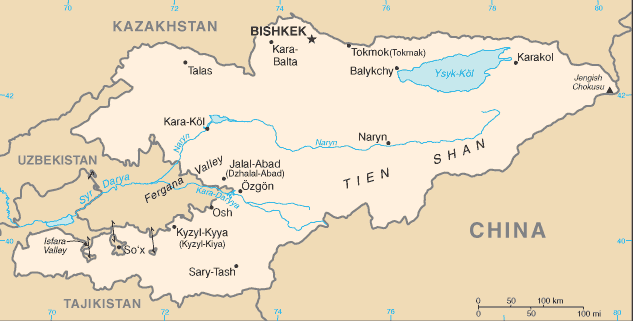
Geography
Area: 77,181 sq. mi.
Cities: Bishkek (capital), Osh, Cholpon Ata,
Karakol.
Terrain: 90% mountainous, with some desert
regions. Elevation
extremes--lowest point: Kulundy village in
the Batken province 401 m; highest point:
Jengish Chokusu (Pik Pobedy) 7,439 m.
People
Nationality: Kyrgyzstani.
Population (July 2008): 5,356,869.
Annual growth rate (2008): 1.38%.
Ethnic groups (2007): Kyrgyz 68.9%; Russian
9.1%; Uzbek 14.4%; Dungan (ethnic Chinese
Muslims) 1%; Uighurs 1%; Tajik 0.9%, Kazakh
0.8%, Tatars 0.7%; Korean 0.4%, German 0.3%.
Main religions: Islam; Russian Orthodox.
Languages: Kyrgyz (state); Russian (official,
2001).
Education: Nine years compulsory. Literacy--98.7%.
Health (2006): Infant
mortality rate--29.2
deaths/1,000 live births. Life expectancy--67.7
years.
Population distribution (2006): Urban 64.7%;
rural 35.3%.
Government
Type: Republic.
Independence: August 31, 1991 (from the Soviet
Union).
Constitution: May 5, 1993; amended in 1996,
1998, 2003, 2006, and 2007.
Branches: Executive--president,
prime minister. Legislative--parliament. Judicial--Supreme
Court, Constitutional Court, local courts,
Procurator-General.
Administrative subdivisions: Seven oblasts and
the municipality of Bishkek.
Political parties and leaders: Ak Jol People's
Party, no formal leader, but this is the party
of President Bakiyev; Social Democratic Party of
Kyrgyzstan, Deputy Almazbek Atambayev; Party of
Communists of Kyrgyzstan, Deputy Iskhak Masaliev;
Ar Namys (Dignity) Party, Feliks Kulov; Ata-Meken
(Fatherland) Party, Omurbek Tekebaev; Jany
Kyrgyzstan Party, Presidential Advisor Usen
Sydykov; Erkindik (Freedom) Party, Shamshibek
Utebaev; Zamandash Party, Muktarbek Omurakunov;
Ak Shumkar Party, Temir Sariyev.
Economy
GDP: 2007, $3.75 billion; 2006, $2.8 billion;
2003, $1.9 billion.
GDP growth rate in 2007: 8.2%.
Inflation rate in 2007: 10.2%.
GDP per capita (2006 est.): $536.
Unemployment rate (as of the end of 2006):
17.7%.
Natural resources: Abundant hydropower;
significant deposits of gold and rare earth
metals; locally exploitable coal, oil, and
natural gas; other deposits of iron, bauxite,
copper, tin, molybdenum, mercury, and antimony.
Agriculture: Products--tobacco,
cotton, wheat, vegetables (potatoes, sugar
beets, beans), fruits (apples, apricots,
peaches, grapes), berries, sheep, goats, cattle,
wool.
Industry: Types--small
machinery (electric motors, transformers), light
industry (cotton and wool processing, textiles,
food processing), construction materials
(cement, glass, slate), shoes, furniture,
mining, energy.
Trade: Exports (2007)--$1.34
billion: cotton, wool, meat, tobacco, gold,
mercury, uranium, hydropower, machinery, shoes. Partners--Russia
20.7%, Switzerland 19.9%, Kazakhstan 18.0%,
Afghanistan 10.4%. Imports--$2.64
billion: oil and gas, machinery and equipment,
foodstuffs. Partners--Russia
40.5%, China 14.7%, Kazakhstan 12.9%, Uzbekistan
5%.
Total external debt mid-2008 was $3.16 billion,
of which $2.19 billion was public debt.
PEOPLE AND HISTORY
According to recent findings of Kyrgyz and
Chinese historians, Kyrgyz history dates back to
201 B.C. The earliest descendents of the Kyrgyz
people, who are believed to be of Turkic
descent, lived in the northeastern part of what
is currently Mongolia. Later, some of their
tribes migrated to the region that is currently
southern Siberia and settled along the Yenisey
River, where they lived from the 6th until the
8th centuries. They spread across what is now
the Tuva region of the Russian Federation,
remaining in that area until the rise of the
Mongol Empire in the 13th century, when the
Kyrgyz began migrating south. In the 12th
century, Islam became the predominant religion
in the region. Most Kyrgyz are Sunni Muslims of
the Hanafi school.
During the 15th-16th centuries, the Kyrgyz
people settled in the territory currently known
as the Kyrgyz Republic. In the early 19th
century, the southern territory of the Kyrgyz
Republic came under the control of the Khanate
of Kokand, and the territory was formally
incorporated into the Russian Empire in 1876.
The Russian takeover instigated numerous revolts
against tsarist authority, and many Kyrgyz opted
to move into the Pamir mountains or to
Afghanistan. The suppression of the 1916
rebellion in Central Asia caused many Kyrgyz to
migrate to China.
Soviet power was initially established in the
region in 1918, and in 1924, the Kara-Kyrgyz
Autonomous Oblast was created within the Russian
Federal Socialist Republic. (The term
Kara-Kyrgyz was used until the mid-1920s by the
Russians to distinguish them from the Kazakhs,
who were also referred to as Kyrgyz.) In 1926,
it became the Kyrgyz Autonomous Soviet Socialist
Republic. On December 5, 1936, the Kyrgyz Soviet
Socialist Republic (SSR) was established as a
full Union Republic of the U.S.S.R.
During the 1920s, the Kyrgyz Republic saw
considerable cultural, educational, and social
change. Economic and social development also was
notable. Literacy increased, and a standard
literary language was introduced. The Kyrgyz
language belongs to the Southern Turkic group of
languages. In 1924, an Arabic-based Kyrgyz
alphabet was introduced, which was replaced by
Latin script in 1928. In 1941 Cyrillic script
was adopted. Many aspects of the Kyrgyz national
culture were retained despite suppression of
nationalist activity under Joseph Stalin, who
controlled the Soviet Union from the late 1920s
until 1953.
The early years of glasnost in the late 1980s
had little effect on the political climate in
the Kyrgyz Republic. However, the republic's
press was permitted to adopt a more liberal
stance and to establish a new publication,
Literaturny Kirghizstan, by the Union of
Writers. Unofficial political groups were
forbidden, but several groups that emerged in
1989 to deal with an acute housing crisis were
permitted to function.
In June 1990, ethnic tensions between Uzbeks and
Kyrgyz surfaced in an area of the Osh Oblast,
where Uzbeks form a majority of the population.
Violent confrontations ensued, and a state of
emergency and curfew were introduced. Order was
not restored until August 1990.
The early 1990s brought measurable change to the
Kyrgyz Republic. The Kyrgyzstan Democratic
Movement (KDM) had developed into a significant
political force with support in parliament. In
an upset victory, Askar Akayev, the president of
the Kyrgyz Academy of Sciences, was elected to
the presidency in October 1990. The following
January, Akayev introduced new government
structures and appointed a new government
comprised mainly of younger, reform-oriented
politicians. In December 1990, the Supreme
Soviet voted to change the republic's name to
the Republic of Kyrgyzstan. (In 1993, it became
the Kyrgyz Republic.) In February 1991, the name
of the capital, Frunze, was changed back to its
pre-revolutionary name--Bishkek.
Despite these moves toward independence,
economic realities seemed to work against
secession from the U.S.S.R. In a referendum on
the preservation of the U.S.S.R. in March 1991,
88.7% of the voters approved a proposal to
retain the U.S.S.R. as a "renewed federation."
On August 19, 1991, when the State Committee for
the State of Emergency (SCSE) assumed power in
Moscow, there was an attempt to depose Akayev in
Kyrgyzstan. After the coup collapsed the
following week, Akayev and Vice President German
Kuznetsov announced their resignations from the
Communist Party of the Soviet Union (CPSU), and
the entire politburo and secretariat resigned.
This was followed by the Supreme Soviet vote
declaring independence from the U.S.S.R. on
August 31, 1991. Kyrgyz was announced as the
state language in September 1991. (In December
2001, through a constitutional amendment, the
Russian language was given official status.)
In October 1991, Akayev ran unopposed and was
elected President of the new independent
republic by direct ballot, receiving 95% of the
votes cast. Together with the representatives of
seven other republics, he signed the Treaty of
the New Economic Community that same month. On
December 21, 1991, the Kyrgyz Republic formally
entered the new Commonwealth of Independent
States (CIS).
In 1993, allegations of corruption against
Akayev's closest political associates blossomed
into a major scandal. One of those accused of
improprieties was Prime Minister Chyngyshev, who
was dismissed for ethical reasons in December.
Following Chyngyshev's dismissal, Akayev
dismissed the government and called upon the
last communist premier, Apas Djumagulov, to form
a new one. In January 1994, Akayev initiated a
referendum asking for a renewed mandate to
complete his term of office. He received 96.2%
of the vote.
A new constitution was passed by the parliament
in May 1993. In 1994, however, the parliament
failed to produce a quorum for its last
scheduled session prior to the expiration of its
term in February 1995. President Akayev was
widely accused of having manipulated a boycott
by a majority of the parliamentarians. Akayev,
in turn, asserted that the communists had caused
a political crisis by preventing the legislature
from fulfilling its role. Akayev scheduled an
October 1994 referendum, overwhelmingly approved
by voters, which proposed two amendments to the
constitution--one that would allow the
constitution to be amended by means of a
referendum, and the other creating a new
bicameral parliament called the Jogorku Kenesh.
Elections for the two legislative chambers--a
35-seat full-time assembly and a 70-seat
part-time assembly--were held in February 1995
after campaigns considered remarkably free and
open by most international observers, although
the election-day proceedings were marred by
widespread irregularities. Independent
candidates won most of the seats, suggesting
that personalities prevailed over ideologies.
The new parliament convened its initial session
in March 1995. One of its first orders of
business was the approval of the precise
constitutional language on the role of the
legislature.
On December 24, 1995, President Akayev was
reelected for another 5-year term with wide
support (75% of vote) over two opposing
candidates. President Akayev used government
resources and state-owned media to carry out his
campaign. Three (out of six) candidates were
de-registered shortly before the election.
A February 1996 referendum--in violation of the
constitution and the law on referendums--amended
the constitution to give President Akayev more
power. Although the changes gave the president
the power to dissolve parliament, it also more
clearly defined the parliament's powers. Since
that time, the parliament has demonstrated real
independence from the executive branch.
An October 1998 referendum approved
constitutional changes, including increasing the
number of deputies in the lower house, reducing
the number of deputies in the upper house,
providing for 25% of lower house deputies to be
elected by party lists, rolling back
parliamentary immunity, introducing private
property, prohibiting adoption of laws
restricting freedom of speech and mass media,
and reforming the state budget.
Two rounds of parliamentary elections were held
on February 20, 2000 and March 12, 2000. With
the full backing of the United States, the
Organization for Security and Cooperation in
Europe (OSCE) reported that the elections failed
to comply with commitments to free and fair
elections and hence were invalid. Questionable
judicial proceedings against opposition
candidates and parties limited the choice of
candidates available to Kyrgyz voters, while
state-controlled media only reported favorably
on official candidates. Government officials put
pressure on independent media outlets that
favored the opposition. The presidential
election that followed later in 2000 also was
marred by irregularities and was not declared
free and fair by international observers.
March 2002 events in the southern district of
Aksy, where six people protesting the arbitrary
arrest of an opposition politician were shot
dead by police, engendered nationwide protests.
President Akayev initiated a constitutional
reform process, which initially included the
participation of a broad range of government,
civil, and social representatives in an open
dialogue. The reform process resulted in a
February 2003 referendum, which was marred by
voting irregularities. The amendments to the
constitution approved by the referendum resulted
in further control by the president and weakened
the parliament and the Constitutional Court.
Under the new constitution, the previously
bicameral parliament became a 75-seat unicameral
legislature following the 2005 parliamentary
elections.
Parliamentary elections were held February 27
and March 13, 2005. The United States agreed
with the findings of the OSCE that while the
elections failed to comply with commitments to
free and fair elections, there were improvements
over the 2000 elections, notably the use of
indelible ink, transparent ballot boxes, and
generally good access by election observers.
Sporadic protests against widespread fraud
during the parliamentary runoff elections in
March 2005 erupted into calls for the government
to resign. By March 24, 15,000 pro-opposition
demonstrators called for the resignation of the
president and his regime in Bishkek. Some
injuries were reported when opposition
demonstrators were attacked by police and
pro-government thugs. Protestors seized the
presidential administration building, after
which President Akayev left the country for
Kazakhstan, and then Russia. Looting broke out
in parts of Bishkek on the evening of March 24,
causing an estimated $100 million in damage.
Opposition leaders, caught by surprise by
developments, moved to form a broadly inclusive
"Committee of National Unity." Opposition leader
Kurmanbek Bakiyev was named acting President and
Prime Minister. Bakiyev formed an alliance with
primary rival Feliks Kulov whereby Kulov agreed
to drop out of the presidential race if Bakiyev
appointed him Prime Minister upon winning the
elections.
Bakiyev easily won the July 10, 2005
presidential elections with over 88% of the
vote. An unprecedented number of domestic and
international observers monitored the elections
and noted significant improvements in the
electoral process over the parliamentary
elections, although there were some reports of
irregularities.
Opposition groups held a series of
demonstrations in 2006, including the entire
first week of November, to protest the lack of
progress on reform, in particular of the
constitution, promised by President Bakiyev in
2005. The Kyrgyz parliament adopted amendments
to the constitution and President Bakiyev signed
the amended constitution on November 9, 2006,
which limited the powers of the president and
increased the role of parliament. After the
government resigned on December 19, the Kyrgyz
parliament voted on December 30 to adopt new
amendments restoring some of the presidential
powers lost in November. President Bakiyev
signed the changes into law January 15, 2007.
In March 2007, President Bakiyev appointed
opposition leader Almaz Atambayev as Prime
Minister. A week-long opposition protest in
April 2007 ended when police cleared the main
Ala-Too Square in Bishkek.
In September 2007, the Constitutional Court
invalidated the November 2006 and December 2006
versions of the constitution. President Bakiyev
then called a snap national referendum on a new
version of the constitution, which strengthened
the powers of the president and provided for a
parliament elected by party lists. The new
constitution was approved in an October 2007
referendum that was marked by serious
irregularities, including massive inflation of
turnout figures. President Bakiyev then
dissolved the parliament, calling for new
elections. The December 2007 elections were
deeply flawed, with the new pro-presidential Ak
Jol party gaining 71 out of 90 seats. The
largest opposition party, Ata Meken, did not
gain any seats, despite probably receiving
enough votes to meet the regional thresholds
required to enter parliament. Following the
elections, a new government was formed, headed
by the former energy minister, Igor Chudinov, as
Prime Minister.
GOVERNMENT AND POLITICAL CONDITIONS
The 1993 constitution defines the form of
government as a democratic republic. The
executive branch includes a president and prime
minister. The judicial branch comprises a
Supreme Court, a Constitutional Court, local
courts, and a Procurator-General. The
legislative branch is composed of a 90-member
unicameral parliament.
President Bakiyev made constitutional reform a
key element of his campaign in 2005, and the
November 2006 protests stemmed in part from
members of parliament's demands for action on
that reform. Following parliamentary elections
in December 2007, President Bakiyev announced
that political reform was complete and that the
new government would focus on economic growth
and privatization.
Principal Government Officials
President--Kurmanbek Bakiyev
Prime Minister--Igor Chudinov
Minister of Foreign Affairs--Ednan Karabayev
Ambassador to the U.S.--Zamira Sydykova
The Kyrgyz Republic maintains an embassy in
the United States at 2360 Massachusetts Ave, NW,
Washington, DC 20008 (tel.: (202) 338-5141; fax:
(202) 386-7550).
ECONOMY
Despite the backing of major Western donors,
including the International Monetary Fund (IMF),
the Kyrgyz Republic has had economic
difficulties following independence. Initially,
these were a result of the breakup of the Soviet
trading bloc and resulting loss of markets,
which impeded the republic's transition to a
free market economy. The government has reduced
expenditures, ended most price subsidies, and
introduced a value-added tax. Overall, the
government appears committed to the transition
to a market economy. Through economic
stabilization and reform, the government seeks
to establish a pattern of long-term consistent
growth. Reforms led to the Kyrgyz Republic's
accession to the World Trade Organization (WTO)
on December 20, 1998.
The Kyrgyz Republic's economy was severely
affected by the collapse of the Soviet Union and
the resulting loss of its vast market. In 1990,
some 98% of Kyrgyz exports went to other parts
of the Soviet Union. Thus, the nation's economic
performance in the early 1990s was worse than
any other former Soviet republic except war-torn
Armenia, Azerbaijan, and Tajikistan. While
economic performance has improved in the last
few years, difficulties remain in securing
adequate fiscal revenues and providing a
sufficient social safety net.
Agriculture is an important sector of the
economy in the Kyrgyz Republic. By the early
1990s, the private agricultural sector provided
between one-third and one-half of some harvests.
In 2002 agriculture accounted for 35.6% of GDP
and about half of employment. The Kyrgyz
Republic's terrain is mountainous, which
accommodates livestock raising, the largest
agricultural activity. Main crops include wheat,
sugar beets, cotton, tobacco, vegetables, and
fruit. Wool, meat, and dairy products also are
major commodities.
Agricultural processing is a key component of
the industrial economy, as well as one of the
most attractive sectors for foreign investment.
The Kyrgyz Republic is rich in mineral resources
but has negligible petroleum and natural gas
reserves; it imports petroleum and gas. Among
its mineral reserves are substantial deposits of
coal, gold, uranium, antimony, and other
rare-earth metals. Metallurgy is an important
industry, and the government hopes to attract
foreign investment in this field. The government
has actively encouraged foreign involvement in
extracting and processing gold. The Kyrgyz
Republic's plentiful water resources and
mountainous terrain enable it to produce and
export large quantities of hydroelectric energy.
The Kyrgyz Republic's principal exports are
nonferrous metals and minerals, woolen goods and
other agricultural products, electric energy,
and certain engineering goods. Its imports
include petroleum and natural gas, ferrous
metals, chemicals, most machinery, wood and
paper products, some foods, and some
construction materials. Its leading trade
partners include Germany, Russia, China, and
neighboring Kazakhstan and Uzbekistan.
The Kyrgyz Republic exports antimony, mercury,
rare-earth metals, and chemical products to the
United States. It imports grain, medicine and
medical equipment, vegetable oil, paper
products, rice, machinery, agricultural
equipment, and meat from the United States. In
2007 Kyrgyz exports to the U.S. totaled $1.73
million; 2007 Kyrgyz imports from the U.S.
totaled $48.6 million, much of which was
equipment, food products, and commodities
provided by assistance programs.
FOREIGN RELATIONS
The Kyrgyz Republic maintains close relations
with other former Soviet countries, particularly
with Kazakhstan and Russia. Recognizing Russia's
concerns about the Russian-speaking minority in
the Kyrgyz Republic, President Akayev was
sensitive to potential perceptions of
discrimination. For example, although the 1993
constitution designates Kyrgyz as the state
language, an amendment to the constitution in
2001 granted official status to the Russian
language. The amended December 30, 2006
constitution reaffirmed the status of the two
languages.
While the Kyrgyz Republic initially remained in
the ruble zone, stringent conditions set by the
Russian Government prompted the Kyrgyz Republic
to introduce its own currency, the som, in May
1993. Withdrawal from the ruble zone was done
with little prior notification and initially
caused tensions in the region. Both Kazakhstan
and Uzbekistan temporarily suspended trade, and
Uzbekistan even introduced restrictions
tantamount to economic sanctions. Both nations
feared an influx of rubles and an increase in
inflation. Uzbekistan and Kazakhstan's hostility
toward the Kyrgyz Republic was short-lived, and
the three nations signed an agreement in January
1994 creating an economic union. Economic
cooperation within the region, though, is still
hampered by unilateral barriers created by the
Kyrgyz Republic's neighbors. The Kyrgyz Republic
has been active in furthering regional
cooperation, such as joint military exercises
with Uzbek and Kazakh troops.
Turkey has sought to capitalize on its cultural
and ethnic links to the region and has found the
Kyrgyz Republic receptive to cultivating
bilateral relations. The Kyrgyz Republic is a
member of the OSCE, the CIS, the Shanghai
Cooperation Organization (SCO), the WTO, and the
United Nations.
Since December 2001, the Kyrgyz Republic has
hosted Manas Air Base, an important logistical
hub for the Coalition effort in Afghanistan.
U.S.-KYRGYZ RELATIONS
The U.S. Government provides humanitarian
assistance, non-lethal military assistance, and
assistance to support economic and political
reforms. It also has supported the Kyrgyz
Republic's requests for assistance from
international organizations.
The United States helped the Kyrgyz Republic
accede to the WTO in December 1998. U.S.
assistance aids the Kyrgyz Republic in
implementing necessary economic, health sector,
and educational reforms, and supports economic
development and conflict resolution in the
Ferghana Valley.
[Also see fact
sheet on
FY 2008 U.S. Assistance to Kyrgyz Republic.]
Principal U.S. Officials
Ambassador--Tatiana Gfoeller
Deputy Chief of Mission--Lee Litzenberger
Political-Economic Officer--Robert Burgess
Management Officer--Patrick Fenning
USAID Director--Patricia Shapiro
The U.S.
Embassy in
the Kyrgyz Republic is located at 171 Prospect
Mira 720016 Bishkek (tel.: 996-312-55-12-41;
fax: 996-312-55-12-64).
 Information
on Countries from Around the World
Information
on Countries from Around the World