
PROFILE
OFFICIAL NAME:
Republic of Cameroon 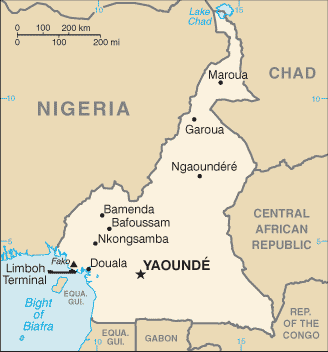
Geography
Area: 475,000 sq. km. (184,000) sq. mi.), about
the size of California.
Cities (2003 Census Bureau estimates): Capital--Yaounde
(pop. 1.1 million). Other
major cities--Douala (1.3 million), Garoua
(424,312), Maroua (409,546), Bafoussam
(319,457), Bamenda (321,490), Nkongsamba
(166,262), and Ngaoundere (216,300).
Terrain: Northern plains, central and western
highlands, southern and coastal tropical
forests. Mt. Cameroon (13,353 ft.) in the
southwest is the highest peak in West Africa and
the sixth in Africa.
Climate: Northern plains, the Sahel
region--semiarid and hot (7-month dry season);
central and western highlands where Yaounde is
located--cooler, shorter dry season; southern
tropical forest--warm, 4-month dry season;
coastal tropical forest, where Douala is
located--warm, humid year-round.
People
Nationality: English
noun and adjective--Cameroonian(s); French
noun and adjective--Camerounais(e).
Population (2008 est.): 18,467,692.
Annual growth rate (2008 est.): 2.218%.
Ethnic groups: About 250.
Religions: Christian 40%, Muslim 20%, indigenous
African 40%.
Languages: French and English (both official)
and about 270 African languages and dialects,
including pidgin, Fulfulde, and Ewondo.
Education: Compulsory between ages 6 and 14. Attendance--65%. Literacy--75%.
Health: Infant
mortality rate (2008)--64.6/1,000
live births. Life
expectancy (2007)--53.3
yrs.
Work force: Agriculture--70%. Industry
and commerce--13%.
Government
Type: Republic; strong central government
dominated by president.
Independence: January 1, 1960 (for areas
formerly ruled by France) and October 1, 1961
(for territory formerly ruled by Britain).
Constitution: June 2, 1972, last amended in
2008.
Branches: Executive--president
(chief of state), 7-year term, no term limits;
appointed prime minister (head of government). Legislative--unicameral
National Assembly (180 members; meets briefly
three times a year--March, June, November); a
new Senate was called for under constitutional
changes made in early 1996. Judicial--falls
under the executive's Ministry of Justice.
Administrative subdivisions: 10 provinces, 58
departments or divisions, 349 subprefectures or
subdivisions.
Political parties: Cameroon People's Democratic
Movement (CPDM) or its predecessor parties have
ruled since independence. Major opposition
parties: the Social Democratic Front (SDF), the
National Union for Democracy and Progress (NUDP),
and the Cameroon Democratic Union (CDU).
Suffrage: Universal at 20.
Economy
GDP (2007 est.): $20.646 billion.
Annual real GDP growth rate (2007): 3.3%.
GDP per capita (2007 est.): $1,095.
Inflation (2007 est.): 0.9%.
Natural resources: Oil, timber, hydroelectric
power, natural gas, cobalt, nickel, iron ore,
uranium.
Agriculture (2007): 44.3% of GDP. Products--timber,
coffee, tea, bananas, cocoa, rubber, palm oil,
pineapples, cotton. Arable
land (2005
est.)--12.54%.
Industry (2007): 15.9% of GDP.
Services (2007): 39.8% of GDP.
Trade (2007): Exports--$3.7
billion: crude oil, timber and finished wood
products, cotton, cocoa, aluminum and aluminum
products, coffee, rubber, bananas. Major
markets--European Union, CEMAC, China, U.S.,
Nigeria (informal). Imports--$3.6
billion: crude oil, vehicles, pharmaceuticals,
aluminum oxide, rubber, foodstuffs and grains,
agricultural inputs, lubricants, used clothing. Major
suppliers--France, Nigeria, Italy, U.S.,
Germany, Belgium, Japan.
PEOPLE
Cameroon's estimated 250 ethnic groups form five
large regional-cultural groups: western
highlanders (or grassfielders), including the
Bamileke, Bamoun, and many smaller entities in
the northwest (est. 38% of population); coastal
tropical forest peoples, including the Bassa,
Douala, and many smaller entities in the
Southwest (12%); southern tropical forest
peoples, including the Ewondo, Bulu, and Fang
(all Beti subgroups), Maka and Pygmies
(officially called Bakas) (18%); predominantly
Islamic peoples of the northern semi-arid
regions (the Sahel) and central highlands,
including the Fulani, also known as Peuhl in
French (14%); and the "Kirdi", non-Islamic or
recently Islamic peoples of the northern desert
and central highlands (18%).
The people concentrated in the southwest and
northwest provinces--around Buea and Bamenda--use
standard English and "pidgin," as well as their
local languages. In the three Northern
provinces--Adamaoua, North, and Far
North--French and Fulfulde, the language of the
Fulani, are widely spoken. Elsewhere, French is
the principal language, although pidgin and some
local languages such as Ewondo, the dialect of a
Beti clan from the Yaounde area, also are widely
spoken. Although Yaounde is Cameroon's capital,
Douala is the largest city, main seaport, and
main industrial and commercial center.
The Western highlands are among the most fertile
regions in Cameroon and have a relatively
healthy environment in higher altitudes. This
region is densely populated and has intensive
agriculture, commerce, cohesive communities, and
historical emigration pressures. From here,
Bantu migrations into eastern, southern, and
central Africa are believed to have originated
about 2,000 years ago. Bamileke people from this
area have in recent years migrated to towns
elsewhere in Cameroon, such as the coastal
provinces, where they form much of the business
community. About 20,000 non-Africans, including
more than 6,000 French and 2,400 U. S. citizens,
reside in Cameroon.
HISTORY
The earliest inhabitants of Cameroon were
probably the Bakas (Pygmies). They still inhabit
the forests of the south and east provinces.
Bantu speakers originating in the Cameroonian
highlands were among the first groups to move
out before other invaders. During the late 1770s
and early 1800s, the Fulani, a pastoral Islamic
people of the western Sahel, conquered most of
what is now northern Cameroon, subjugating or
displacing its largely non-Muslim inhabitants.
Although the Portuguese arrived on Cameroon's
coast in the 1500s, malaria prevented
significant European settlement and conquest of
the interior until the late 1870s, when large
supplies of the malaria suppressant, quinine,
became available. The early European presence in
Cameroon was primarily devoted to coastal trade
and the acquisition of slaves. The northern part
of Cameroon was an important part of the Muslim
slave trade network. The slave trade was largely
suppressed by the mid-19th century. Christian
missions established a presence in the late 19th
century and continue to play a role in
Cameroonian life.
Beginning in 1884, all of present-day Cameroon
and parts of several of its neighbors became the
German colony of Kamerun, with a capital first
at Buea and later at Yaounde. After World War I,
this colony was partitioned between Britain and
France under a June 28, 1919 League of Nations
mandate. France gained the larger geographical
share, transferred outlying regions to
neighboring French colonies, and ruled the rest
from Yaounde. Britain's territory--a strip
bordering Nigeria from the sea to Lake Chad,
with an equal population--was ruled from Lagos.
In 1955, the outlawed Union of the Peoples of
Cameroon (UPC), based largely among the Bamileke
and Bassa ethnic groups, began an armed struggle
for independence in French Cameroon. This
rebellion continued, with diminishing intensity,
even after independence. Estimates of death from
this conflict vary from tens of thousands to
hundreds of thousands.
French Cameroon achieved independence in 1960 as
the Republic of Cameroon. The following year the
largely Muslim northern two-thirds of British
Cameroon voted to join Nigeria; the largely
Christian southern third voted to join with the
Republic of Cameroon to form the Federal
Republic of Cameroon. The formerly French and
British regions each maintained substantial
autonomy. Ahmadou Ahidjo, a French-educated
Fulani, was chosen President of the federation
in 1961. Ahidjo, relying on a pervasive internal
security apparatus, outlawed all political
parties but his own in 1966. He successfully
suppressed the UPC rebellion, capturing the last
important rebel leader in 1970. In 1972, a new
constitution replaced the federation with a
unitary state.
Ahidjo resigned as President in 1982 and was
constitutionally succeeded by his Prime
Minister, Paul Biya, a career official from the
Bulu-Beti ethnic group. Ahidjo later regretted
his choice of successors, but his supporters
failed to overthrow Biya in a 1984 coup. Biya
won single-candidate elections in 1984 and 1988
and flawed multiparty elections in 1992, 1997,
and 2004. His Cameroon People's Democratic
Movement (CPDM) party holds a sizeable majority
in the legislature following 2007 elections--153
deputies out of a total of 180.
GOVERNMENT AND POLITICAL CONDITIONS
The 1972 constitution (amended in 1996 and
2008) provides for a strong central government
dominated by the executive. The president is
empowered to name and dismiss cabinet members,
judges, generals, provincial governors,
prefects, sub-prefects, and heads of Cameroon's
parastatal (about 100 state-controlled) firms,
obligate or disburse expenditures, approve or
veto regulations, declare states of emergency,
and appropriate and spend profits of parastatal
firms. The president is not required to consult
the National Assembly.
The judiciary is subordinate to the executive
branch's Ministry of Justice. The Supreme Court
may review the constitutionality of a law only
at the president's request.
The 180-member National Assembly meets in
ordinary session three times a year
(March-April, June-July, and November-December),
and seldom makes major changes in legislation
proposed by the executive. Laws are adopted by
majority vote of members present or, if the
president demands a second reading, of total
membership.
Following government pledges to reform the
strongly centralized 1972 constitution, the
National Assembly adopted a number of amendments
in December 1995, which were promulgated in a
new constitution in January 1996. The amendments
called for the establishment of a 100-member
Senate as part of a bicameral legislature, the
creation of regional councils, and the fixing of
the presidential term to 7 years, renewable
once. One-third of senators would be appointed
by the president, and the remaining two-thirds
would be chosen by indirect elections. As of
June 2008, neither the Senate nor the regional
council had been created. In April 2008, the
National Assembly acceded to constitutional
changes proposed by the presidency that, inter
alia, removed presidential term limits and
provided the President with immunity from
prosecution for acts committed while in office.
All local government officials are employees of
the central government's Ministry of Territorial
Administration, from which local governments
also get most of their budgets.
While the President, the Minister of Justice,
and the president's judicial advisers (the
Supreme Court) top the judicial hierarchy,
traditional rulers, courts, and councils also
exercise functions of government. Traditional
courts still play a major role in domestic,
property, and probate law. Tribal laws and
customs are honored in the formal court system
when not in conflict with national law.
Traditional rulers receive stipends from the
national government.
The government adopted legislation in 1990 to
authorize the formation of multiple political
parties and ease restrictions on forming civil
associations and private newspapers. Cameroon's
first multiparty legislative and presidential
elections were held in 1992. Because the
government refused to consider opposition
demands for an independent election commission,
the three major opposition parties boycotted the
October 1997 presidential election, which Biya
easily won. Each of Cameroon's national
elections has been marred by severe
irregularities. In December 2000, the National
Assembly passed legislation creating the
National Elections Observatory (NEO), an
election watchdog body. NEO played an active
role in supervising the conduct of local and
legislative elections in June 2002 and July
2007, which demonstrated some progress but were
still hampered by irregularities. The NEO also
supervised the conduct of the presidential
election in October 2004, as did many diplomatic
missions, including the U.S. Embassy. NEO
reported that it was satisfied with the conduct
of the election but noted some irregularities
and problems with voter registration. The U.S.
Embassy also noted these issues with the
election, as well as reports of non-indelible
ink, but concluded that the irregularities were
not severe enough to impact the final result.
The incumbent, Paul Biya, was re-elected with
70.92% of the vote. In December 2006, the
President decreed the creation of Elections
Cameroon (ELECAM), an independent body
responsible for the organization, management and
supervision of all election operations and
referendums. The decree stipulated its creation
by the end of June 2008. The U.S. Embassy
provided monitors for the July 2007
parliamentary and municipal elections and
concurred with the analysis of other observers
and diplomatic missions, who noted some
improvements but persistent flaws, especially in
the registration of voters and the prevention of
voter fraud (indelible ink).
Cameroon has a number of private newspapers,
radio stations, and four private television
stations. Officially censorship was abolished in
1996, but the government sometimes seizes or
suspends newspapers. Mutations, a prominent
private French-daily newspaper in Cameroon, was
seized on April 14, 2003 after the paper
published articles on "Life after Biya."
Since November 2007, the Ministry of
Communication has stepped up harassment and
arresting of journalists. In February 2008, the
government closed Magic FM radio, a Voice of
America (VOA) affiliate, and confiscated their
equipment, which included VOA transmission
equipment, and the same fate awaited Equinoxe
Radio and Television after carrying
controversial reports and critical commentaries
about the regime. Journalists have been fired
from their jobs for openly discussing the change
of the constitution and the U.S. Ambassador's
remarks requesting the government to reopen
closed stations and to return U.S. Government
equipment. The government also banned a popular
song on the radio about constitutional change.
Radio and television continue to be a virtual
monopoly of the state-owned broadcaster, the
Cameroon Radio-Television Corporation (CRTV).
However, there are two independent television
stations and many more regional private radio
stations, although many are owned by or financed
by parliamentarians, mayors, or party officials.
Since the issuance of the decree authorizing the
creation of private radio and television on
April 3, 2000, only two stations have received a
license from the government. On April 9, 2008
the Minister of Communication gave two
television stations and one radio station until
July 2008 to pay the remainder of their license
fee or be shut down. Most media houses have
applied and are currently operating while their
applications are pending. The private radio
stations broadcasting in Yaounde, Douala,
Bafoussam, Bamenda, and Limbe continue to
broadcast, and their existence is tolerated by
the government. There are a dozen community
radio stations supported by the UN Educational,
Scientific, and Cultural Organization (UNESCO)
which are exempted from licenses and have no
political content. Radio coverage extends to
about 80% of the country, while television
covers 60% of the territory.
The Cameroon Government's human rights record
has generally improved, although it remains
deeply flawed, including significant problems
over the past year. There continue to be
reported abuses, including beatings of
detainees, arbitrary arrests, and illegal
searches. Journalists continue to be
intimidated, threatened and arrested when
discussing subjects considered sensitive by the
Cameroonian Government. The judiciary is
frequently corrupt, inefficient, and subject to
political influence. Corruption is a major
problem, although the government has recently
arrested several prominent officials for
corruption.
Principal Government Officials
President--Paul Biya
President of the National Assembly--Djibril
Cavaye Yeguie
Prime Minister--Ephraim Inoni
Minister of Defense--Remy Ze Meka
Ambassador to the United States--Joseph Bienvenu
Charles Foe Atangana
Ambassador to the United Nations--Michel Tommo
Monthe
Cameroon maintains an embassy in the United
States at 2349 Massachusetts Avenue NW,
Washington, DC 20008 (tel.: 202-265-8790).
ECONOMY
Cameroon is blessed with an abundance of
natural resources, including in the agriculture,
mining, forestry, and oil and gas sectors.
Cameroon is the commercial and economic leader
in the sub-region, though regional trade,
especially with Nigeria, remains under-realized.
Cameroon's economy is highly dependent on
commodity exports, and swings in world prices
strongly affect its growth. Cameroon's economic
development has been retarded by economic
mismanagement, pervasive corruption, and a
challenging business environment (for local and
foreign investors). Cameroon remains one of the
lowest-ranked economies on the World Bank's
annual Doing Business and similar surveys and
regularly ranks among the most corrupt countries
in the world. Over the last three years, GDP
growth has averaged 3%, which is far below the
population's expectations and insufficient to
meet the Millennium Challenge goals. Despite
boasting a higher GDP per capita than either
Senegal or Ghana, Cameroon lags behind these two
countries in important socio-economic
indicators, including in health and education.
The government has professed a determination to
foster urgent economic growth and job creation,
and there is a decided up-tick in interest in
the mining sector, but it is not yet clear how
well these promises will translate into improved
performance.
For a quarter-century following independence,
Cameroon was one of the most prosperous
countries in Africa. The drop in commodity
prices for its principal exports--oil, cocoa,
coffee, and cotton--in the mid-1980s, combined
with an overvalued currency and economic
mismanagement, led to a decade-long recession.
Real per capita gross domestic product (GDP)
fell by more than 60% from 1986 to 1994. The
current account and fiscal deficits widened, and
foreign debt grew.
The government embarked upon a series of
economic reform programs supported by the World
Bank and International Monetary Fund (IMF)
beginning in the late 1980s. Many of these
measures have been painful; the government
slashed civil service salaries by 65% in 1993.
The CFA franc--the common currency of Cameroon
and 13 other African states--was devalued by 50%
in January 1994. The government failed to meet
the conditions of the first four IMF programs. A
three-year Poverty Reduction and Growth Facility
(PRGF) approved by the IMF in October 2005 will
end by the end of 2008. It is not clear whether
the Fund will continue with lending after this
date.
Official statistics indicate that inflation is
under control (projected by the World Bank at
2.9% in 2008), but anecdotal evidence suggests
Cameroonians are frustrated and perceive their
spending power is weakening. Public frustration
over rising prices was partly to blame for an
outbreak of social unrest and violence in many
Cameroonian cities in February 2008. In March
2008, the government announced a reduction in
food import tariffs and other measures designed
to reduce the cost of basic commodities.
The government has made halting progress on its
privatization program. The National Water
Utility Corporation (SNEC) was split into two
entities. CAMWATER--to handle
infrastructure--remains in government hands, and
a reformed SNEC is now owned by a consortium led
by the Moroccan Water Utility. Plans to
privatize national air company CAMAIR and
national telecom CAMTEL, however, have
repeatedly faltered because of political
sensitivities and concerns about corruption.
CAMAIR was declared officially defunct and
ceased to operate in May 2008. CAMTEL remains
under the control of the Ministry of Posts and
Telecommunications.
The European Union remains Cameroon's main
trading bloc, accounting for 36.6% of total
imports and 66.1% of exports. France is
Cameroon's main trading partner, but the United
States is the leading investor in Cameroon
(largely through the Chad-Cameroon pipeline and
energy provider AES Sonel). According to press
reports, China recently became the number one
importer of Cameroonian exports, especially
unprocessed timber.
For further information on Cameroon's economic
trends, trade, or investment climate, contact
the International Trade Administration, U.S.
Department of Commerce, Washington, DC 20230
and/or the Commerce Department district office
in any local federal building.
DEFENSE
The Cameroonian military generally has been
an apolitical force dominated by civilian
control. Traditional dependence on the French
defense capability, although reduced, continues.
French military advisers remain closely involved
at senior levels of all the armed forces and the
gendarmes. The armed forces number approximately
28,000 personnel in ground, air, and naval
forces, with the majority being in the army and
gendarmes.
Cameroon's goal is to develop a military with
the capacity to contribute to peacekeeping
efforts. While equipment needs pose a
significant challenge, Cameroonian officers are
already receiving training both in Africa and
abroad, and Cameroon has recently become an
African Contingency Operations Training and
Assistance (ACOTA) partner.
FOREIGN RELATIONS
Cameroon's noncontentious, low-profile approach
to foreign relations puts it squarely in the
middle of other African and developing country
states on major issues. It supports the
principles of noninterference in the affairs of
third countries and increased assistance to
underdeveloped countries. Cameroon is an active
participant in the United Nations, where its
voting record demonstrates its commitment to
causes that include international peacekeeping,
the rule of law, environmental protection, and
Third World economic development. In the UN and
other human rights fora, Cameroon's
nonconfrontational approach has generally led it
to avoid criticizing other countries.
Cameroon enjoys good relations with the United
States and other developed countries. It has
particularly close ties with France, with whom
it has numerous military, economic, and cultural
agreements. China has a number of health and
infrastructure projects underway in Cameroon,
and provides some military assistance. Cameroon
enjoys generally good relations with its African
neighbors. Cameroon has successfully resolved
its border dispute with Nigeria in the oil-rich
Bakassi Peninsula through peaceful legal means
after having submitted the case to the
International Court of Justice (ICJ). With the
support of the UN, both countries are working
closely together to peacefully implement the ICJ
ruling, and a genuine, peaceful turnover of the
peninsula by Nigeria has begun. Roughly 5,000
Nigerians have moved back into Nigeria thus far.
Cameroon is a member of CEMAC (Economic and
Monetary Community of Central Africa) and
supports UN peacekeeping activities in Central
Africa.
U.S.-CAMEROONIAN RELATIONS
U.S.-Cameroonian relations are close, although
from time to time they have been affected by
concerns over human rights abuses and the pace
of political and economic liberalization. The
bilateral U.S. Agency for International
Development (USAID) program in Cameroon closed
for budgetary reasons in 1994.
However, approximately 140 Peace Corps
volunteers continue to work successfully in
agroforestry, community development, education,
and health. The Public Affairs section of the
U.S. Embassy in Yaounde organizes and funds
diverse cultural, educational, and information
exchanges. It maintains a library and helps
foster the development of Cameroon's independent
press by providing information in a number of
areas, including U.S. human rights and
democratization policies. The Embassy's
Self-help and Democracy and Human Rights Funds
are some of the largest in Africa.
Through several State Department and USAID
regional funds, the Embassy also provides funds
for: biodiversity protection, refugees,
HIV/AIDS, democratization, and girl's
scholarships. The U.S. Department of Agriculture
(USDA) provided a commodity grant valued at $6
million in 2003 to fund agricultural development
projects in the North and Far North provinces.
Similar programs were approved in 2004, 2005,
and 2006. The $4 million 2004 program was to
fund an agricultural development and nutrition
enhancement project in the East and Adamawa
provinces. The $4 million 2005 program was to
integrate tree crops and agri-business to
enhance household livelihood security in
vulnerable communities of the Center and South
West provinces. The 2006 project was to focus on
an agroforestry program to be carried out in the
North West and West provinces.
The United States and Cameroon work together in
the United Nations and a number of other
multilateral organizations. While in the UN
Security Council in 2002, Cameroon worked
closely with the United States on a number of
initiatives. The U.S. Government continues to
provide substantial funding for international
financial institutions, such as the World Bank,
IMF, and African Development Bank, which provide
financial and other assistance to Cameroon.
Principal U.S. Officials
Ambassador--Janet
E. Garvey
Deputy Chief of Mission--Stephen Fox
Management Officer--Charles F. Werderman
Public Affairs Officer-- Lonnie Kelley
Political/Economic/Commercial Officer--Scott
Ticknor
Defense Attache--Major Matthew Sousa
Peace Corps Director--James Ham
Consular Officer--William Swaney
The U.S.
Embassy in
Cameroon has moved from its previous downtown
Yaounde location to a New Embassy Compound
adjacent to the golf course at the base of the
Mont Fébé. The new Embassy Chancery contacts
are: Tel: (237) 2220 15 00/Fax: (237) 2220 16 20
while the Consular Section can be reached
directly at Tel: (237) 2220 16 03/Fax: (237)
2220 1752. The mailing address is: B.P. 817,
Yaounde, Cameroon. The U.S. mailing address is
American Embassy Yaounde, Department of State,
Washington, DC 20521-2520.
 Information
on Countries from Around the World
Information
on Countries from Around the World