
PROFILE
OFFICIAL NAME:
Republic of Cape Verde
Geography
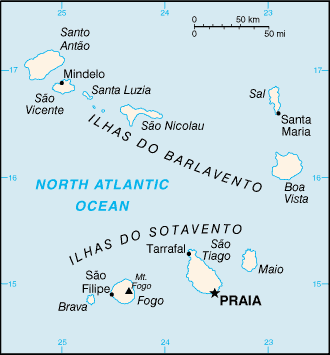
Area: 4,033 sq. km. (1,557 sq. mi.), slightly
larger than Rhode Island.
Cities: Capital--Praia
(pop. 106,052). Other
city--Mindelo (pop. 67,844).
Terrain: Steep, rugged, rocky, volcanic.
Climate: Temperate; warm, dry summer;
precipitation meager and erratic.
People
Nationality: Noun
and adjective--Cape Verdean(s).
Population (2008): 499,796.
Annual growth rate (2008): 1.41%.
Ethnic groups: Creole (mixed African and
Portuguese) 71%, African 28%, European 1%.
Religions: Roman Catholic, Protestant.
Languages: Portuguese (official); Crioulo
(national).
Education: Literacy (2008)--77%.
Health: Infant
mortality rate (2008)--24.8/1,000. Life
expectancy (2008)--72.5
yrs.
Government
Type: Republic.
Independence: July 5, 1975.
Constitution: 1980; revised 1992, 1995, and
1999.
Branches: Executive--president
(head of state), prime minister (head of
government), Council of Ministers. Legislative--National
Assembly. Judicial--Supreme
Court, lower courts.
Administrative subdivisions: 17 administrative
districts.
Political parties: African Party for
Independence of Cape Verde or PAICV [Jose Maria
Pereira NEVES, chairman]; Democratic Alliance
for Change or ADM [Eurico MONTEIRO] (a coalition
of PCD, PTS, and UCID); Democratic Christian
Party or PDC [Manuel RODRIGUES]; Democratic
Renovation Party or PRD [Victor FIDALGO];
Democratic and Independent Cape Verdean Union or
UCID [Antonio MONTEIRO]; Movement for Democracy
or MPD [Agostinho LOPES]; Party for Democratic
Convergence or PCD [Eurico MONTEIRO]; Party of
Work and Solidarity or PTS [Isaias RODRIGUES];
Social Democratic Party or PSD [Joao ALEM].
Suffrage: Universal over 18.
Economy
GDP (nominal, 2007): $1.603 billion.
GDP per capita (2007): $3,200.
Real GDP growth rate (2008, projected): 6.5%.
Inflation (2007): 3.29%.
Natural resources: Salt, pozzolana, limestone.
Agriculture: Products--bananas,
corn, beans, sugarcane, coffee, fruits,
vegetables, livestock products.
Industry: Types--fish
and fish products, clothing, shoes, beverages,
salt, construction, building materials, ship
repair, furniture, metal products, tourism.
Trade (2007): Exports--$80.36
million: fuel, clothing, shoes and shoe parts,
fish and crustaceans. Imports--$768
million: consumer goods, intermediary goods,
capital goods, petroleum. Major
trading partners, exports--Spain 44.2%,
Portugal 21.7%, Netherlands 12.6%, Morocco 4.6%. Major
trading partners, imports--Portugal 41.1%,
Netherlands 10.6%, Spain 6.5%, Italy 5.4%, Cote
d'Ivoire 5.2%, Brazil 4.8%.
Fiscal year: Calendar year.
Currency: Escudo (CVEsc 70 = $1 as of June
2008), which is pegged to the Euro.
Economic aid received: $161 million (2005). Largest
donors--Portugal ($43 million); European
Community ($22 million); World Bank-IDA ($21
million); Luxembourg ($15 million); Netherlands
($10 million); the United States ($9 million).
GEOGRAPHY
The Cape Verde Islands are located in the
mid-Atlantic Ocean some 450 kilometers (about
300 mi.) off the west coast of Africa. The
archipelago includes 10 islands and 5 islets,
divided into the windward (Barlavento) and
leeward (Sotavento) groups. The main islands in
the Barlavento group are Santo Antão, São
Vicente, Santa Luzia, São Nicolau, Sal, and Boa
Vista; those of the Sotavento group include Maio,
Santiago, Fogo, and Brava. All larger islands
but Santa Luzia are inhabited.
Three islands--Sal, Boa Vista, and Maio--generally
are level and very dry. Mountains higher than
1,280 meters (4,200 ft.) are found on Santiago,
Fogo, Santo Antão, and São Nicolau.
Sand carried by high winds has created
spectacular rock formations on all islands,
especially the windward ones. Sheer, jagged
cliffs rise from the sea on several of the
mountainous islands. Natural vegetation is
sparse in the uplands and coast, but interior
valleys support denser growth.
Rainfall is irregular, and the archipelago
suffers periodic droughts and consequent food
shortages. The average precipitation per year in
Praia is 24 centimeters (9.5 in.). During the
winter, storms blowing from the Sahara sometimes
cloud the sky, but sunny days are the norm year
round.
PEOPLE
The Cape Verde archipelago was uninhabited until
the Portuguese discovered the islands in 1456.
Enslaved Africans were brought to the islands to
work on Portuguese plantations. They were joined
by entrepreneurs and refugees fleeing religious
persecution in Europe, leading to a rich
cultural and ethnic mix. The influence of
African culture is most pronounced on the island
of Santiago, where half the population resides.
Sparse rain and few natural resources
historically have induced Cape Verdeans to
emigrate. It is believed that of the more than 1
million individuals of Cape Verdean ancestry,
fewer than half actually live on the islands.
Some 500,000 people of Cape Verdean ancestry
live in the United States, mainly in New
England. Portugal, Netherlands, Italy, France,
and Senegal also have large communities.
The official language is Portuguese, but most
Cape Verdeans also speak a Creole dialect--Crioulo--which
is based on archaic Portuguese but influenced by
African and European languages. Cape Verde has a
rich tradition of Crioulo literature and music.
HISTORY
In 1462, Portuguese settlers arrived at Santiago
and founded Ribeira Grande (now Cidade Velha)--the
first permanent European settlement city in the
tropics. In the 16th century, the archipelago
prospered from the transatlantic slave trade.
Pirates occasionally attacked the Portuguese
settlements. Sir Francis Drake sacked Ribeira
Grande in 1585. After a French attack in 1712,
the city declined in importance relative to
Praia, which became the capital in 1770.
With the decline in the slave trade, Cape
Verde's early prosperity slowly vanished.
However, the islands' position astride
mid-Atlantic shipping lanes made Cape Verde an
ideal location for re-supplying ships. Because
of its excellent harbor, Mindelo (on the island
of São Vicente) became an important commercial
center during the 19th century.
Portugal changed Cape Verde's status from a
colony to an overseas province in 1951 in an
attempt to blunt growing nationalism.
Nevertheless, in 1956, Amilcar Cabral, a Cape
Verdean, and a group of Cape Verdeans and
Guinea-Bissauans organized (in Guinea-Bissau)
the clandestine African Party for the
Independence of Guinea-Bissau and Cape Verde (PAIGC),
which demanded improvement in economic, social,
and political conditions in Cape Verde and
Portuguese Guinea and formed the basis of the
two nations' independence movement. Moving its
headquarters to Conakry, Guinea in 1960, the
PAIGC began an armed rebellion against Portugal
in 1961. Acts of sabotage eventually grew into a
war in Portuguese Guinea that pitted 10,000
Soviet bloc-supported PAIGC soldiers against
35,000 Portuguese and African troops.
By 1972, the PAIGC controlled much of Portuguese
Guinea despite the presence of the Portuguese
troops, but the organization did not attempt to
disrupt Portuguese control in Cape Verde.
Portuguese Guinea declared independence in 1973
and was granted de jure independence in 1974.
Following the April 1974 revolution in Portugal,
the PAIGC became an active political movement in
Cape Verde. In December 1974, the PAIGC and
Portugal signed an agreement providing for a
transitional government composed of Portuguese
and Cape Verdeans. On June 30, 1975, Cape
Verdeans elected a National Assembly, which
received the instruments of independence from
Portugal on July 5, 1975.
Immediately following the November 1980 coup in
Guinea-Bissau, relations between Cape Verde and
Guinea-Bissau became strained. Cape Verde
abandoned its hope for unity with Guinea-Bissau
and formed the African Party for the
Independence of Cape Verde (PAICV). Problems
have since been resolved, and relations between
the countries are good. The PAICV and its
predecessor established a one-party system and
ruled Cape Verde from independence until 1990.
Responding to growing pressure for pluralistic
democracy, the PAICV called an emergency
congress in February 1990 to discuss proposed
constitutional changes to end one-party rule.
Opposition groups came together to form the
Movement for Democracy (MPD) in Praia in April
1990. Together, they campaigned for the right to
contest the presidential election scheduled for
December 1990. The one-party state was abolished
September 28, 1990, and the first multi-party
elections were held in January 1991. The MPD won
a majority of the seats in the National
Assembly, and MPD presidential candidate
Mascarenhas Monteiro defeated the PAICV's
candidate with 73.5% of the votes. Legislative
elections in December 1995 increased the MPD
majority in the National Assembly. The party won
50 of the National Assembly's 72 seats. A
February 1996 presidential election returned
President Mascarenhas Monteiro to office.
Legislative elections in January 2001 returned
power to the PAICV, with the PAICV holding 40 of
the National Assembly seats, MPD 30, and Party
for Democratic Convergence (PCD) and Party for
Labor and Solidarity (PTS) 1 each. In February
2001, the PAICV-supported presidential candidate
Pedro Pires defeated former MPD leader Carlos
Veiga by only 13 votes.
GOVERNMENT AND POLITICAL CONDITIONS
The Cape Verde constitution--adopted in 1980 and
revised in 1992, 1995, and 1999--forms the basis
of government. The president is head of state
and is elected by popular vote for a 5-year
term. The prime minister is head of government
and proposes other ministers and secretaries of
state. The prime minister is nominated by the
National Assembly and appointed by the
president. Members of the National Assembly are
elected by popular vote for 5-year terms.
Cape Verde enjoys a stable democratic system.
The Movement for Democracy (MPD) captured a
governing majority in the National Assembly in
the country's first multi-party general
elections in 1991. The MPD was returned to power
with a larger majority in the general elections
held in December 1995. In 2001, the PAICV
regained power, with four parties holding seats
in the National Assembly--PAICV 40, MPD 30, PCD
1, and PTS 1. Nationwide municipal elections
were held March 21, 2004.
In January 2006, Cape Verde held a successful
round of parliamentary elections, followed by
successful presidential elections on February
12, 2006. The National Electoral Commission
(NEC) judged both elections free and fair. The
leading parliamentary opposition party filed a
court case in an attempt to overrule the NEC on
the grounds of alleged fraud; this action
ultimately failed. Three parties now hold seats
in the National Assembly--PAICV 40, MPD 30, and
Cape Verdean Independent Democratic Union (UCID)
2. Municipal elections were held in May 2008,
with the Movement for Democracy party taking
many of the seats within the municipalities.
The judicial system is comprised of a Supreme
Court of Justice--whose members are appointed by
the president, the National Assembly, and the
Board of the Judiciary--and regional courts.
Separate courts hear civil, constitutional, and
criminal cases. Appeal is to the Supreme Court.
Principal Government Officials
President--Pedro Verona Pires
Prime Minister--Jose Maria Neves
Defense Minister--Maria Cristina Lopes Almeida
Fontes Lima
President of the National Assembly--Aristides
Lima
Minister of Foreign Affairs--Jose Brito
Ambassador to the United States--Fatima Lima
Veiga
Ambassador to the United Nations--Antonio Lima
Consul General to the United States
(Boston)--Maria Mascarenhas
Cape Verde maintains an embassy in the United
States at 3415 Massachusetts Avenue, NW,
Washington DC 20007 (tel. 202-965-6820) and one
consulate at 535 Boylston Street, Boston MA
02116 (tel. 617-353-0014).
ECONOMY
Cape Verde has few natural resources and suffers
from poor rainfall and limited fresh water. Only
4 of the 10 main islands (Santiago, Santo Antão,
Fogo, and Brava) normally support significant
agricultural production, and over 90% of all
food consumed in Cape Verde is imported. Mineral
resources include salt, pozzolana (a volcanic
rock used in cement production), and limestone.
The economy of Cape Verde is service-oriented,
with commerce, transport, and public services
accounting for more than 70% of GDP. Although
nearly 70% of the population lives in rural
areas, agriculture and fishing contribute only
about 9% of GDP. Light manufacturing accounts
for most of the remainder. An amount estimated
at about 20% of GDP is contributed to the
domestic economy through remittances from
expatriate Cape Verdeans.
Since 1991, the government has pursued
market-oriented economic policies, including an
open welcome to foreign investors and a
far-reaching privatization program. It
established as top development priorities the
promotion of market economy and of the private
sector; the development of tourism, light
manufacturing industries, and fisheries; and the
development of transport, communications, and
energy facilities. From 1994 to 2000 there was a
total of about $407 million in foreign
investments made or planned, of which 58% were
in tourism, 17% in industry, 4% in
infrastructure, and 21% in fisheries and
services.
Fish and shellfish are plentiful, and small
quantities are exported. Cape Verde has cold
storage and freezing facilities and fish
processing plants in Mindelo, Praia, and on Sal.
Cape Verde's strategic location at the
crossroads of mid-Atlantic air and sea lanes has
been enhanced by significant improvements at
Mindelo's harbor (Porto Grande) and at Sal's and
Praia's international airports. A new
international airport was opened in Boa Vista in
December 2007. Ship repair facilities at Mindelo
were opened in 1983. The major ports are Mindelo
and Praia, but all other islands have smaller
port facilities. In addition to the
international airport on Sal, airports have been
built on all of the inhabited islands. All but
the airport on Brava enjoy scheduled air
service. The archipelago has 3,050 kilometers
(1,830 mi.) of roads, of which 1,010 kilometers
(606 mi.) are paved, most using cobblestone.
Future prospects depend heavily on the
maintenance of aid flows, the encouragement of
tourism, remittances, outsourcing labor to
neighboring African countries, and the momentum
of the government's development program.
FOREIGN RELATIONS
Cape Verde pursues a nonaligned foreign policy
and seeks cooperative relations with all states.
Angola, Brazil, China, Cuba, France, Portugal,
Russia, Senegal, Spain, and the United States
maintain embassies in Praia. Several others,
mostly European countries, maintain honorary
consulates. In addition, Cape Verde maintains
multilateral relations with other Lusophone
nations and holds membership in many
international organizations. On July 23, 2008,
Cape Verde became the 153rd member of the World
Trade Organization (WTO), in hopes of opening
its markets for imported goods and services.
U.S.-CAPE VERDEAN RELATIONS
The cordial relations between the United States
and Cape Verde have strong historical roots. In
the early 18th century, U.S. whaling ships
appear to have begun recruiting crews from Brava
and Fogo to hunt whales that were abundant in
the waters surrounding Cape Verde. Ties between
the American colonies and Cape Verde are
documented as early as the 1740s, when American
ships routinely anchored in Cape Verdean ports
to trade for salt or buy slaves. The tradition
of emigration to the United States began at that
time and continues today.
The first U.S. consulate in sub-Saharan Africa
was established in Cape Verde in 1818. U.S.
consular representation continued throughout the
19th century. The United States recognized Cape
Verde on its independence day and supported its
admission to the United Nations. Cape Verde
assigned one of its first ambassadors to the
United States, and a resident U.S. ambassador
was posted to Cape Verde in 1983. Prime Minister
Jose Neves visited Cape Verdean communities in
New England during an official trip to the
United States in 2002, and President Pires
visited the United States in April 2005. Prime
Minister Neves also visited the U.S. in
September 2007.
The United States provided emergency
humanitarian aid and economic assistance to Cape
Verde in the period immediately following Cape
Verde's independence, as well as after natural
disasters, including a hurricane that struck the
island of Brava in 1982, and after a severe
volcanic eruption on Fogo in 1995. Cape Verde
also is eligible for trade benefits under the
African Growth and Opportunity Act (AGOA),
and has signed an Open Skies agreement to
facilitate air travel safety and expansion. On
July 4, 2005, Cape Verde became the third
country to sign a compact with the U.S.
Government-funded Millennium Challenge
Corporation (MCC); the five-year assistance
package is worth over $110 million in addressing
rural economic expansion, infrastructure
development, and development of tourism and a
community college system.
Principal U.S. Officials
Ambassador--Marianne
Myles
Deputy Chief of Mission--Patrick Dunn
Consul--Leslie Hayden
Political/Consular Officer-Ruth Rudzinski
The U.S.
Embassy in
Cape Verde is at Rua Abílio Macedo, 6, Praia;
C.P.201, tel. (238) 260 8900, fax 2611 355.
 Information
on Countries from Around the World
Information
on Countries from Around the World